
24/7 Customer Support

Free returns

Same-day & Next-day Delivery

Quality Guaranteed

Unlock Your Welcome Offers: FREE Delivery | Up to 80% OFF | Free 30-day JoyPlus trial
Download the APP
A car interior ambient lighting kit can transform a plain cabin with RGB colour, illuminated footwells and glowing door trim. However, a product that looks impressive in a listing may be difficult to install, poorly suited to your vehicle or awkward to control once fitted.
The most common buying mistakes are easy to avoid if you check the technical details before ordering.
A listing may advertise 175 or 236 inches of fibre optic cable, but the light still needs to travel from the LED source to each visible section. Long runs can appear dimmer, particularly if a single LED powers several lengths. Check the number of light sources, controllers and included sections rather than relying on total cable length alone.
A modular kit with separate car footwell lights, door trim lights and dashboard sections can provide more consistent coverage than one continuous strip.
Most RGB car LED strip lights are designed for 12V vehicles, including cars, SUVs, pick-ups and vans. That does not guarantee that the strip will fit every dashboard or door panel gap. Acrylic light guides may be around 2–3mm thick, while some fibre optic designs require a transparent tube and sufficient trim space.
Before purchasing, inspect the intended route and measure narrow gaps. Also check whether your vehicle is 12V or 24V. A 24V truck, bus or commercial vehicle may require an appropriate step-down converter if the product permits this arrangement.
Canbus error-free LED bulbs are designed to reduce dashboard warnings caused by lower LED power consumption, but compatibility can vary between vehicles. A T10 W5W LED bulb may fit the socket yet still produce flickering, a warning message or polarity-related issues.
Confirm the original bulb code, dimensions and voltage in the owner’s manual before ordering. Test one bulb first where possible and retain the original bulbs until the replacements work correctly.
A typical 12V car interior light kit connects through a cigarette lighter socket, accessory outlet or a suitably installed ACC circuit. Plug-in power is easier for DIY use, while hardwiring can create a neater appearance but should be completed carefully.
Do not connect a 12V product to a higher-voltage supply without confirming compatibility. Some headliner kits have unusual power descriptions, so check the supplied adapter and vehicle connection method rather than relying only on the product title.
Wireless Bluetooth car lights may use a dedicated app such as Lotus Lantern, LotusLamp X, LED LAMP or StarLamp. Check whether your phone supports the required operating system and whether Bluetooth pairing is needed each time the vehicle starts.
App-controlled car interior lights commonly offer static colours, brightness adjustment, timing and dynamic patterns. Sound-sensitive or music-sync car lights react to microphone input, so the result depends on cabin volume and microphone placement. This feature should be viewed as an optional effect, not a substitute for reliable static lighting.
Acrylic strips can distribute light along a trim gap and may offer a smooth, continuous appearance. Fibre optic car ambient lighting is usually more discreet, but it must not be folded sharply or crushed behind panels. Excessive bending can interrupt light transmission.
For a car starlight headliner kit, installation is considerably more involved: the headliner generally needs to be removed, holes mapped and fibres secured from behind. This is a substantial modification rather than a quick plug-and-play upgrade.
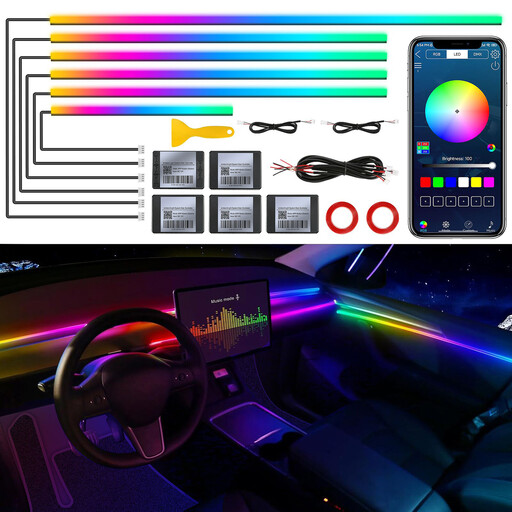
Why This Fits Their Persona: A practical starting point for drivers wanting dashboard and footwell illumination without a larger door-panel installation.
Its listed sections are defined as 4 × 29.5-inch, 43.3-inch and 14-inch strips, making planning easier than estimating from one long cable.
593 LEDs, 12V operation, app control and static or dynamic colour modes.
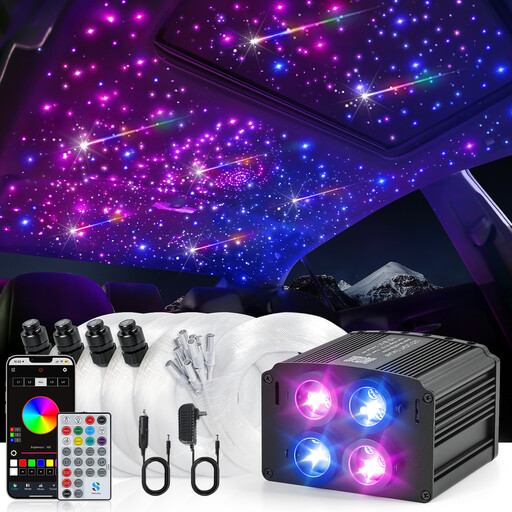
Why This Fits Their Persona: Suits modifiers planning a roof-focused interior project and willing to spend more time on careful headliner preparation.
The kit specifies fibre quantities, mixed diameters, four ports and a compact light engine, helping buyers plan the installation before drilling.
Includes 1,000 twinkle fibres, 240 meteor strands, app control and an RF remote.
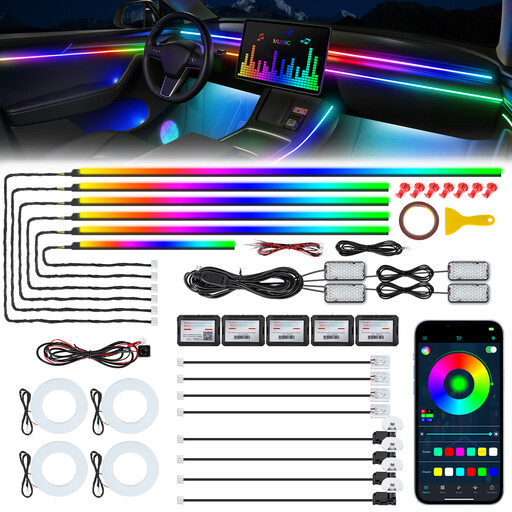
Why This Fits Their Persona: Designed for enthusiasts wanting coordinated dashboard, footwell, door handle, storage box and door speaker illumination.
The multi-controller layout separates the main and subsidiary sections, reducing the need to force one strip around every cabin contour.
Includes four footwell lights, four door-handle lights, four storage-box lights and music-sync control.
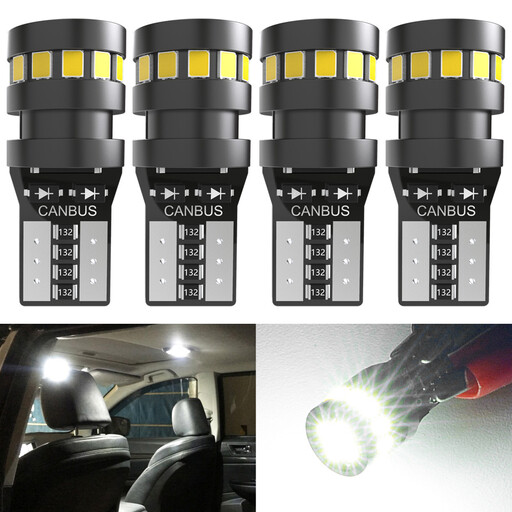
Why This Fits Their Persona: A straightforward option for replacing dome, map, courtesy or number plate bulbs without installing a full ambient system.
The product lists T10, W5W, 501, 194, 168 and 2825 references, allowing comparison with the original bulb before purchase.
Pack of four, 12V–24V specification, aluminium body and 300 lumens per bulb as listed.
We have compiled a complete, real-time list of products that fully satisfy these strict selection criteria and UK safety regulations.
Test every component before pushing trim back into place. Keep wiring away from pedals, seat rails, airbags and hot surfaces. Ambient lighting should not distract the driver or create reflections across the windscreen. Avoid positioning bright strips where they can be confused with external vehicle lamps.
For a clean result, plan the cable route first, clean adhesive surfaces and leave access to the controller. If hardwiring to a fuse box, use an appropriate fused accessory circuit and seek qualified assistance if you are unsure.
Plug-in acrylic kits with a pry tool and adhesive can be suitable for careful DIY installation. Door-panel systems and headliner kits require more trim removal, cable management and preparation. Always test the lighting before final assembly.
Lifespan depends on heat, voltage, vibration and installation quality. Product listings may state figures such as 60,000 hours for replacement bulbs, but actual service life can vary. Correct voltage, adequate ventilation and avoiding crushed light guides help reduce premature faults.
LED systems generally use less power than equivalent halogen lighting, but consumption varies according to the number of sections, brightness and animation mode. Disconnect plug-in kits when the vehicle is parked for extended periods unless the installation is designed to switch off with the ignition.