
24/7 Customer Support

Free returns

Same-day & Next-day Delivery

Quality Guaranteed

Unlock Your Welcome Offers: FREE Delivery | Up to 80% OFF | Free 30-day JoyPlus trial
Download the APP
Adding custom lighting to your car's interior can transform the driving experience, creating a modern and personalised atmosphere. However, the market for car interior ambient lighting is filled with options that can be confusing. Many UK drivers, eager to upgrade their vehicles, fall into common traps, ending up with a subpar result that looks cheap and fails quickly.
As a Joybuy Product Recommendation Officer, my role is to help you navigate these choices. This guide will highlight the critical pitfalls to avoid and break down the key features you need to look for, ensuring you invest in a kit that delivers a clean, professional finish.
Before you add any kit to your basket, be aware of these frequent issues that can turn an exciting DIY project into a frustrating waste of money.
To avoid the pitfalls above, focus on these two essential specifications. They are the primary indicators of a quality car atmosphere lights kit.
The material that delivers the light is crucial for the final look.
How you interact with your lights determines how much you'll enjoy them.
Based on these criteria, we've matched a few standout kits to different types of UK car enthusiasts.
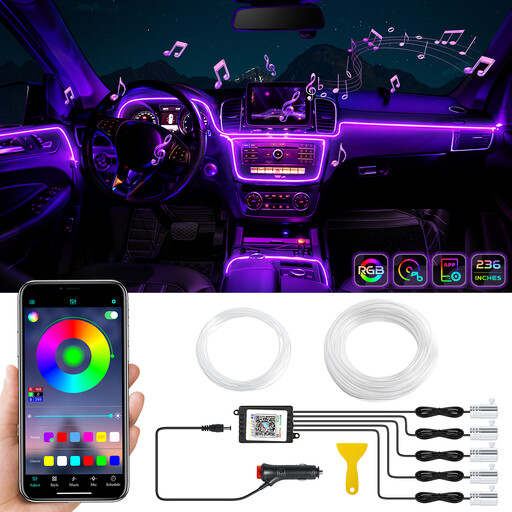
Why This Fits Their Persona: Perfect for those new to car modification. This kit focuses on the essentials—dashboard and centre console—with a single, long fibre optic tube that can be cut to size. The 12V plug-and-play power source makes it an unintimidating first project.
Its simple 5-point LED design and generous 6-metre tube length provide enough flexibility for a straightforward installation, avoiding the wiring nightmare of more complex kits.
Very accessible entry point. The entire kit is powered by a single car charger, and the fibre optic is easy to trim and fit into panel gaps with the included pry tool.
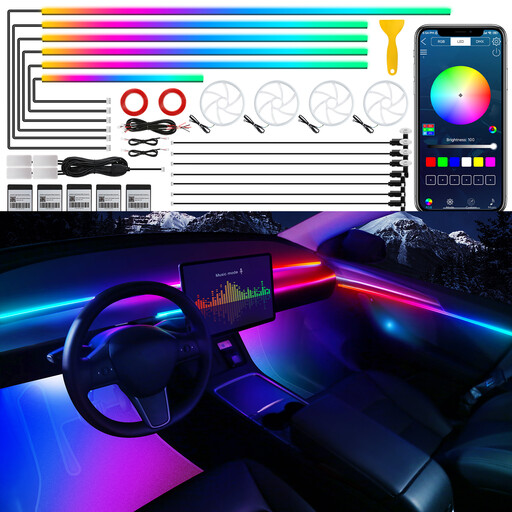
Why This Fits Their Persona: For the driver who wants a complete, immersive lighting overhaul. This comprehensive 22-in-1 kit includes acrylic strips for the dash and doors, plus separate modules for footwells, door handles, storage boxes and even speaker horns.
It uses high-quality acrylic strips with embedded LEDs, providing bright, perfectly uniform light and completely avoiding the hotspot issue. The modular system with a main controller and four sub-controllers simplifies wiring for full-cabin coverage.
Features dual-zone control via the app, allowing separate colours and modes for different cabin areas. The "Dreamcolor" RGB-IC technology enables dynamic chasing and flowing effects.
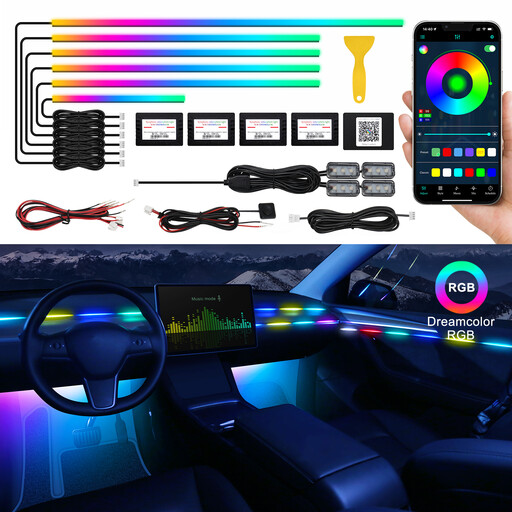
Why This Fits Their Persona: This kit strikes an excellent balance. It provides the premium, uniform lighting of acrylic strips for the main dash and door lines, and includes essential footwell lights, but forgoes the smaller, more niche lights for a simpler installation and better value.
It delivers the high-end look of uniform acrylic lighting without the overwhelming complexity of a 20+ piece kit. The app control is robust, giving you access to dynamic modes without the risk of a buggy interface.
Offers the same "Dreamcolor" RGB-IC chasing effects as the premium kits. It's a significant aesthetic upgrade that focuses on the most impactful areas of the car's interior.
We have compiled a complete, real-time list of products that fully satisfy these strict selection criteria and UK safety regulations.
Most DIY kits are designed for ease of installation and include a plug that fits directly into your car's 12V accessory socket (the cigarette lighter). This is the simplest method. For a more integrated look, some kits can be hardwired to your car's fuse box. If you choose this route, it's recommended to connect it to an "accessory" or "ignition-switched" fuse, which only provides power when the car is on.
LEDs are extremely energy-efficient and draw a negligible amount of power when the car is running. The main concern is battery drain when the car is parked. Kits powered by the 12V socket will turn off with the car. If you hardwire a kit, connecting it to an ignition-switched fuse ensures it cannot draw power when the engine is off, preventing any risk of a flat battery.
Yes, almost all kits are designed to be cut for a custom fit. However, you must follow the manufacturer's guidance. Fibre optic tubes can generally be cut to any length with a sharp blade. Acrylic strips have designated copper cut points, usually marked with a small scissor icon. Cutting anywhere else will break the circuit and cause the rest of the strip to stop working. Always measure twice and cut once.