
24/7 Customer Support

Free returns

Same-day & Next-day Delivery

Quality Guaranteed

Unlock Your Welcome Offers: FREE Delivery | Up to 80% OFF | Free 30-day JoyPlus trial
Download the APP
A car interior LED ambient light strip can change the feel of a cabin without permanent modifications. However, colourful images and long length claims do not always tell you how practical a kit will be in a real UK vehicle.
The most common buying mistakes are easy to overlook:
Most universal car ambient lighting kits use the vehicle’s 12V accessory supply, commonly through a cigarette-lighter socket or compatible adapter. Check the listed voltage carefully. For example, some kits specify DC 10–16V, while others are described as 12V systems.
Do not connect a kit to an unsuitable power source or exceed its stated voltage. A higher input may damage components, while a lower input can make the light dim and affect music-sync performance. Before installation, test the complete kit and plan where the controller and cables will sit.
For UK use, position lighting so it does not obstruct the driver’s view, interfere with controls or create distracting reflections across the windscreen. These products are intended as interior decorative lighting rather than a replacement for legally required vehicle lamps.
A traditional fibre optic car light strip usually sends light from LED units through a transparent fibre. It can be tucked into dashboard and door-trim gaps, but brightness may reduce along the length. Some designs use several LED outputs to improve coverage.
An acrylic car interior lighting strip uses an acrylic lens to spread light along the visible section. This can provide a more continuous appearance, although the strip still needs to be routed without tight folds or excessive bends. If the product is cuttable, follow the marked cutting guidance. Cutting through a resistor or the wrong end can leave part of the strip with uneven colour or no illumination.
Look for the details behind terms such as Dreamcolour car LED strip, music sync and wireless app control:
Music-sync car lights can respond to sound captured by a built-in microphone, including music and voices. This may work differently depending on cabin noise, phone position and volume, so treat it as an entertainment mode rather than a guaranteed beat-perfect connection.
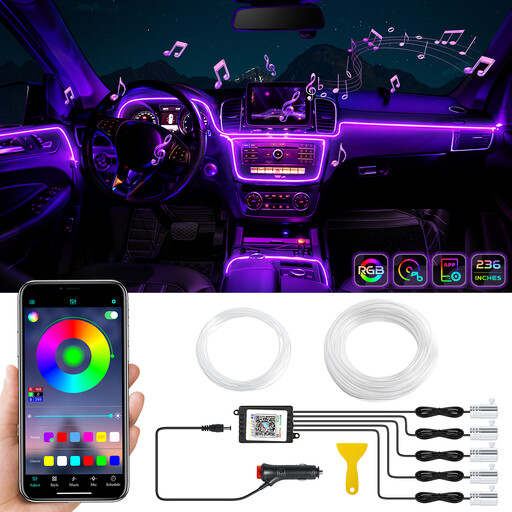
Why This Fits Their Persona: A practical starting point for drivers wanting colourful car interior mood lighting without a multi-zone installation. The 236-inch fibre line can be divided for selected dashboard or door areas.
The listing specifies a 10–16V RGB system, test-before-installation guidance and a supplied pry tool, making the setup requirements clearer.
Bluetooth app control, 29 preset modes, sound-sensitive mode and a car charger are included.
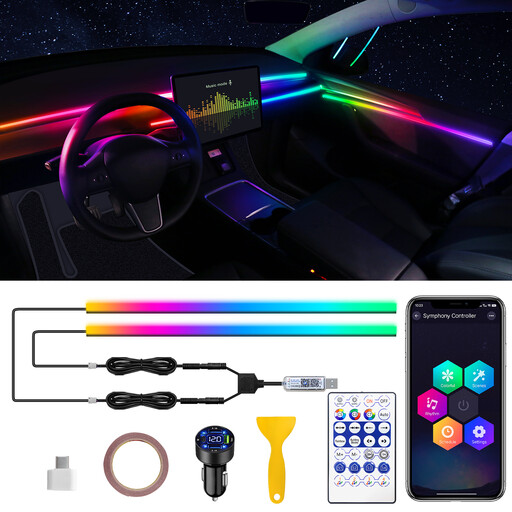
Why This Fits Their Persona: Suitable for customisers who prefer a more continuous acrylic appearance across selected interior lines and want to adjust the look from a phone.
The product details identify six separate strips and explain the cutting limitation, helping buyers plan rather than assume one uninterrupted length.
Acrylic lens construction, Bluetooth control, RGB Smart IC effects and sound-sensitive modes.
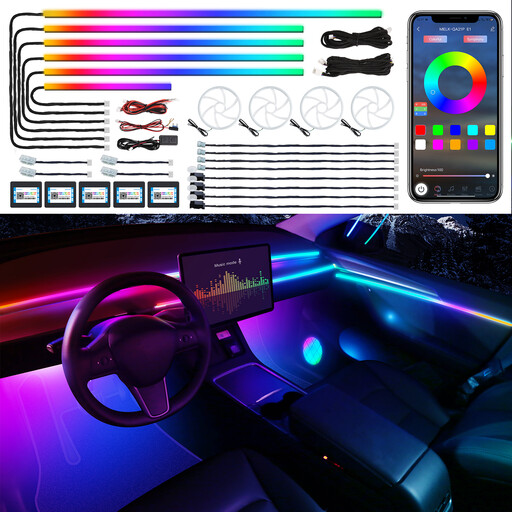
Why This Fits Their Persona: Designed for a comprehensive cabin installation covering dashboard, doors, storage areas, horn areas and footwells.
The multi-controller layout separates zones, while the instructions warn against folding the fibre and specify how the main and sub-controllers connect.
Includes four footwell lamps, four door-handle lights, four storage-box lights and four door-horn lights with dual-zone control.
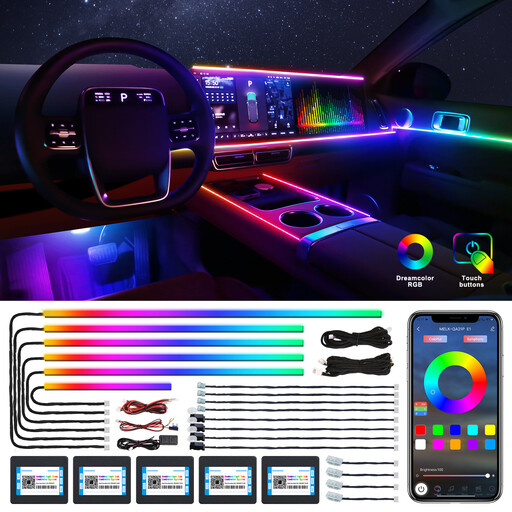
Why This Fits Their Persona: A middle-ground option for drivers wanting dashboard, door and footwell coverage without the additional horn-light components.
The supplied zone arrangement makes the intended coverage clearer, and the product information identifies the need for a clean, dry surface and suitable power source.
Offers LotusLamp X app control, sound-active effects, static colours and separate control for selected lighting zones.
We have compiled a complete, real-time list of products that fully satisfy these strict selection criteria and UK safety regulations.
Basic kits can be fitted by a careful DIY user using a supplied pry tool and accessory-socket connection. More comprehensive kits with door and footwell zones require additional cable routing and controller placement. Always read the vehicle-specific fitment requirements before removing trim.
Lifespan depends on heat, voltage stability, moisture, cable strain and installation quality. Avoid exceeding the stated voltage, keep controllers secure and do not sharply bend the fibre or acrylic strip. A kit with memory function can also reduce repeated setup after each journey.
A 12V LED kit is generally intended for low-power decorative use, but actual consumption depends on the number of active sections, brightness and effect selected. Turn the lights off when the vehicle is parked and avoid leaving an accessory-powered kit connected if your vehicle’s socket remains live.