
24/7 Customer Support

Free returns

Same-day & Next-day Delivery

Quality Guaranteed

Unlock Your Welcome Offers: FREE Delivery | Up to 80% OFF | Free 30-day JoyPlus trial
Download the APP
A car interior LED ambient lighting kit can add colour to a dashboard, centre console, doors and footwells without a permanent interior refit. However, product listings often use similar phrases for very different systems. LED counts, “16 million colours”, music sync and app control do not always tell you how easy a kit will be to install or whether it will suit your vehicle.
Before buying, look beyond the headline features. The right kit should match your vehicle’s power supply, interior gaps, preferred control method and installation confidence.
A high LED count may sound impressive, but it does not automatically mean the whole cabin will be evenly illuminated. Some fibre optic kits use a small number of light sources feeding a longer cable. This can create brighter areas near the LED emitter and dimmer sections further away.
Acrylic car LED strip lights distribute light along an acrylic lens and are designed to create a more continuous trim effect. Check the actual strip lengths and included accessories rather than relying only on the advertised bead or LED count.
Wireless app control normally refers to Bluetooth communication between your phone and the controller. The lighting still needs a physical connection to a 12V power source, such as a suitable accessory socket, USB adapter or professionally installed ACC circuit.
Multi-controller systems may also require extension leads between the main controller and door, footwell or storage-compartment sections. Plan where the control box will sit before buying, especially in a van, SUV or large truck cabin.
Many car interior trim lights can be shortened, but not at any point. Cutting through a resistor or an unsuitable section can cause part of the strip to lose colour synchronisation or stop lighting. Acrylic and fibre optic materials may also be damaged by folding or sharp bends.
Always test the kit before installation, identify the permitted cutting area and retain enough length for routing around corners. A supplied pry tool can help tuck trim into gaps, but forcing a strip into a narrow panel can mark the interior or damage the light guide.
Most products in this category are designed for 12V car interior lighting. Confirm that your vehicle uses a compatible 12V accessory supply. A 24V commercial vehicle, bus or heavy-duty truck may need a suitable step-down converter; do not connect a 12V kit directly to a 24V circuit.
For a straightforward DIY setup, a kit with a cigarette-lighter connection can be convenient. Hardwiring to an ACC fuse may produce a cleaner appearance, but it should be completed with appropriate protection and by someone familiar with automotive electrical work.
Look for practical safety features such as short-circuit protection, memory function and low-heat operation. These features do not remove the need for correct installation, suitable cable routing and inspection of connectors.
Acrylic strips can produce a relatively uniform line along dashboard and door trim gaps. Fibre optic systems usually require the optical cable to be inserted into a transparent tube and connected to separate LED emitters. They can offer more routing flexibility, but installation may involve more preparation.
Check the strip thickness against the gap in your vehicle. A listing may describe a strip as ultra-thin, yet the trim channel in a particular car may still be too narrow. Measure first, particularly around modern dashboards with tightly clipped panels.
RGB car interior lights may offer static colours, brightness adjustment, chasing effects and scene modes. RGB Smart IC or Dreamcolor systems can display moving patterns along the strip instead of changing the entire strip to one colour at once.
App names and functions vary. Some kits use LED LAMP, Lotus Lantern, LotusLamp X or similar Bluetooth applications. Check whether your phone uses iOS or Android and whether the controller supports the functions you actually want.
Music-sync car lights generally react to sound captured by a microphone in the controller. They may respond to cabin noise or voice as well as music, so the effect can vary with volume and microphone placement. Use dynamic modes only when they will not distract you while driving.
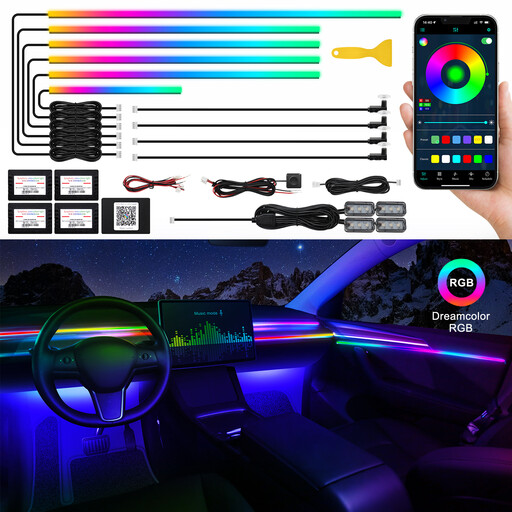
Why This Fits Their Persona: A practical starting point for drivers wanting dashboard, footwell and door-handle illumination without selecting the most extensive multi-zone package.
Its listed package includes six acrylic strips, four footwell lamps, four door-handle lights and multiple controllers, making the coverage easier to assess before purchase.
593 LEDs, Bluetooth app control, static and chasing modes, plus a stated 12V operating voltage.
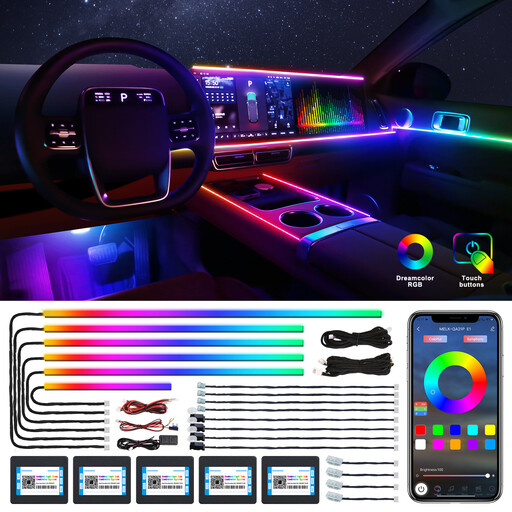
Why This Fits Their Persona: Suits owners creating a coordinated cabin design across dashboard, doors, footwells and storage areas.
The 18-in-1 configuration identifies the included footwell, door-handle and storage-compartment sections rather than leaving coverage to guesswork.
600 LEDs, dual-zone control, app and touch-button operation, sound-active modes and memory function.
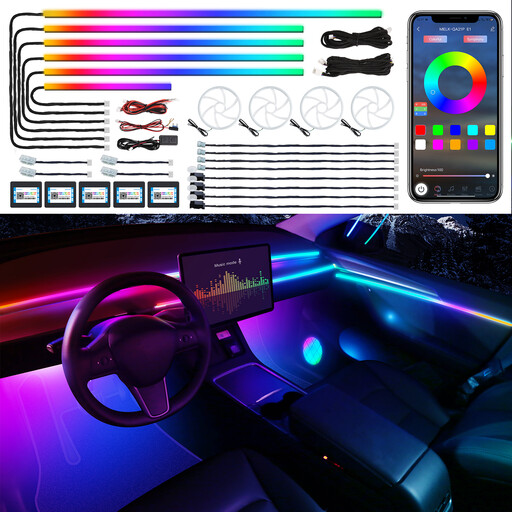
Why This Fits Their Persona: Designed for larger cabins, show vehicles, SUVs, vans and custom interiors where extra lighting zones are useful.
It lists separate door-handle, storage-box, footwell and door-horn lights, helping heavy users plan a complete multi-zone installation.
22-in-1 layout, 175-inch acrylic strip system, 12V compatibility, Bluetooth control and dual-zone effects.
Install lighting so it does not obstruct controls, pedals, mirrors or the driver’s view. Avoid positioning bright car neon lights where they shine directly into your eyes or reflect strongly in the windscreen. Lights that could be confused with emergency vehicle signals, or that are visible outside the vehicle, may create legal and safety concerns.
For a tidy result, clean and dry the trim surface, test every section, conceal wiring and secure the controller. If you are connecting to the fuse box, use appropriate automotive protection and consider professional installation. LED systems generally use modest power, but leaving them active while the engine is off can still discharge a battery over time.
We have compiled a complete, real-time list of products that fully satisfy these strict selection criteria and UK safety regulations.
Interior lighting is generally permitted when installed safely and used responsibly. It must not distract the driver, obstruct visibility or imitate restricted external warning lights. Check the installation against current UK road-use requirements and switch off distracting effects while driving.
Plug-and-play footwell LED lights and cigarette-lighter-powered kits are commonly suited to careful DIY installation. Hardwiring, door-panel removal and fuse-box connections require more knowledge. Always test the kit first, follow its voltage instructions and avoid folding the acrylic or fibre optic strip.