
24/7 Customer Support

Free returns

Same-day & Next-day Delivery

Quality Guaranteed

Unlock Your Welcome Offers: FREE Delivery | Up to 80% OFF | Free 30-day JoyPlus trial
Download the APP
A car interior LED ambient light strip can add colour around the dashboard, doors and footwells without a permanent vehicle modification. However, product listings often make similar kits appear interchangeable. In practice, the power connection, light-guide material, app compatibility and installation method can make a significant difference to the finished result.
This guide explains the details worth checking before buying, including common marketing pitfalls affecting RGB car interior lights, Bluetooth app-controlled car lights and music-sync car LED lights.
A listing may advertise 175 or 236 inches of material, but this does not necessarily mean one continuous strip can be installed across the entire cabin. Some kits divide the material between dashboard sections, footwells, door handles and storage compartments.
Check:
A kit with fewer accessories may suit a small hatchback, while an SUV, lorry or motorhome may need multiple zones and longer wiring.
Flexible fibre optic and acrylic lighting can usually be adjusted, but the light source, resistor or control circuit may limit where cutting is safe. Cutting in the wrong place can result in a dark section, uneven colour or unsynchronised effects.
Before trimming, read the supplied instructions and leave spare length where the product specifies. Fibre optic material should also not be folded sharply or bent in half, as light transmission may be reduced.
“Universal” generally describes the intended vehicle range, not a promise that every dashboard gap or door trim will accept the strip neatly. Some interiors have narrow seams, textured plastics or panels that require more dismantling.
For UK vehicles, also consider:
Ambient lighting is for interior decoration. Avoid bright or flashing settings that could distract the driver, and use it responsibly on public roads.
Most car ambient lighting kits are designed for a 12V DC automotive supply, commonly through a cigarette-lighter socket or a suitable USB adapter. The MAODANER kit listed below specifies a DC input range of 10–16V, while the Dreamcolour-style kits specify 12V operation.
Do not connect a kit to a higher-voltage source. A voltage that is too high may damage components, while an insufficient supply can reduce brightness or slow music-reactive effects. If a kit is connected to a fuse box rather than an accessory socket, consider professional installation unless you are confident with automotive wiring.
Fibre optic car lights use one or more LEDs to send light through a transparent fibre or tube. They can create a discreet line along a trim gap and are often easy to hide. Brightness may vary along longer sections, particularly if the light source is positioned at only one end.
Acrylic light strips use an acrylic lens or light guide to distribute illumination along the strip. The product descriptions for several Dreamcolour and VGETTING kits specify a slim, bendable acrylic profile with multiple LEDs or a distributed light effect. These can be suitable where a more even line is wanted, although they still need careful routing around corners.
Bluetooth app-controlled car lights may offer static colours, brightness adjustment, timing and animated modes. Check the required app and operating-system compatibility before purchase. Some kits use “Lotus Lantern”, “LED LAMP” or “LotusLamp X”, so do not assume that one app controls every controller.
A built-in microphone enables music-sync car LED lights to respond to nearby sound. This is not the same as direct integration with the vehicle’s audio system: cabin volume, microphone position and road noise can affect the response.
For larger installations, look for separate zones. Footwell lights, car door handle lights, door storage lights and dashboard sections may be independently controlled on multi-controller systems.
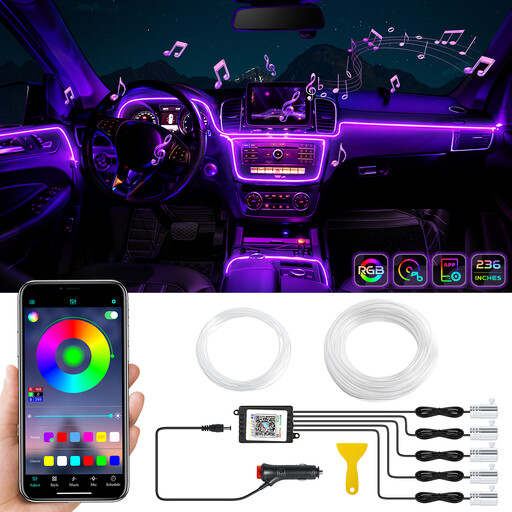
Why This Fits Their Persona: A practical starting point for drivers who want dashboard or trim lighting without selecting a larger multi-zone system.
The package lists a 6-metre optical fibre line, transparent tube, pry tool and car charger. The instructions also explain how the fibre can be divided into sections and where LEDs should be connected.
Bluetooth iOS and Android app control, 29 preset modes, sound sensing, memory function and a stated 10–16V DC operating range.
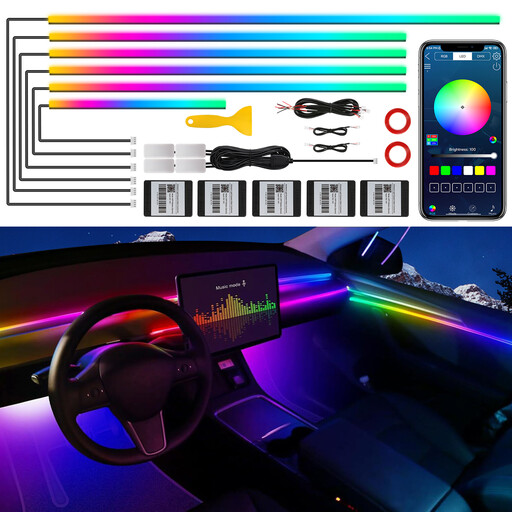
Why This Fits Their Persona: Suitable for owners seeking a more structured cabin installation covering the dashboard, footwells and door handles.
Its listed contents identify six acrylic strips, four footwell lamps, four door-handle lights and multiple controllers, making the coverage clearer than a single-length description.
Acrylic light distribution, Bluetooth “LED LAMP” app control, static and animated modes, plus sound-responsive operation.
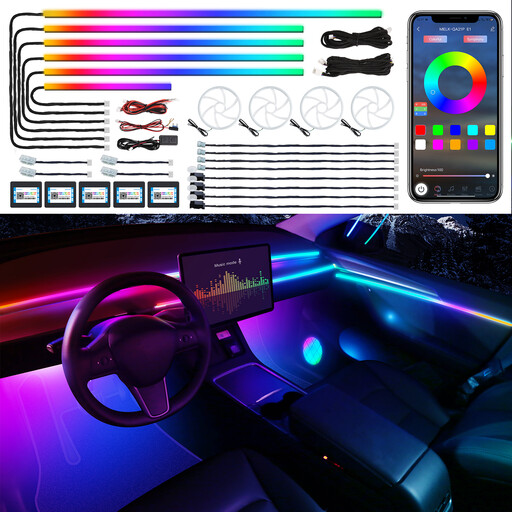
Why This Fits Their Persona: Designed for DIY hobbyists planning a detailed installation across multiple cabin zones in a car, SUV or lorry.
The specification separates dashboard, footwell, door-handle, storage-box and door-horn lighting. This helps buyers plan the installation instead of relying on an unclear total length.
Five controllers, dual-zone control, 16 million colour options, sound sensing and a stated 12V supply design.
Test the car ambient lighting kit before pushing the fibre or acrylic strip into trim gaps. Clean and dry the surface, use the supplied pry tool carefully and hide LED sources and wiring where they cannot catch on clothing or interfere with controls.
Power consumption varies by LED count, brightness and operating mode. A kit running from the accessory socket draws power only while that circuit is active, but a permanently wired installation may continue drawing power when the vehicle is parked. Confirm the controller’s standby behaviour and switch the system off if the vehicle will be left unused for an extended period.
Interior decorative lighting is generally permitted, but it must not obstruct the driver, create unsafe glare or be confused with mandatory vehicle lighting. Keep brightness moderate and avoid distracting animated modes while driving. Always check the vehicle’s handbook and use suitable installation practices.
Many plug-and-play 12V car interior lighting kits are intended for DIY installation using an accessory socket. More complex installations involving fuse boxes, door panels, headliners or airbag areas require greater care. If you are unsure about vehicle wiring, use a qualified installer.
Lifespan depends on heat, moisture, vibration, wiring quality and how often the kit is operated. Avoid sharply bending fibre or acrylic guides, exceeding the specified voltage and leaving loose connections exposed. These steps can help maintain consistent illumination, but no fixed service life should be assumed for every vehicle or installation.