
24/7 Customer Support

Free returns

Same-day & Next-day Delivery

Quality Guaranteed

Unlock Your Welcome Offers: FREE Delivery | Up to 80% OFF | Free 30-day JoyPlus trial
Download the APP
A car interior LED ambient light strip can change the atmosphere of a cabin without replacing trim or making permanent cosmetic changes. However, many kits look similar in online listings while differing considerably in controller design, strip construction, installation coverage and power requirements.
For UK car owners, the main challenge is separating useful specifications from inflated descriptions. Before buying, consider these common pitfalls.
A high LED number does not automatically guarantee an even-looking installation. Some fibre optic systems use light sources at intervals, which may create brighter points and darker sections. An acrylic car LED light strip uses a translucent acrylic lens to distribute light along the strip, but the final appearance still depends on how neatly it is fitted into the trim gap.
Look for the actual strip lengths, the number of separate sections and whether the kit includes dedicated modules for footwells or doors, rather than relying only on a headline LED count.
Most wireless app-controlled kits use Bluetooth between your phone and the controller. They still need a 12V power connection, wiring between the main controller and light sections, and sometimes additional sub-controllers.
Check whether the kit is powered through a cigarette lighter socket or designed for an ACC-fuse connection. A socket connection is generally more approachable for a reversible DIY installation, while hardwiring may give a tidier result but should be completed carefully.
Universal fitment does not mean every vehicle has identical trim gaps. Acrylic strips can be too thick for particularly narrow channels, and fibre optic lines should not be folded sharply. Cutting in the wrong place may affect the final illuminated section or colour synchronisation.
Measure the dashboard, centre console and door trim gaps first. Also check whether the kit includes a pry tool, adhesive tape, extension leads and enough separate controllers for your intended layout.
Most 12V car interior lighting kits are intended for passenger cars, SUVs, vans and pick-ups with a 12V supply. Confirm your vehicle’s electrical system before ordering; a 24V commercial vehicle may require a suitable step-down converter.
A kit’s stated safety features may include short-circuit protection, memory function and low-heat LED operation. These are useful specifications, but they do not replace correct installation. Test the lights before fitting, keep wiring away from pedals and moving parts, and avoid routing cables across airbag deployment areas.
For wireless app-controlled car lights, check the app compatibility with your Android or iOS device, Bluetooth range and available control modes. Common functions include:
Music synchronisation normally responds to sound captured by a microphone, so it may react to voices and road noise as well as music. It is an entertainment feature rather than a precision audio visualiser.
Acrylic light strips are suited to dashboard edges, centre consoles and door trim gaps where an even line is preferred. Fibre optic car ambient lighting can offer more flexibility in routing, but it may require inserting a fibre into a transparent tube and connecting the ends to LED sources.
For broader coverage, look for kits that include:
Keep illuminated areas subtle enough that they do not interfere with visibility or distract the driver. Check the Highway Code and any relevant vehicle requirements before using bright or animated lighting on public roads.
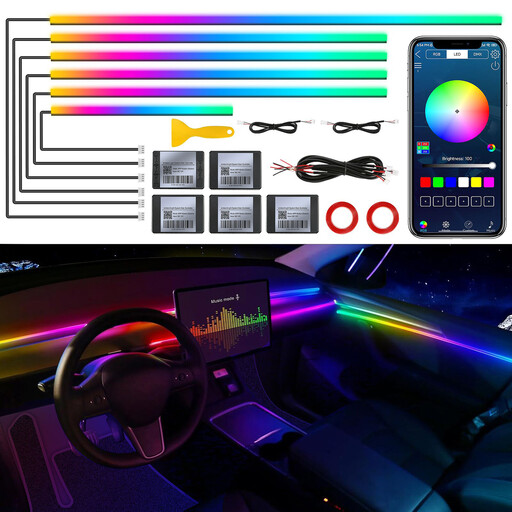
Why This Fits Their Persona: A straightforward choice for first-time DIY upgraders who want dashboard and trim illumination without adding door-handle or footwell modules.
The listing specifies six acrylic strips, measuring 4 × 29.5 inches, 1 × 43.3 inches and 1 × 14 inches, rather than presenting only a total length.
593 LEDs, Bluetooth app control, music sensor, static and dynamic modes, plus a hidden touch button.
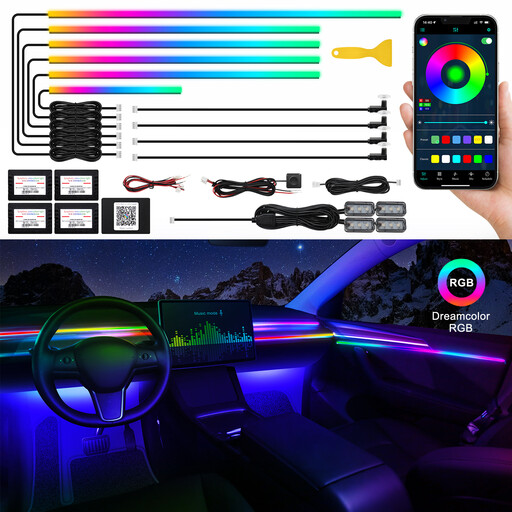
Why This Fits Their Persona: Suitable for owners seeking a coordinated cabin layout across the dashboard, footwells and four door handles.
The package contents identify four footwell lamps, four door-handle lights, six main acrylic strips, one main controller and four sub-controllers.
12V operation, RGB Smart IC effects, app control for iOS and Android, and stated cuttable sections.
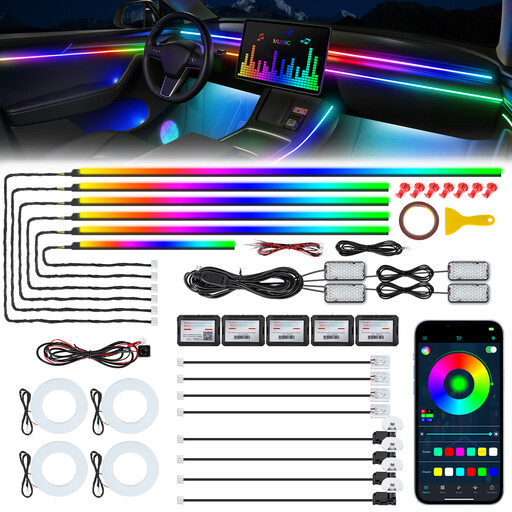
Why This Fits Their Persona: Designed for larger cabins, SUVs, pick-ups and van owners who want lighting across several separate interior zones.
The 22-in-1 specification lists footwell, door-handle, door-storage and door-horn lighting, helping buyers plan coverage before installation.
Six acrylic strips, multiple controllers, music-sync mode, 593 LEDs and a stated operating range of -20°C to +60°C.
We have compiled a complete, real-time list of products that fully satisfy these strict selection criteria and UK safety regulations.
Interior lighting rules can depend on brightness, colour, placement and whether the lights distract other road users or obstruct the driver’s view. Fit ambient lighting away from the windscreen and controls, use modest brightness while driving, and check current UK guidance for your vehicle.
A 12V LED kit is generally designed for low-voltage vehicle use, but consumption varies by LED count, brightness and the number of zones operating. Switch the kit off when the engine is not running unless you have confirmed its battery impact.
Lifespan depends on heat, moisture, vibration, wiring quality and installation. Avoid trapping sections where they can be crushed, protect connectors from moisture and follow the specified voltage. A clean, reversible installation can reduce premature damage and make future replacement easier.