
24/7 Customer Support

Free returns

Same-day & Next-day Delivery

Quality Guaranteed

Unlock Your Welcome Offers: FREE Delivery | Up to 80% OFF | Free 30-day JoyPlus trial
Download the APP
A car interior LED light strip can transform a plain cabin with colour, footwell illumination and music-synchronised effects. However, the wrong kit may leave you with uneven brightness, loose wiring, an app that will not pair or more installation work than expected.
For UK drivers, the main buying decision is not simply how many colours a product offers. You also need to check the power source, strip construction, control method, vehicle layout and whether the lighting can be installed without interfering with driving controls or safety equipment.
A listing may promote hundreds of LEDs, but the number alone does not tell you how evenly the light will appear inside the car. Traditional fibre optic car interior lights often depend on light entering from one or several LED sources. This can create brighter ends and dimmer sections.
Acrylic light strips use a translucent acrylic edge or lens to spread light along the visible trim. This may provide a more continuous appearance, but brightness still depends on installation position, the hidden LED source and the vehicle’s trim design. Look for clear information about strip lengths, light sources and included zones rather than relying only on a large LED figure.
Wireless car mood lighting generally means Bluetooth app control, not battery-powered lighting. Most kits still require a connection to a 12V vehicle supply, such as a cigarette-lighter socket, USB adapter or suitable accessory circuit.
Before buying, check where the controller will sit and whether cables can be concealed behind trim. A kit with several sub-controllers may offer better coverage but can require more careful cable routing.
Some fibre optic and acrylic strips can be cut, but not at every point. Cutting through a resistor, LED connection or unsuitable section may cause a segment to remain dark or fall out of colour synchronisation.
Use the supplied instructions and test the entire kit before installation. Avoid folding an acrylic or fibre optic strip sharply, as excessive bending can reduce light transmission or damage the material.
A typical 12V car interior lighting kit is intended for automotive electrical systems, but product voltage ranges vary. Several kits listed for vehicle use specify 12V DC, while another fibre optic design states 10–16V. Match the product specification to your vehicle and use the supplied connector or an appropriate fused connection.
For a simple installation, a 12V accessory socket is usually more accessible. A permanent fuse-box installation may produce a tidier finish, but it should only be attempted if you understand automotive wiring or use a qualified installer. Keep wiring away from pedals, steering components, hot surfaces and airbag deployment areas.
An app-controlled car LED lights kit can offer colour selection, brightness adjustment, timing, scene modes and animation speed. Bluetooth control is convenient at close range, but it is different from Wi-Fi or factory-integrated vehicle control.
If you want music-sync car lights, check whether the controller uses a built-in microphone. Sound-reactive effects respond to sound captured by the microphone, so results can vary with cabin volume, phone placement and road noise. Voice control may also be listed, but app and controller compatibility should be confirmed before purchase.
A dashboard ambient light strip alone may not illuminate the rest of the cabin. For a more integrated appearance, compare kits by included zones:
A 175-inch kit may cover a large car, SUV or truck, but the actual result depends on the route and how much material is concealed inside the trim. Measure the intended paths before ordering.
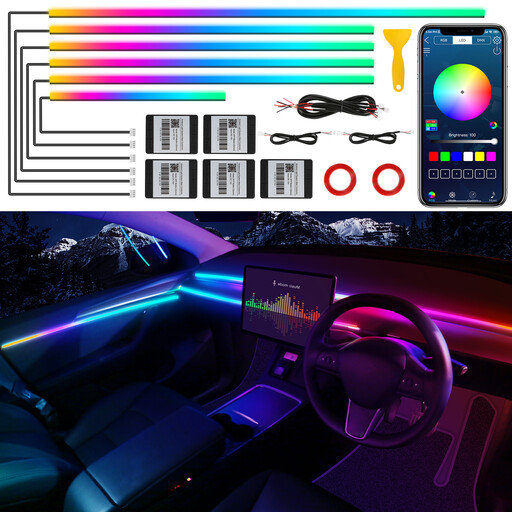
Why This Fits Their Persona: A practical starting point for drivers wanting dashboard colour effects and footwell lighting without selecting a larger multi-zone package.
The listing specifies six main strips, four footwell lights, a main controller and sub-controllers, helping clarify what the multi-zone design includes.
175-inch total strip length, Bluetooth app control, RGB Smart IC effects and a stated 12V working voltage.
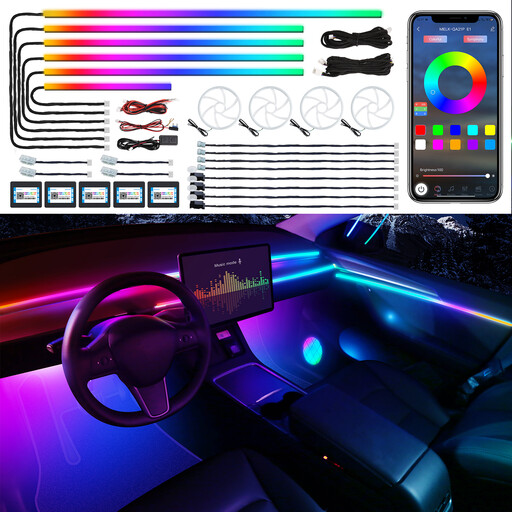
Why This Fits Their Persona: Suitable for enthusiasts planning a coordinated cabin design across the dashboard, doors, footwells and storage areas.
Its stated package contents identify footwell, door-handle, storage-compartment and door-horn lighting rather than relying on a single strip count.
Includes dual-zone control, Bluetooth app operation, music sensing, touch controls and a 12V system.
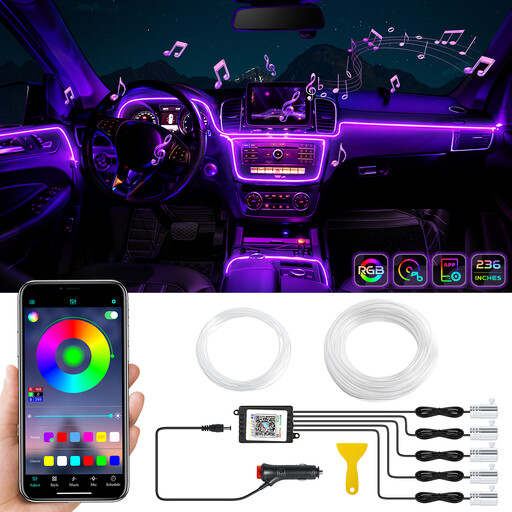
Why This Fits Their Persona: A flexible option for DIY modders covering several trim routes in a larger car, SUV, truck or recreational vehicle.
The listing explains that the 236-inch fibre can be divided into three to five sections and identifies five LED light sources.
Offers 6 metres of optical fibre, app adjustment for brightness and speed, music sensing and a stated 10–16V operating range.
We have compiled a complete, real-time list of products that fully satisfy these strict selection criteria and UK safety regulations.
Test the car interior LED light strip before placing it behind trim. Clean and dry adhesive surfaces, route cables neatly and leave enough slack near removable panels. Keep lighting subtle enough that it does not distract you or create reflections in the windscreen. Do not position lights where they obscure instruments, warning indicators or safety equipment.
LED lighting normally uses modest power, but consumption varies with brightness, the number of active zones and the controller. Using the accessory socket means the kit will usually switch off with the vehicle, while a permanent connection may continue drawing power unless correctly switched or fused.
Many listed kits are designed for cars and trucks using a 12V supply, but trim gaps and power connections differ. Check the voltage, available socket and strip dimensions before installation. Larger vehicles may need longer routes or additional planning.
They generally react to sound captured by a built-in microphone rather than connecting directly to the stereo. Performance can change with cabin noise, volume and microphone placement. Static colour modes remain available when synchronisation is unsuitable.
Lifespan depends on heat, moisture, installation quality, voltage stability and how often the lights are used. Avoid exceeding the specified voltage, protect connectors from moisture and do not sharply fold fibre optic or acrylic sections. Proper routing and careful handling can help reduce premature damage.