
24/7 Customer Support

Free returns

Same-day & Next-day Delivery

Quality Guaranteed

Unlock Your Welcome Offers: FREE Delivery | Up to 80% OFF | Free 30-day JoyPlus trial
Download the APP
A car interior LED ambient lighting kit can transform a plain cabin with colour, motion and subtle illumination. However, product listings often focus on LED counts and “millions of colours” while leaving important installation details unclear.
Before buying, UK drivers should look beyond appearance. Check how the kit receives power, whether the light strips can be fitted neatly, how the app connects and whether the finished installation could distract you or affect visibility while driving.
A listing may advertise hundreds of LEDs, but the result depends on how light is distributed. Some traditional fibre optic car ambient lighting kits rely on light travelling from a small number of emitters. This can create brighter areas near the controller and dimmer sections further along the strip.
Acrylic light strips use an illuminated lens to spread light along the visible section. They can provide a more continuous appearance, but they still need to be installed without sharp bends or compression.
Most wireless app-controlled car lights use Bluetooth for control, but the controller and lighting sections still require a suitable 12V power connection. Multi-zone kits may also include extension cables, sub-controllers and separate connections for doors or footwells.
Check the package contents before purchase. A kit that appears simple online may require trim removal, cable routing and access to a centre-console or accessory power supply.
Music-sync car LED lights usually react to sound detected by a built-in microphone. They may respond to music, speech or road noise, depending on microphone placement and sensitivity. This is different from a system connected directly to the vehicle’s audio signal.
Similarly, voice control may operate through the mobile app or controller rather than through the car’s factory voice assistant. Read the control method carefully so the features match your expectations.
Most kits in this category are 12V car interior lighting products. Confirm that the kit is intended for a 12V vehicle system and follow the supplied wiring instructions. A voltage mismatch can cause dim operation, slower effects or component damage.
Useful features include:
Avoid routing cables across moving parts or placing lighting components where they could obstruct the driver’s view.
A cuttable car LED strip can be useful when fitting different dashboards, door panels or centre consoles. Cutting must only take place at the manufacturer’s permitted end or marked point. Cutting through a resistor or active section may leave part of the strip unlit or cause colour synchronisation problems.
Acrylic strips are often bendable rather than foldable. Do not force them around tight corners, fold them in half or trap them under trim. Measure each route first, allowing enough length for corners and connection points.
Check whether the controller works with your phone’s operating system and whether it uses Bluetooth rather than Wi-Fi. Some kits use a dedicated application, while others rely on a generic lighting app.
Look for practical functions such as:
A stated remote range, such as 0–10 metres, is usually measured in open conditions. The actual range inside a vehicle can be reduced by trim, metal components and phone position.
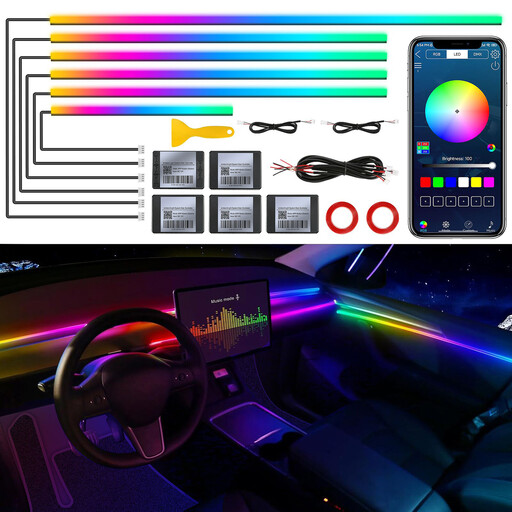
Why This Fits Their Persona: A practical starting point for drivers wanting app control and custom colours without immediately choosing a larger multi-zone package.
The listing specifies a 12V system, Bluetooth app control, cuttable strips and short-circuit protection, making the main compatibility checks easier to complete before installation.
Six acrylic strips, Dreamcolor RGB Smart IC effects, music sensing and separate control for selected zones.
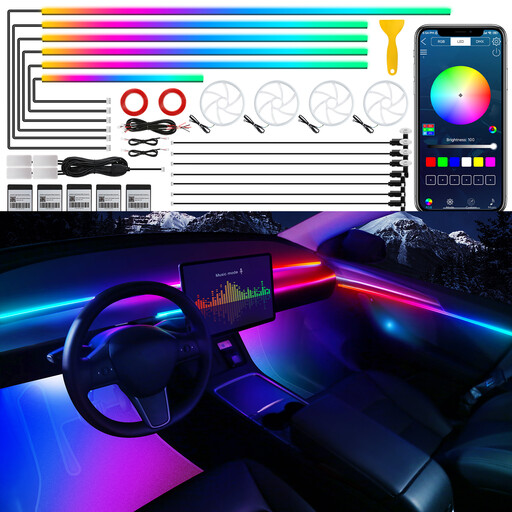
Why This Fits Their Persona: Suitable for customisation-focused owners who want to illuminate several cabin areas, including doors, storage compartments and footwells.
Its multi-controller layout is described for several installation zones, helping buyers plan cable routing rather than assuming one strip will cover the entire cabin.
Includes footwell, door-handle, storage-box and door-horn lighting, with app control, voice control and music synchronisation.
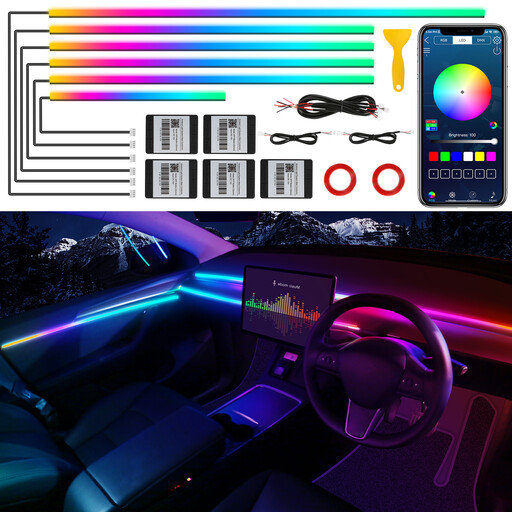
Why This Fits Their Persona: A flexible option for larger cars, lorries or owners planning a more involved dashboard and footwell installation.
The specifications identify the main controller, sub-controllers, 12V operation, cuttable strips and connection zones, so the installation can be measured before trim is removed.
593 LEDs, four footwell lamps, dual-zone control, dynamic chasing effects and compatibility with iOS and Android app control.
Test the lights before routing cables or attaching adhesive. Clean mounting surfaces, avoid covering factory warning labels and keep every wire away from pedals, seat rails, steering components and airbags.
Interior ambient lighting should remain subdued enough not to distract the driver. Do not position strips or controllers where they obstruct the windscreen, mirrors, instrument display or number-plate visibility. If the installation involves permanent wiring, consult a qualified vehicle electrician, particularly if the vehicle has complex electronics or warranty restrictions.
Adhesive-backed fittings can loosen in cold weather, heat or damp conditions. Mechanical clips or concealed trim channels may provide a more secure finish where available. Keep the product instructions and check the seller’s returns and warranty information before cutting any strip.
They can draw power while connected, especially if wired to a permanent supply. Using an ignition-switched accessory circuit means the lights turn off with the vehicle, reducing the risk of leaving them active. Follow the wiring instructions and avoid leaving decorative lighting operating for long periods when the engine is off.
Some kits are designed to be cut, but only at the permitted end or marked cutting location. Do not fold the strip or cut through a resistor. Test the kit first and measure the route before making any irreversible alteration.
Interior decorative lighting must not obstruct the driver’s view, create distracting glare or be confused with required exterior signals. Keep brightness controlled while driving and avoid fitting lighting that imitates emergency or official vehicle signals. When in doubt, check current DVSA guidance or ask a qualified vehicle professional.