
24/7 Customer Support

Free returns

Same-day & Next-day Delivery

Quality Guaranteed

Unlock Your Welcome Offers: FREE Delivery | Up to 80% OFF | Free 30-day JoyPlus trial
Download the APP
Adding custom lighting is one of the most popular ways to personalise a vehicle's cabin, transforming its look and feel. However, the market for car interior LED lights is flooded with options and it's easy to make a purchase you'll later regret. Many drivers find their exciting new upgrade quickly turns into a disappointment.
As the Joybuy Product Recommendation Officer, my role is to help you navigate the options and identify the key features that separate a quality kit from a waste of money. Before you buy, be aware of these common pitfalls:
To ensure you get a lighting system that lasts and performs as expected, focus on these core parameters.
The biggest difference in quality comes from how the light is delivered.
How you interact with your lights is crucial for day-to-day enjoyment.
Most kits are designed to run on a car's 12V system. The two most common power sources are:
Always check that the kit includes safety features like short-circuit protection and has a low power draw to prevent any strain on your car's battery.
Instead of a single "best" option, the right choice depends on your vehicle, your DIY comfort level and the final look you want to achieve. Here are a few recommendations matched to different user profiles.
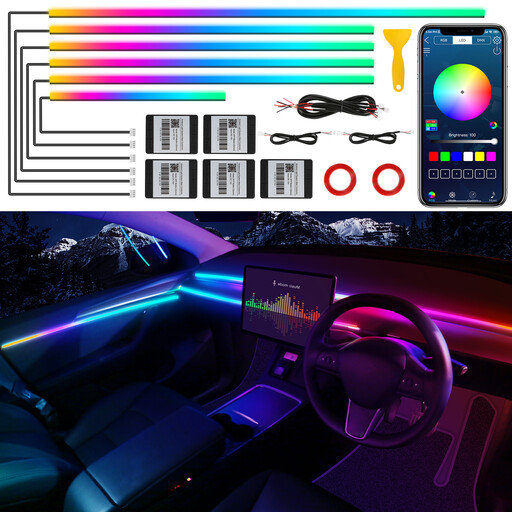
Why This Fits Their Persona: This user wants a comprehensive, integrated ambient lighting system that covers the dashboard, doors and footwells for a professional, factory-fitted look. They are comfortable with a more involved DIY installation to achieve a perfect result.
This kit uses acrylic light strips, which provide the smooth, uniform glow that avoids the "dotty" look of cheaper strips. Its multi-controller system simplifies wiring for a full-cabin setup.
Includes everything for a complete installation: 6 main strips, 4 footwell lamps and sub-controllers. Features advanced app control with dynamic "Dreamcolor" chasing effects.
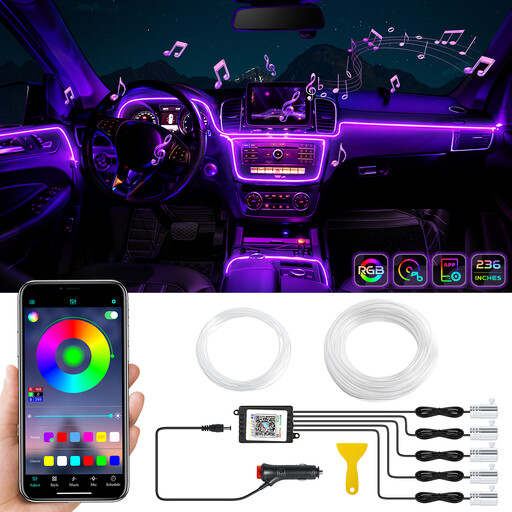
Why This Fits Their Persona: This driver wants a quick and noticeable upgrade without the hassle of complex wiring. They value simplicity and a clean look, preferring a system they can install themselves in under an hour using a simple power source.
It directly solves the "wiring nightmare" by using a single 12V car charger plug. The fibre optic tube is designed to be tucked into panel gaps, avoiding the unreliable adhesives of cheaper strip lights.
Very simple installation with a long 6-metre fibre optic cable that can be cut to size. Features app control with music sync and 16 million colours for easy customisation.
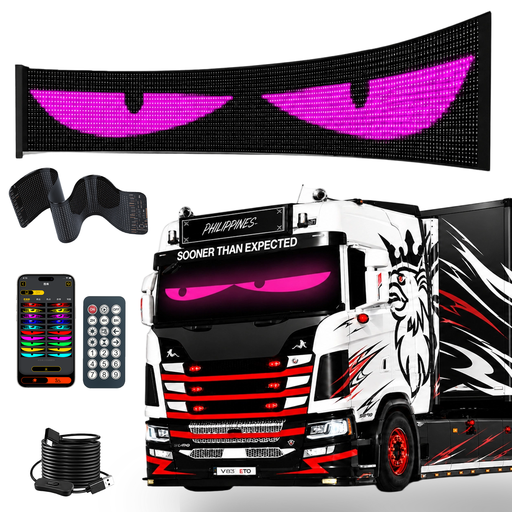
Why This Fits Their Persona: This user isn't just looking for subtle ambient lighting; they want their car to stand out. This programmable LED panel for the windscreen offers a unique way to display animations and custom graphics, making a bold statement at car meets or while parked.
As a self-contained unit, it completely bypasses the common pitfalls of interior strip lighting like complex wiring, poor diffusion and failing adhesives. It has a clear, singular purpose and is built to handle external conditions.
Offers unique customisation with programmable text, patterns and animations via an app. It's IP65 waterproof and uses a simple USB power source, making it easy to install and remove.
We have compiled a complete, real-time list of products that fully satisfy these strict selection criteria and UK safety regulations.
Yes, they are legal to install and use. However, the law is clear that they must not distract the driver or be mistaken for emergency vehicle lights. This means you should not have any red or blue lights visible from the front of the vehicle and the light should not be so bright that it causes glare or impairs your vision, especially at night. It is also illegal to have them flashing in a way that could distract other road users.
Generally, no. LED lights are extremely energy-efficient. Most kits are designed to power on only when the car's ignition is on or the 12V socket is active. When your car is off, the lighting kit should not draw any power. Quality kits also have a memory function, so they remember your last setting without needing constant power.
Installation is typically straightforward. The kits come with a thin, transparent tube and a separate fibre optic strand. You use a small plastic pry tool (usually included) to gently open a gap in your car's interior trim, such as along the dashboard or door panels. You then press the transparent tube into this gap. Finally, you feed the fibre optic strand into the tube and connect the ends to the LED light sources. This creates a clean, professional look without any glue.