
24/7 Customer Support

Free returns

Same-day & Next-day Delivery

Quality Guaranteed

Unlock Your Welcome Offers: FREE Delivery | Up to 80% OFF | Free 30-day JoyPlus trial
Download the APP
Upgrading your vehicle with car interior led lights can transform the cabin's atmosphere, making every drive feel more personal and modern. However, the market is flooded with options and it's easy to end up with a kit that disappoints. As a Joybuy Product Recommendation Officer, my role is to help you navigate the choices and find a solution that delivers on its promises without the common headaches.
Before you add anything to your basket, let's look at the three most common pitfalls that buyers encounter. Understanding these will help you sidestep low-quality products and invest in an ambient car lighting kit that you'll enjoy for years to come.
To ensure you get a quality lighting system, focus on these core technical aspects. They are the true indicators of performance and longevity, far more important than flashy marketing claims.
The type of light strip determines the final look. Standard LED strips, often used for car footwell lighting, are simple and effective but can be prone to the hotspotting issue mentioned earlier.
For a more refined and integrated appearance, consider fibre optic car interior lights or modern acrylic strips. These systems use a thin, flexible tube that is inserted into the gaps between your car's interior panels. A light source at the end illuminates the entire length of the tube, producing a continuous, uniform line of light. This method provides a professional, factory-fitted look that is hard to achieve with basic surface-mounted strips.
All colour-changing kits are not created equal.
When evaluating a kit with an app, check which application it uses (often listed in the product description, e.g., "Lotus Lantern" or "Magic Lantern"). A quick search for reviews of the app itself can give you an idea of its stability and user-friendliness.
A good kit is a complete kit. Look for packages that include not just the light strips but also essential installation accessories like a plastic pry tool for opening panel gaps, sufficient wiring length and clear instructions.
Power is another consideration. Most kits plug directly into your car's 12V accessory outlet (the cigarette lighter). This is the simplest method for a DIY installation. Some more advanced kits offer the option to be hardwired to the vehicle's fuse box, which provides a cleaner, hidden installation and ensures the lights turn on and off with the car's ignition.
Based on these practical criteria, we've matched a few standout options to different types of users.
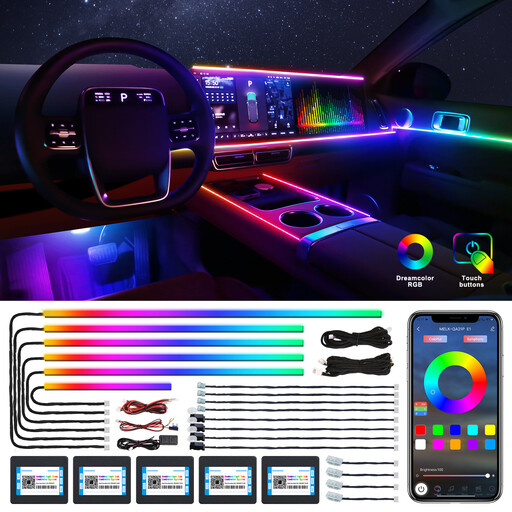
Why This Fits Their Persona: For the driver who wants a complete, professional-looking overhaul. This 18-in-1 kit includes dedicated lighting for the dashboard, all four doors, handles, storage boxes and footwells, providing total cabin immersion.
The use of acrylic light strips ensures a uniform, hotspot-free glow. Its multi-controller design (one main, four sub-controllers) creates a more stable and responsive system, avoiding the connectivity issues of single-controller kits.
Comprehensive Coverage: The 18-in-1 configuration leaves no part of the interior unlit.
RGBIC Technology: Delivers advanced "Dreamcolor" chasing and music sync effects.
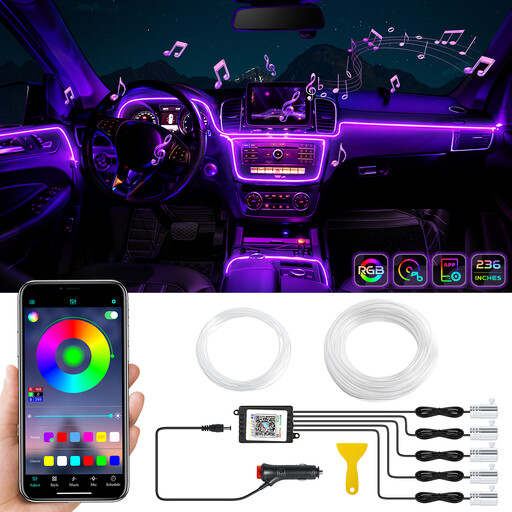
Why This Fits Their Persona: Ideal for those wanting a significant visual upgrade without complex wiring. This kit is powered directly by the car charger, and the long fibre optic cable can be cut to size for a custom fit along the dash and centre console.
Its "plug and play" design via the car charger completely bypasses complicated installation. The fibre optic technology provides a smooth, uniform light, avoiding the cheap look of spotted LED strips.
Simple Installation: Powers up via the 12V outlet, making it accessible for any DIY skill level.
Flexible Customisation: The 236-inch fibre optic line can be cut to fit various dashboard and console layouts.
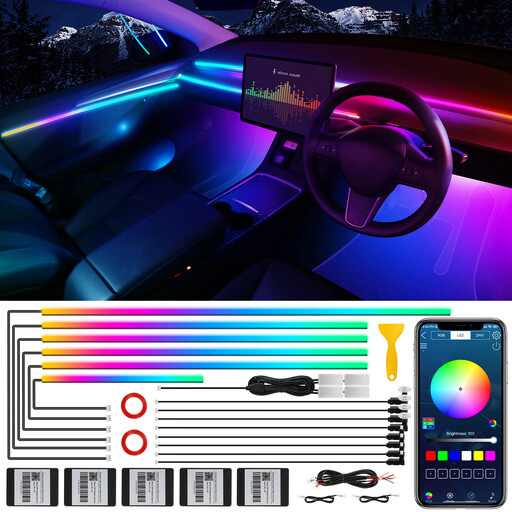
Why This Fits Their Persona: This kit is for the user who wants advanced control. It features Dual-Zone Control, allowing you to set different colours and modes for the main acrylic strips versus the footwell lights simultaneously, creating complex and unique lighting schemes.
By offering dual-zone control via a robust app and physical touch buttons, it provides a reliable and versatile user experience that goes beyond basic, buggy apps. The acrylic strips also prevent any hotspotting issues.
Dual-Zone Control: Customise two separate areas of your car's interior independently.
Multiple Control Methods: Use the app for deep customisation or the hidden touch buttons for quick changes.
We have compiled a complete, real-time list of products that fully satisfy these strict selection criteria and UK safety regulations.
Yes, they are legal to install and use. However, according to UK law, they must not distract the driver or be visible from the outside in a way that could be confused with emergency vehicle lights or other standard vehicle lights. A red light visible from the front or a white light visible from the rear, for example, is not permitted. It is advisable to use them subtly and ensure they do not flash or cause glare that could affect your concentration while driving.
LEDs are very energy-efficient and draw a minimal amount of power. When the car is running, the alternator will easily power the lights without any issue. If you have a kit that can remain on while the car is off, it could eventually drain the battery over a very long period (many days or weeks). However, most kits with a hardwiring option are connected to the ACC (accessory) circuit, meaning they only receive power when the ignition is on, preventing any battery drain.
Installation is generally straightforward for a patient DIYer. The process involves using a supplied plastic pry tool to gently create a small opening in the seams of your dashboard or door panels. The thin, transparent tube containing the fibre optic is then tucked into this gap. The most time-consuming part is often hiding the wires neatly for a clean finish. No permanent modification or drilling is typically required.