
24/7 Customer Support

Free returns

Same-day & Next-day Delivery

Quality Guaranteed

Unlock Your Welcome Offers: FREE Delivery | Up to 80% OFF | Free 30-day JoyPlus trial
Download the APP
Whether you're dealing with an unexpected flat tyre on the roadside or performing routine maintenance in your garage, a reliable car jack is an essential piece of equipment for any vehicle owner. However, with so many options available—from compact scissor jacks to powerful hydraulic trolley jacks—choosing the right one can feel complicated. The wrong choice might not fit under your car, or worse, may not be safe for its weight.
This guide is designed to cut through the clutter. We'll walk you through the key considerations for selecting a car jack that suits your vehicle, whether it's a low-slung sports car, a family saloon or a large SUV. We'll cover load capacities, jack types and safety certifications to help you make a confident and informed decision.
Before you purchase, it's important to understand a few key factors. Matching the jack to your specific car and needs ensures both safety and ease of use.
A jack's load capacity is the most critical safety feature. You can find your vehicle's Gross Vehicle Weight (GVW) in the owner's manual or on a sticker inside the driver's door jamb. While a jack only lifts a portion of this weight (usually one corner or one end), a good rule of thumb is to choose a jack with a capacity that is at least 75% of your vehicle's total weight.
The type of jack you need often depends on your vehicle's ground clearance and how you plan to use it.
For vehicles with low ground clearance, such as sports cars or modified saloons, a low profile car jack is essential. These jacks are designed with a very low entry height (often under 100mm) to slide easily under the vehicle's jacking points. Conversely, a car jack for an SUV may require a higher maximum lifting height to get the wheels off the ground.
When lifting a vehicle weighing over a tonne, safety is paramount. Always look for jacks that meet recognised safety standards. In the UK and Europe, EN 1494 and CE certification are key indicators that the product has been assessed to meet high safety, health and environmental protection requirements. Never work under a vehicle supported only by a jack; always use appropriately rated axle stands for safety.
Here are a few recommendations from our catalogue, selected to meet the needs of different UK drivers and their vehicles.
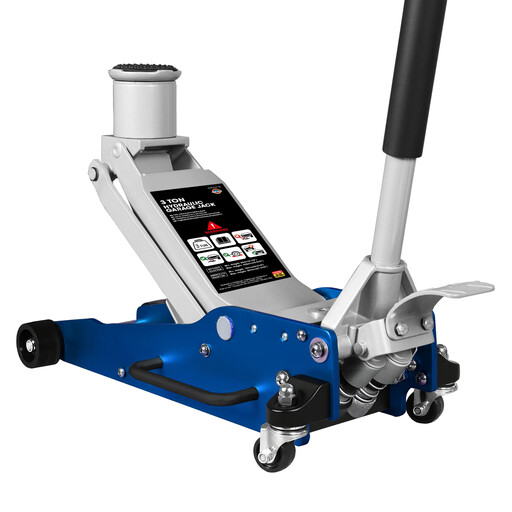
Why It Stands Out: This jack offers exceptional versatility. Its dual-mode lifting system, combining an ultra-low 85mm entry point with a height extender, makes it suitable for almost any vehicle, from a car jack for a sports car to a large van. The dual-pump mechanism provides a quick lift, while the aluminium car jack construction keeps it relatively lightweight and portable for its power.
Pros:
Who is it for? This is an excellent all-rounder for the home mechanic or a household with multiple vehicles, offering the flexibility to safely lift low-clearance performance cars and high-clearance SUVs or vans.
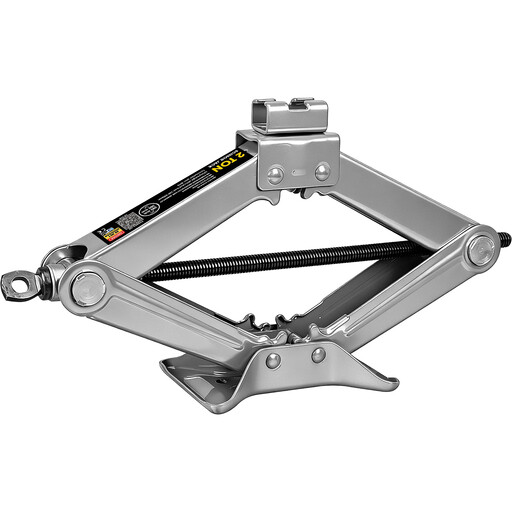
Why It Stands Out: The TCE T10202 scissor jack is the definition of a practical and reliable emergency tool. Its foldable design collapses to just 120mm, allowing it to be stored neatly in the boot without taking up valuable space. The high-strength steel construction and wide base provide stability, while the long crank handle makes lifting smooth and manageable.
Pros:
Who is it for? Every driver who wants a dependable, easy-to-store jack for roadside emergencies like a tyre change or for simple maintenance tasks at home.
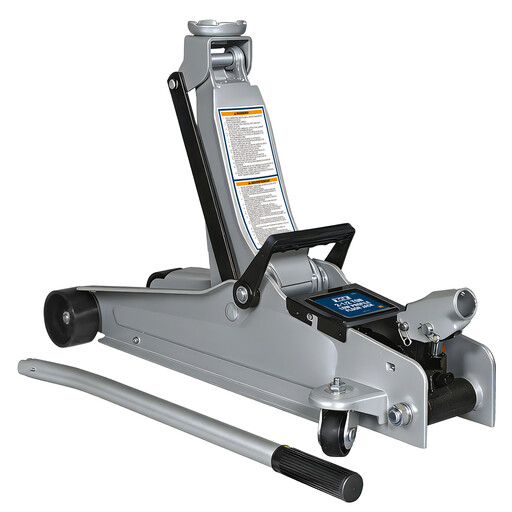
Why It Stands Out: Built specifically for vehicles that sit close to the ground, this hydraulic trolley jack features an impressive 85mm ultra-low entry height. This makes it a go-to choice for owners of supercars, performance cars and modified vehicles. Its heavy-duty steel structure ensures durability and stability under load, providing peace of mind during use.
Pros:
Who is it for? Primarily for owners of sports cars, performance models and other vehicles with very low ground clearance who need a reliable and robust lifting solution.
If the recommendations above don't quite match what you're looking for, or if you're interested in exploring other workshop equipment, we have a wider selection available. From different jack capacities to a variety of other automotive tools, you can find the right equipment for your garage.
Browse our full range of Tools and Fixings to find the perfect equipment for your needs.
For most standard UK vehicles like a Ford Focus, VW Golf or Vauxhall Corsa, a 2 ton jack provides ample capacity. These cars typically have a GVW well under 2 tonnes, and since a jack only lifts a fraction of that weight, a 2-ton rating offers a safe margin. However, always check your vehicle's owner's manual for its specific weight before purchasing.
A scissor jack is a mechanical jack that is lightweight, compact and operated with a manual crank. It's ideal for keeping in your car for emergencies. A hydraulic trolley jack is larger, sits on wheels, and uses a hydraulic pump to lift the vehicle with far less physical effort. It is more stable and better suited for regular use in a garage or workshop.
You will likely need a low profile car jack if you own a sports car, a performance saloon or any vehicle with lowered suspension. A quick way to check is to measure the distance from the ground to your car's official jacking point. If this clearance is less than about 120mm, a standard jack may not fit, and a low profile model is the correct choice.