
24/7 Customer Support

Free returns

Same-day & Next-day Delivery

Quality Guaranteed

Unlock Your Welcome Offers: FREE Delivery | Up to 80% OFF | Free 30-day JoyPlus trial
Download the APP
A flat battery or a soft tyre on a cold, damp morning is a frustration every UK driver dreads. While a portable car jump starter with air compressor seems like the perfect all-in-one solution, the market is flooded with options that can be confusing. Many devices promise immense power and features, but not all deliver when you need them most. Before you invest in this essential piece of emergency kit, it's crucial to understand the common pitfalls that lead to buyer's remorse.
Many drivers are caught out by three key issues:
This guide will help you navigate these traps, focusing on the practical specifications that matter for reliable performance on UK roads.
To choose a dependable emergency car starter, you need to look past the marketing hype and focus on a few core parameters. Understanding these will ensure you get a device that works for your vehicle, not just one that looks good on paper.
The single most important factor is whether the jump starter can handle your vehicle's engine. A portable car battery booster designed for a 1.2L petrol hatchback will not have enough power to turn over a 3.0L diesel van.
When comparing the battery life of a battery booster pack, you will often see capacity listed in milliamp-hours (mAh). However, this number can be misleading as it's often measured at a lower voltage (3.7V). A more accurate and standardised measure of a battery's total energy storage is Watt-hours (Wh).
A higher Wh rating means the device holds more energy, allowing for more jump starts or longer operation of its other features, like the torch or charging your phone. When comparing models, always look for the Wh rating for a true like-for-like comparison of its power reserve.
For a car jumper with tyre inflator to be truly useful, the compressor needs to be effective. Two figures determine its performance:
Based on these practical criteria, we've selected a few multi-functional jump starters that are well-suited for different types of UK drivers.
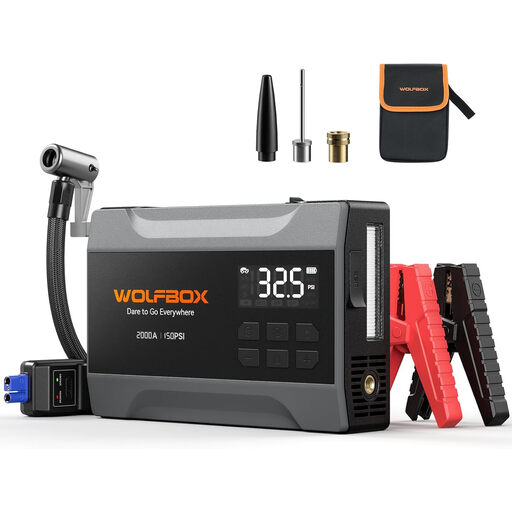
Why This Fits Their Persona: Ideal for drivers of small to medium-sized petrol cars (up to 5.0L). It's a compact and straightforward solution for common roadside issues like a dead battery on a frosty morning or a slow puncture discovered before the work commute.
Its specifications are clearly stated for smaller petrol engines, avoiding the trap of over-promising power. The 150 PSI compressor with auto-shutoff is a practical, reliable feature, not just a gimmick.
Combines two essential emergency functions in one compact unit that easily fits in the boot. The 37Wh capacity provides a solid power reserve for its intended use.
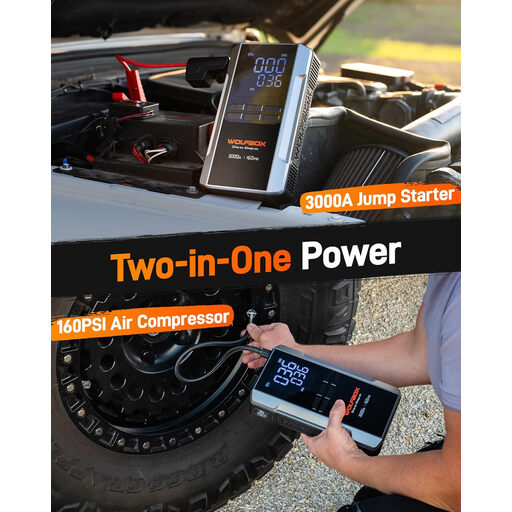
Why This Fits Their Persona: Perfect for drivers of larger petrol SUVs (up to 8.0L) or medium-sized diesel vehicles (up to 6.0L). Its higher power and larger battery (59.2Wh) offer peace of mind for family holidays and long-distance travel across the UK.
It provides a significant step up in power and battery capacity (Wh), matching its claims to the needs of larger vehicles. The 65W fast charge capability means the unit itself can be recharged quickly before a trip.
The combination of high jump-starting power, a robust 160 PSI compressor and a large battery capacity makes it a versatile and reliable tool for demanding situations.
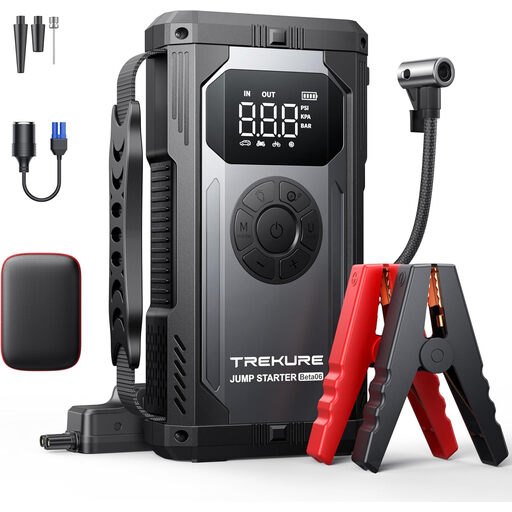
Why This Fits Their Persona: For van owners, 4x4 enthusiasts or those with large diesel engines (up to 10.0L). This unit is built for maximum power, capable of starting virtually any 12V car or van on the road, making it suitable for commercial use or serious off-roading.
This device backs up its high peak amp rating with a clear and impressive engine compatibility (up to 10.0L diesel), providing genuine heavy-duty capability. Its large 23800mAh battery and fast airflow (35 L/min) are built for serious work.
Unmatched starting power for 12V systems and a high-efficiency compressor. The inclusion of a 12V DC output socket also allows it to power other accessories like a car fridge, making it a true multi-purpose `portable power bank`.
We have compiled a complete, real-time list of products that fully satisfy these strict selection criteria and UK safety regulations.
With proper care, a quality 12v jump box should last between 3 to 5 years. To maximise its lifespan, it is recommended to recharge the unit at least once every 3 to 6 months, even when not in use. Storing it in a cool, dry place like your car's boot is ideal, but avoid exposing it to extreme temperatures for prolonged periods.
Yes, most modern lithium-ion jump starters are designed to operate in a wide range of temperatures, typically from -20°C to 60°C. They are safe to be stored in your vehicle year-round. However, be aware that extreme cold can temporarily reduce the battery's output. For maximum performance during a severe cold snap, it can be beneficial to bring the unit indoors the night before a journey.
For most drivers, yes. It combines the two most common roadside assistance needs—a dead battery and a flat tyre—into a single, compact device. This not only saves valuable space in your boot but is also more cost-effective than purchasing a separate portable car battery booster and a tyre inflator. It offers a complete and convenient solution for roadside peace of mind.