
24/7 Customer Support

Free returns

Same-day & Next-day Delivery

Quality Guaranteed

Unlock Your Welcome Offers: FREE Delivery | Up to 80% OFF | Free 30-day JoyPlus trial
Download the APP
A flat battery or a soft tyre on a cold, wet morning is a situation every UK driver dreads. While breakdown services are an option, being self-reliant saves time, money and stress. A car jump starter with air compressor is a popular all-in-one solution, but the market is flooded with devices making bold claims. Many buyers end up with a gadget that fails when it's needed most.
As a Joybuy Product Recommendation Officer, my role is to help you see past the marketing jargon. Before you buy, be aware of these common pitfalls that lead to wasted money and a false sense of security.
To ensure your all-in-one car emergency tool is up to the task, focus on these three core parameters.
The power you need is directly related to your vehicle's engine. A small petrol engine requires far less power to turn over than a large diesel one, especially in cold weather.
Don't just look at the PSI. For practical use on a car tyre, check for:
For a versatile jump starter power bank, consider its charging capabilities.
Based on these practical criteria, we've matched several models to different UK driver profiles.
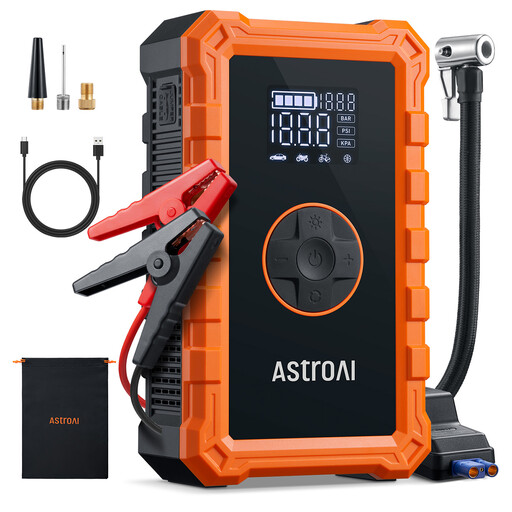
Why This Fits Their Persona: Ideal for drivers of standard UK family cars (e.g., Ford Focus, VW Golf and Nissan Qashqai). It offers a balanced combination of power and portability for daily commutes and school runs, without paying for overkill features.
It avoids the "peak amps illusion" with a realistic 1500A rating, suitable for its target engines (up to 6.0L petrol/3.0L diesel). The large 2.4" screen provides clear, real-time pressure readings, preventing the "blind inflation" problem.
The intuitive large screen and auto-shutoff compressor make it very user-friendly. Its compact design includes onboard storage for cables, keeping everything neat in the boot.

Why This Fits Their Persona: For families with larger vehicles like SUVs, people carriers or vans used for holidays and outdoor trips. This user needs a powerful and reliable unit that can handle bigger engines and provide robust safety features.
The 4500A peak current is genuinely capable of starting larger engines (up to 9.0L petrol/8.0L diesel), avoiding the trap of being underpowered. Its 10-layer smart protection system provides confidence, even for less experienced users.
Excellent power for a wide range of UK passenger and light commercial vehicles. The multi-mode 500-lumen LED light is genuinely useful for roadside repairs or as an emergency signal.
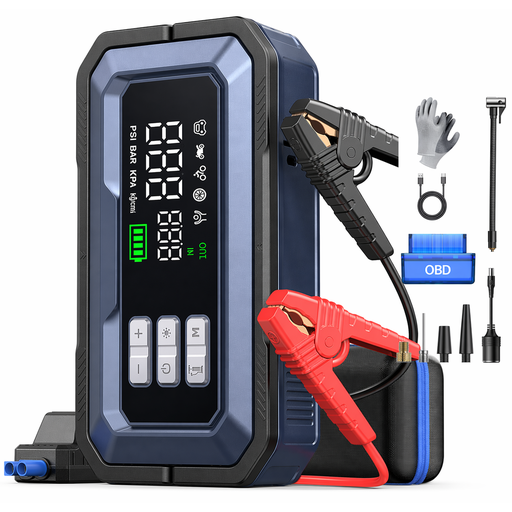
Why This Fits Their Persona: This is for the serious user with a large diesel van, motorhome or boat, or someone who wants a complete roadside assistance kit. They value maximum power and genuinely useful extra features beyond just jump-starting.
It delivers on its high-end promises. The 7000A peak current is backed by compatibility with diesel engines up to 14L. It includes a functional 160W DC output and an OBD2 fault code reader, features that are often just marketing gimmicks on lesser models.
Unmatched versatility. It's not just a jump starter; it's a mobile power station and a basic diagnostic tool, making it a comprehensive piece of emergency equipment.
We have compiled a complete, real-time list of products that fully satisfy these strict selection criteria and UK safety regulations.
The lifespan of the unit itself can be many years with proper care. The internal lithium battery is the main component that ages. Typically, you can expect the battery to perform well for 3 to 5 years or several hundred charge cycles. To maximise its life, it is crucial to recharge the unit at least once every 3 to 6 months, even if it hasn't been used. This prevents the battery from deep-discharging, which can cause permanent damage.
Yes, most models are designed to operate in a wide temperature range, often from -20°C to 60°C, making them suitable for year-round storage in a vehicle. However, be aware that extreme cold can temporarily reduce the battery's output. For optimal performance, it's a good practice to bring the unit indoors for a full charge before a long trip in winter. Also, most manufacturers advise against attempting a jump-start if the unit's own battery level is below 25%.
Yes, absolutely. It is highly recommended to give the device a full charge as soon as you receive it. Even if it arrives with some power, this initial full charge helps to calibrate the battery cells and ensures you have maximum power available for its first use in an emergency.