
24/7 Customer Support

Free returns

Same-day & Next-day Delivery

Quality Guaranteed

Unlock Your Welcome Offers: FREE Delivery | Up to 80% OFF | Free 30-day JoyPlus trial
Download the APP
A flat battery on a frosty morning or a low tyre pressure warning miles from the nearest service station are frustrations every UK driver can relate to. A car jump starter with air compressor seems like the perfect all-in-one solution, a compact gadget promising to rescue you from the most common roadside troubles.
However, the market is flooded with devices making bold claims. It's easy to end up with a product that fails when you need it most. As a Joybuy Product Recommendation Officer, my role is to help you see past the marketing jargon. Before you buy, be aware of these common purchasing pitfalls that can leave you with an unreliable gadget and out of pocket.
Many multifunction jump starters look similar, but their internal components and real-world performance can vary dramatically. Here are three key areas where shoppers often get misled.
You will see figures like 3000A, 5000A or even 7000A advertised prominently. This "peak amp" rating refers to the maximum current the device can discharge for a fraction of a second. While a higher number looks impressive, it's not the most important metric for starting a typical family car. A poorly designed unit with a high peak rating may still fail to deliver the sustained power—known as cranking amps—needed to turn over a cold engine. Focusing only on peak amps can lead you to buy an underpowered device for your vehicle.
Many products claim to inflate a tyre in "minutes." This is often based on inflating a small bicycle tyre, not a standard car tyre from flat. The crucial specification to look for is the airflow rate, measured in litres per minute (L/min). A higher L/min rate means faster inflation. Furthermore, the accuracy of the built-in pressure gauge and the reliability of the auto-shutoff feature are vital. An inaccurate gauge can lead to over- or under-inflated tyres, compromising your safety on the road.
The heart of any portable jump starter is its lithium-ion battery. Cheaper models often use lower-grade cells that lose their charge quickly, especially when left in a cold car boot over winter. More importantly, they may lack a full suite of safety protections. A quality 12v jump pack with compressor should include, at a minimum, protection against reverse polarity (connecting the clamps to the wrong terminals), short circuits and overheating. Without these, you risk damaging your car's electronics or the device itself.
To make an informed choice, focus on these three core parameters. They provide a much clearer picture of a device's true capability.
Instead of focusing on peak amps, check the manufacturer's stated engine compatibility. This is usually specified by engine size in litres (L) for both petrol and diesel. For example, a device rated for "up to 6.0L petrol and 3.0L diesel" gives you a practical measure of its power. Diesel engines require significantly more power to start, so always check the diesel rating if you own one. This ensures your chosen emergency car kit has the necessary strength.
Nearly every car battery booster with tyre inflator will claim a maximum pressure of 150 PSI. This is more than enough, as car tyres typically require only 30-40 PSI. The more practical figure, as mentioned, is the airflow rate (L/min). A rate of 35 L/min or higher is respectable for a portable unit and will inflate a standard car tyre in a reasonable time. Also, look for a clear digital display and an automatic shut-off function to prevent over-inflation.
Battery capacity is measured in milliamp-hours (mAh) or watt-hours (Wh). A higher capacity means more jump starts between recharges or more power to charge your devices. Many of these units double as a power bank with air compressor, featuring USB ports to charge phones and tablets. Check for modern charging ports like USB-C with Power Delivery (PD) for faster recharging of the unit itself and your other gadgets. A built-in LED torch with an SOS mode is also a standard and highly useful feature for any roadside assistance tool.
Based on these practical criteria, we've matched a few standout products to different UK driver profiles.
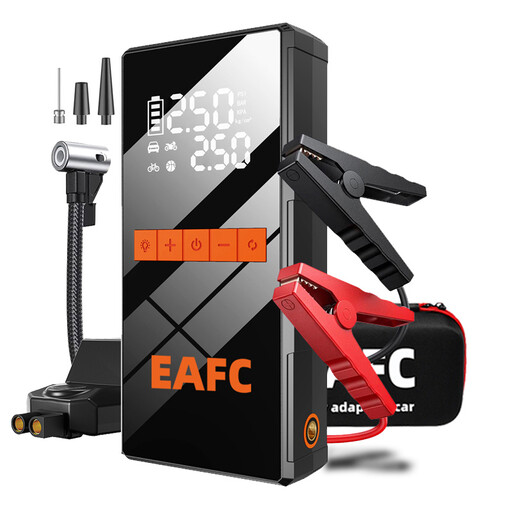
Why This Fits Their Persona: Ideal for drivers of small to medium-sized petrol cars (e.g., Ford Fiesta, VW Golf) who need a compact, no-fuss device for peace of mind on their daily drives. It's small enough to fit in a glovebox and covers the most common emergencies without over-the-top specifications.
It avoids the "peak amps" trap by clearly stating its suitability for smaller engines (up to 4.0L petrol/2.0L diesel), providing an honest performance expectation rather than an inflated number.
Its primary advantage is its compact size and affordability. It provides the essential 4-in-1 functions (jump start, compressor, power bank and torch) in a highly portable package.
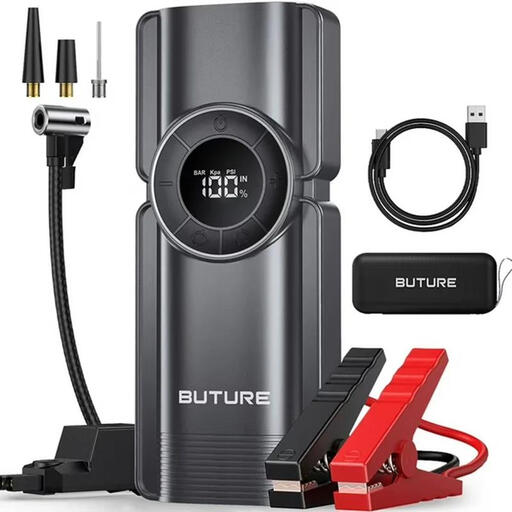
Why This Fits Their Persona: Perfect for those with larger family cars, SUVs or diesel MPVs. This user values reliability for long road trips and needs enough power to start a substantial engine, plus the ability to keep the kids' tablets charged.
It provides a clear and realistic engine compatibility rating (up to 8.5L petrol/8.0L diesel), giving confidence that it can handle more demanding vehicles, unlike weaker models with exaggerated claims.
Its strong starting power for both petrol and large diesel engines is a key benefit. The smart air compressor with presets and auto-shutoff adds a layer of convenience and safety for tyre maintenance on the go.
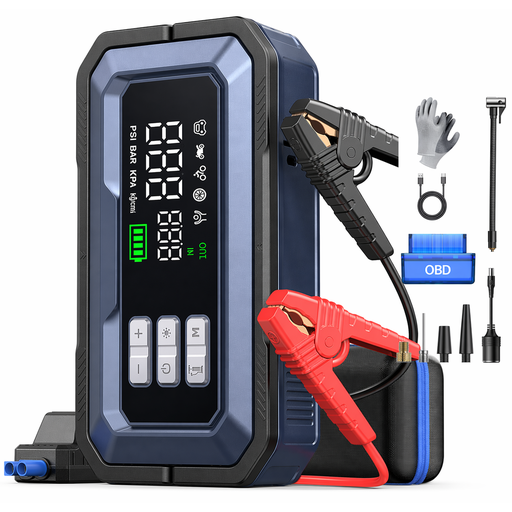
Why This Fits Their Persona: This is for the serious user—the van driver, the owner of a large 4x4 or the enthusiast who wants a complete diagnostic and emergency tool. Its ability to start huge diesel engines and read vehicle fault codes sets it apart.
It sidesteps the trap of useless features by including genuinely useful professional-grade functions. The OBD2 reader and powerful 160W DC output for running car accessories are practical tools, not gimmicks.
Its immense power (for diesel up to 14L) and multi-functionality are its core strengths. The inclusion of an OBD2 fault code reader transforms it from a simple emergency device into a valuable diagnostic tool.
We have compiled a complete, real-time list of products that fully satisfy these strict selection criteria and UK safety regulations.
The device itself can last for many years with proper care. The internal lithium battery, however, typically has a lifespan of 3-5 years or between 500 and 1000 charge cycles. Its longevity is influenced by how often it's used, its storage conditions (avoiding extreme heat or cold) and maintenance, such as recharging it every 3-6 months to keep the battery healthy.
Yes, most models are designed to operate within a wide temperature range, often from -20°C to 60°C. While they will function in the cold, a battery's efficiency can be reduced at very low temperatures. For optimal performance, it is a good practice to ensure the unit is fully charged before a long journey in winter. Storing it with a 50-75% charge is generally recommended for maintaining long-term battery health.
For the vast majority of UK passenger cars, a jump starter with a 3000A peak current is more than sufficient. This level of power can typically handle petrol engines up to around 8.0L and diesel engines up to 6.0L. For a standard family car with a 1.6L to 2.0L engine, even a 1500A model is often adequate. The most reliable method is to ignore the peak amp figure and instead check the manufacturer's recommended engine size compatibility.