
24/7 Customer Support

Free returns

Same-day & Next-day Delivery

Quality Guaranteed

Unlock Your Welcome Offers: FREE Delivery | Up to 80% OFF | Free 30-day JoyPlus trial
Download the APP
A dead battery or a flat tyre can turn a routine commute or a planned road trip into a stressful ordeal. While a car jump starter with air compressor seems like the perfect all-in-one solution, the market is filled with devices that over-promise and under-deliver. Many UK drivers invest in these gadgets for peace of mind, only to find them useless when an emergency strikes.
As the Joybuy Product Recommendation Officer, my role is to help you see past the marketing jargon. Before you make a purchase, let's look at the common traps that lead to buyer's remorse and how to identify a truly reliable roadside companion.
Many multi-function units fail on their core promises. Here are the three most frequent issues we see:
To ensure your emergency car tool kit is dependable, focus on these three non-negotiable parameters.
Instead of being swayed by peak amps, look for clear information on the engine sizes the device can handle. A reputable manufacturer will state its capability, for example, "Starts all petrol engines and up to 7.0L jump starter for diesel engines." This is a far more practical indicator of its real-world power than an isolated amp figure. For UK winters, a unit with robust cold-cranking ability is essential.
While the maximum pressure (150 PSI) is a useful metric, the speed of inflation is determined by the airflow rate, measured in Litres per Minute (L/min). A unit with an airflow below 20 L/min will be frustratingly slow. For practical use on car tyres, look for a model that offers at least 30-40 L/min. This ensures you can inflate a tyre from flat to full in minutes, not half an hour. An automatic shut-off feature, which stops the compressor once the target pressure is reached, is also a highly valuable convenience.
A reliable car battery booster pack with compressor must protect against user error and electrical faults. Do not purchase a unit without these core safety features:
In the UK, look for CE certification, which indicates the product meets health, safety and environmental protection standards. This is a fundamental mark of a product designed with user safety in mind.
We've analysed the market based on the critical factors above. Instead of a simple list, we match products to specific user needs.
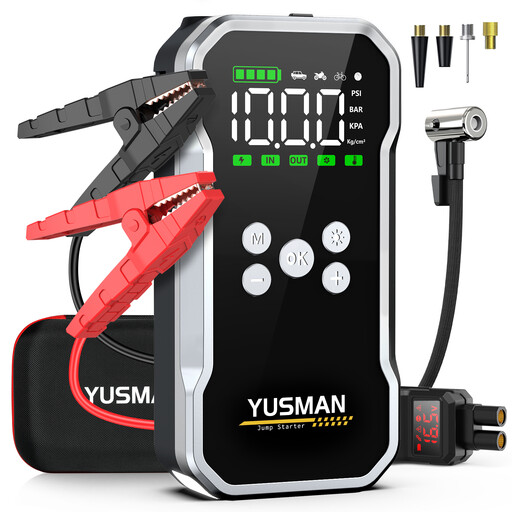
Why This Fits Their Persona: This is for the driver who wants a single, reliable device to handle the most common roadside emergencies. As a 4-in-1 multi-function jump starter, it combines a powerful starter, a fast compressor, a USB power bank with jump starter functionality and an emergency torch. It's ideal for families, commuters with older cars and anyone who values preparedness without cluttering their boot.
It directly addresses the pitfalls by specifying it can start up to 7L diesel engines, providing a clear power benchmark. The compressor boasts an airflow of 45 L/min, well above the minimum for practical use. It also features 10 intelligent protection systems and is CE certified, ensuring safety.
The combination of high starting power and a genuinely fast air compressor is its main strength. The inclusion of a durable storage case and multiple inflation nozzles adds significant practical value.
While a jump starter covers major emergencies, keeping your vehicle in top shape also involves routine care. For other versatile workshop essentials, you may want to explore our wider collections.
We have compiled a complete, real-time list of products that fully satisfy these strict selection criteria and UK safety regulations.
1. How long does a portable jump starter and air compressor hold its charge? A good quality unit can typically hold a significant charge for 3 to 6 months. However, we recommend checking the battery level and topping it up every 2 to 3 months to ensure it's ready when you need it, particularly before a long journey or during the colder winter months.
2. Can I use a car battery booster pack with a compressor on a completely dead battery? Yes, modern jump starters are designed for this purpose. Their effectiveness will depend on the unit's power output and your vehicle's engine size. Always refer to the manufacturer's specifications, which should clearly state the compatible engine types (e.g., "up to 7.0L diesel" or "all petrol engines").
3. Is a 150 PSI tyre inflator necessary for a car? Standard car tyres require between 30-40 PSI, so 150 PSI may seem excessive. This figure represents the compressor's maximum potential pressure, indicating its overall capability. The more important factor for practical use is the airflow rate (L/min), which determines how quickly it can inflate your tyre to the correct pressure. The high PSI rating simply confirms it has more than enough power for any car, motorcycle or bicycle tyre.