
24/7 Customer Support

Free returns

Same-day & Next-day Delivery

Quality Guaranteed

Unlock Your Welcome Offers: FREE Delivery | Up to 80% OFF | Free 30-day JoyPlus trial
Download the APP
A flat battery or a soft tyre can turn a routine commute into a roadside headache. While a car jump starter with air compressor seems like the perfect all-in-one solution, the market is flooded with devices that over-promise and under-deliver. Many UK drivers invest in a car emergency kit only to find it fails them when needed most.
As the Joybuy Product Recommendation Officer, my role is to help you see past the marketing jargon. Before you buy, be aware of these common pitfalls that lead to wasted money and continued frustration.
To make a smart purchase, focus on the technical details that determine real-world performance. Here are the three non-negotiable factors to check before you buy.
Ignore the headline peak amp figure for a moment and look for the starting current or specific engine compatibility. A reputable manufacturer will state the engine sizes it can handle, for example, "up to 8.0L petrol and 6.0L diesel."
While maximum pressure (PSI) is listed on every model, the airflow rate (LPM) is the true indicator of a tyre inflator's speed.
Also, look for features like an auto-shutoff function, which allows you to preset your desired tyre pressure (e.g., 35 PSI). The compressor will automatically stop when it reaches that pressure, preventing over-inflation.
The battery capacity, measured in milliamp-hours (mAh), determines how many times you can jump-start a car or charge your devices. A capacity of 15,000-27,000mAh is a solid range for a multi-function device.
Equally important are the built-in safety protections. A quality unit must include:
Based on these practical criteria, here are a few options tailored to different UK driver profiles.
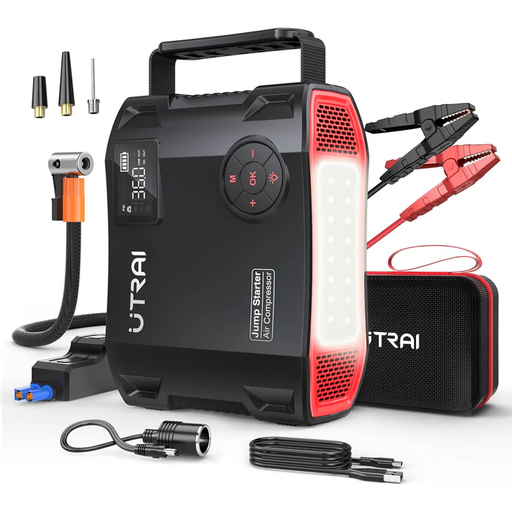
Why This Fits Their Persona: Ideal for tradespeople with diesel vans, owners of large SUVs or anyone who needs maximum power. Its high peak current and large battery capacity provide confidence for starting big engines, even in the cold.
It counters the "slow compressor" trap with a stated 45L/min airflow, ensuring rapid tyre inflation. It also clearly specifies its suitability for up to 10.0L diesel engines, moving beyond vague peak amp claims.
High-capacity 27000mAh battery and a powerful 160W DC output to run other 12V accessories like car vacuums or fridges. The LCD screen shows real-time tyre pressure during inflation.
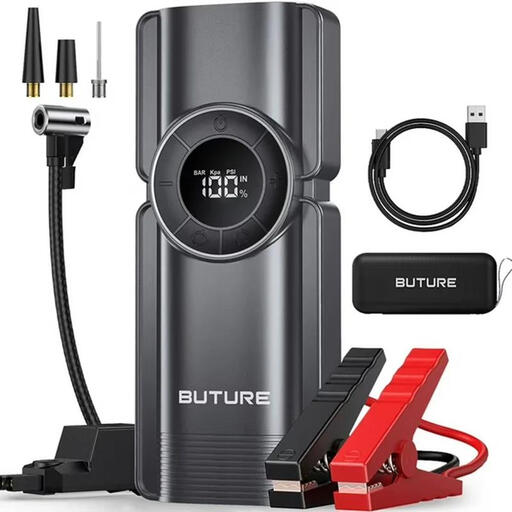
Why This Fits Their Persona: A great balanced choice for the average UK driver with a petrol or medium-sized diesel car or MPV. It provides ample power for most situations without the bulk of a larger unit, making it a practical addition to any car boot.
This model avoids ambiguity by stating its compatibility for up to 8.5L petrol / 8.0L diesel engines. Its compressor also features a preset pressure and auto-shutoff, preventing guesswork and over-inflation.
Features a clear LED display showing remaining battery and output status. The entire kit comes in a compact carry case, keeping all accessories organised and ready for use.
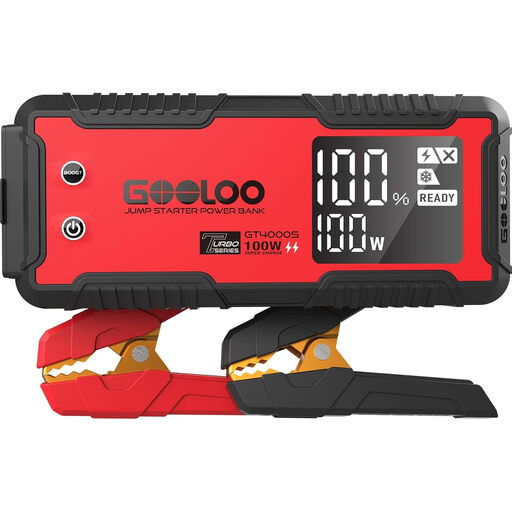
Why This Fits Their Persona: For the driver who prioritises powerful jump-starting capability and fast charging in a compact form, and may already own a separate tyre inflator. Its high power-to-size ratio is excellent for those with limited storage space.
This unit tackles the "dead battery" trap with its 100W two-way fast charging, allowing the jump starter itself to be recharged very quickly. It also boasts a long standby time, reducing the chance of finding it depleted.
Very powerful for its size, capable of starting up to 10.0L diesel engines. The 100W fast-charging port can also be used to rapidly charge compatible laptops and other devices.
We have compiled a complete, real-time list of products that fully satisfy these strict selection criteria and UK safety regulations.
To avoid the "dead when you need it" problem, it's good practice to recharge your jump starter every 3 to 4 months, even if you haven't used it. This helps maintain the battery's health and longevity. Some models with very low self-discharge rates may last longer, but it's always wise to check the manufacturer's specific recommendations and top it up before a long road trip.
No, this is a critical point. Diesel engines require much more power to turn over than petrol engines. You must select a jump starter that is explicitly rated for your vehicle's engine type and size. Look for a heavy duty jump starter with a high peak current (over 2500A) and a clear statement of diesel engine compatibility (e.g., "for up to 8.0L diesel engines"). Using an underpowered unit will likely fail to start the vehicle and could potentially damage the jump starter.
While a 150 PSI rating sounds impressive, it's not essential for car tyres, which typically require only 30-40 PSI. However, a high PSI rating often indicates a more powerful motor within the compressor. The more practical metric to focus on is the airflow rate (LPM). A higher LPM means faster inflation, which is far more valuable in a roadside emergency. A unit with a preset pressure function is also highly recommended for convenience and safety.