
24/7 Customer Support

Free returns

Same-day & Next-day Delivery

Quality Guaranteed

Unlock Your Welcome Offers: FREE Delivery | Up to 80% OFF | Free 30-day JoyPlus trial
Download the APP
A flat battery or a soft tyre can turn a routine commute into a roadside headache. While many UK drivers have breakdown cover, waiting for assistance isn't always practical. This is where a modern car jump starter with air compressor comes in, combining two essential emergency tools into one compact unit. However, the market is filled with confusing specifications and bold claims. Choosing the wrong one can mean you're left with a device that fails when you need it most.
As a Joybuy Product Recommendation Officer, my role is to help you navigate these choices. We'll look past the marketing hype and focus on the practical features that matter for UK drivers, ensuring you get a reliable tool for your emergency car kit.
Before looking at what to buy, it's crucial to understand what to avoid. Many shoppers are misled by a few common marketing tactics that result in a poor purchase.
To make an informed decision, focus on these three non-negotiable parameters.
This is the primary function. The power you need is directly related to your vehicle's engine size (in litres) and type.
As a general rule for a 12v jump starter, look for at least 1500A for small-to-medium petrol cars. For larger SUVs or diesel vehicles, a model with 3000A or more provides a much safer margin, especially in winter.
A useful tyre inflator needs more than just high pressure.
The internal battery powers everything. Its capacity, measured in milliamp-hours (mAh), determines how many jump-starts you can perform or how many times you can charge your phone.
A larger capacity (e.g., 20,000mAh or more) is always beneficial. Also, check the outputs. A good jump starter power bank will include USB-A and modern USB-C ports for charging devices and some premium models even feature a 12V DC output to power other car accessories.
Based on these practical criteria, here are a few options suited to different types of UK drivers.
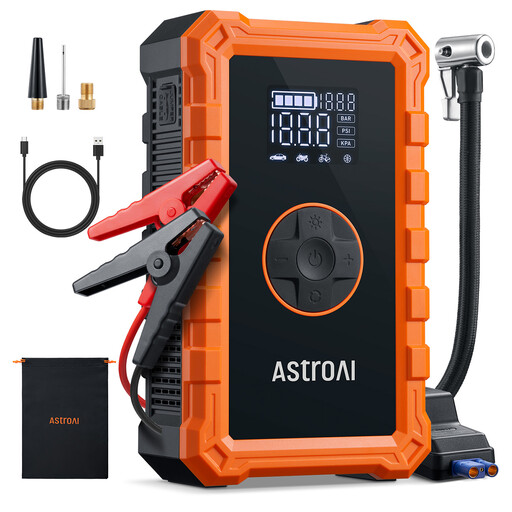
Why This Fits Their Persona: An excellent entry-level choice for drivers of small to medium-sized cars (e.g., Ford Fiesta, VW Golf). It provides sufficient power for most common petrol engines and basic tyre inflation without the cost of features you may not need.
It avoids the "peak amps illusion" by offering a realistic 1500A, which is genuinely suitable for its target vehicles (up to 6.0L petrol/3.0L diesel), rather than an inflated, unusable figure.
Features a large, clear 2.4" screen that makes it easy to use, even for those unfamiliar with such devices. The auto-shutoff compressor adds a layer of convenience not always found at this level.
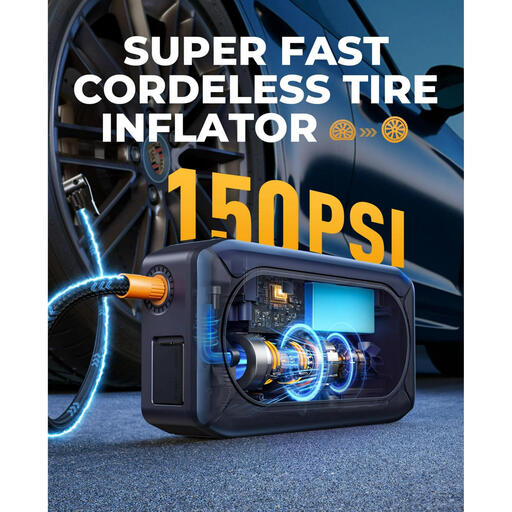
Why This Fits Their Persona: A powerful all-rounder for drivers of larger vehicles like a Nissan Qashqai, Ford Transit or Land Rover Discovery. The high starting power provides peace of mind for bigger petrol and diesel engines, making it ideal for family road trips.
This unit delivers a substantial 4500A peak current, easily overcoming the "underpowered all-in-one" pitfall. It's genuinely capable of starting engines up to 9.0L petrol or 8.0L diesel, as stated.
Its advanced cooling technology helps reduce heat buildup during operation, a common issue with powerful units. The comprehensive 10-layer safety system provides extra protection against user error.
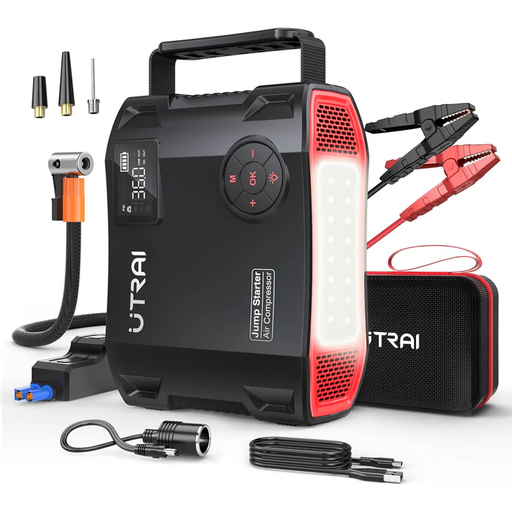
Why This Fits Their Persona: For the DIY enthusiast, van owner or professional who needs maximum power and versatility. This is more than a jump starter; it's a portable power station for the serious user who might need to run other 12V accessories.
It sidesteps the "limited function" trap by including a powerful 160W DC output. This allows it to power devices like portable fridges or car vacuum cleaners, making it a truly multi-functional tool.
Its 6000A peak current and 27,000mAh capacity are at the high end of the consumer market, providing confidence for starting very large engines. The fast 45L/min airflow also makes tyre inflation noticeably quicker.
We have compiled a complete, real-time list of products that fully satisfy these strict selection criteria and UK safety regulations.
To avoid the pitfall of a dead emergency device, it's good practice to recharge your jump starter every 3 to 4 months, even if you haven't used it. This maintains the battery's health. Some models with very low self-discharge rates may hold a charge for longer, but it's always wise to check the battery level before a long trip.
Yes, most modern lithium-ion jump starters are designed to operate in a wide range of temperatures, typically from -20°C to 60°C. They are built to be stored in a vehicle year-round. However, be aware that extreme cold can temporarily reduce any battery's effectiveness, which is why choosing a unit with more power than you think you need is a sensible precaution.
For the majority of drivers, the convenience and space-saving nature of an all-in-one jump starter is a significant advantage. It means one device to keep charged and one item to store in your boot. If you are a professional or have a specific need for a very high-performance air compressor for frequent, heavy use then separate devices might be more suitable. For roadside emergencies, a combined unit is hard to beat.