
24/7 Customer Support

Free returns

Same-day & Next-day Delivery

Quality Guaranteed

Unlock Your Welcome Offers: FREE Delivery | Up to 80% OFF | Free 30-day JoyPlus trial
Download the APP
A flat battery or a soft tyre can turn a routine journey into a roadside headache. While breakdown services are an option, waiting hours for assistance isn't always practical. This is why a multi-function car jump starter with an air compressor has become an essential piece of kit for UK drivers. This single device can get your engine running and your tyres inflated, offering peace of mind on daily commutes, family holidays and rural drives.
However, the market is flooded with options and it's easy to fall for marketing hype. As a Joybuy Product Recommendation Officer, my role is to help you see past the flashy numbers and identify the features that truly matter. Before you buy, be aware of these common purchasing pitfalls that can leave you with an unreliable gadget when you need it most.
To ensure you get a dependable emergency car starter, focus on the practical specifications, not just the headline figures. Here’s what to look for in a quality car booster pack with pump.
Instead of focusing solely on peak amps, check the manufacturer's recommended engine compatibility. A reputable brand will clearly state the maximum petrol and diesel engine sizes (in litres) the device can handle. For a typical family car in the UK (e.g., 1.6L petrol or 2.0L diesel), a unit rated for up to 6.0L petrol/3.0L diesel is more than adequate. If you drive a large van, SUV or motorhome with a bigger diesel engine, you will need a more powerful portable car battery booster with a higher rating.
A useful 12v jump starter and tyre inflator needs to be both powerful and fast.
The battery determines how much you can do on a single charge. Capacity is measured in milliamp-hours (mAh) or Watt-hours (Wh). A larger capacity means more jump starts or tyre top-ups. Equally important are the built-in safety protections. A reliable portable power pack for car must include safeguards against:
We've analysed the specifications of various models to match them with the real-world needs of UK drivers. Instead of a one-size-fits-all approach, here are our recommendations based on different user profiles.
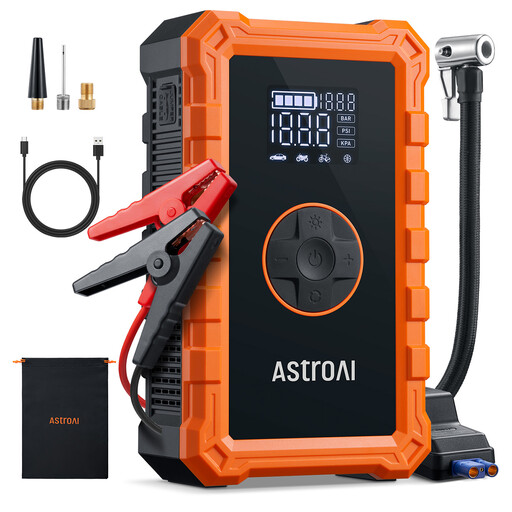
Why This Fits Their Persona: Ideal for owners of standard UK cars (hatchbacks, saloons and small SUVs) who need a reliable, no-fuss device for peace of mind. Its compact design fits easily in the boot or glove box.
It provides clear engine compatibility (up to 6.0L petrol/3.0L diesel), avoiding the "peak amps" illusion. The large 2.4" screen displays real-time pressure, making the compressor genuinely user-friendly.
The intuitive digital display simplifies operation for those who aren't car experts. It clearly shows battery level, operational status and tyre pressure, removing guesswork.
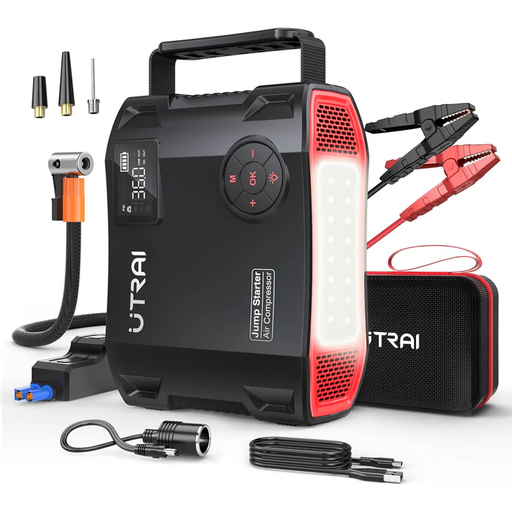
Why This Fits Their Persona: Built for owners of large vehicles like vans, motorhomes, 4x4s and boats. Its high power output is essential for starting large-capacity diesel engines, which are common in these vehicles.
It backs its 6000A peak claim with a specific 10.0L diesel engine rating and a high 45L/min airflow rate. This provides verifiable performance data, countering both the power and compressor speed traps.
Exceptional power for large engines and a very fast inflation speed. The 160W DC output is a significant bonus, allowing it to power other 12V accessories like portable fridges or work lights.
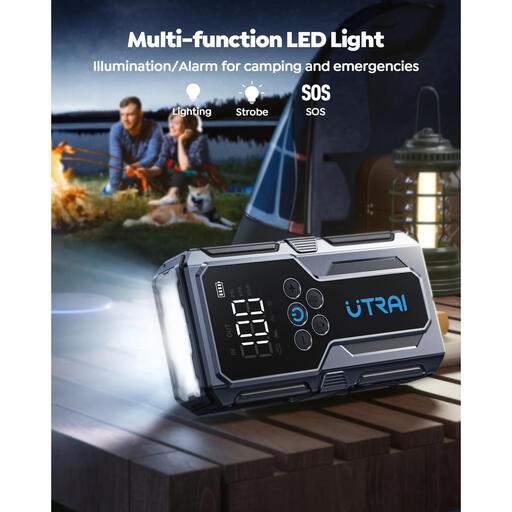
Why This Fits Their Persona: Perfect for campers, festival-goers and road-trippers who need more than just an emergency tool. It combines strong jump-starting power with a capable compressor and modern fast-charging ports for all their gadgets.
This model addresses the battery longevity trap by including multiple safety protections and highlighting its reliable standby performance. It offers a balanced feature set rather than overstating one single metric.
Its function as a high-capacity power bank with both USB and USB-C quick charge ports makes it a true all-in-one solution for staying powered up while away from mains electricity.
We have compiled a complete, real-time list of products that fully satisfy these strict selection criteria and UK safety regulations.
The lifespan of a quality unit is typically between 3 to 5 years, but this depends heavily on maintenance. The internal lithium battery requires care. To preserve its health and ensure it's ready when needed, you should recharge the device every 3 to 6 months, even if it hasn't been used.
Yes, most models are designed to be stored in a vehicle and have a wide operating temperature range (e.g., -20°C to 60°C). While it is safe to leave in your car, be aware that extreme cold can temporarily reduce the battery's output. For the most effective jump start in freezing conditions, it can be beneficial to bring the unit indoors to warm to room temperature before use.
For the majority of petrol cars (up to 6.0L engines) and smaller diesel cars (up to 3.0L engines) on UK roads, a 1500A peak current jump starter is generally sufficient. However, if you own a vehicle with a large diesel engine, such as a commercial van, a large SUV or a motorhome, it is advisable to select a more powerful model with a peak current of 2500A or higher for reliable starting, particularly in cold weather. Always refer to the manufacturer's stated engine size compatibility.