
24/7 Customer Support

Free returns

Same-day & Next-day Delivery

Quality Guaranteed

Unlock Your Welcome Offers: FREE Delivery | Up to 80% OFF | Free 30-day JoyPlus trial
Download the APP
A flat battery on a cold, dark morning is a familiar frustration for many UK drivers. But what happens when you also discover a flat tyre? Being stranded by either issue is inconvenient; being hit by both can ruin a day. This is where a multi-functional car jump starter with air compressor comes in, promising a single solution for multiple roadside woes.
However, the market is flooded with devices that make bold claims but often fail when you need them most. Many drivers find themselves with a gadget that can't start a cold diesel engine or a compressor that overheats after inflating half a tyre. Before you invest in this essential piece of your emergency car kit, it's crucial to understand the common pitfalls that lead to wasted money and continued vulnerability on the road.
To choose a reliable portable jump starter with tyre inflator, you need to look beyond the headline numbers and focus on the specifications that determine real-world performance.
Understanding the power of a jump starter is key. While Peak Amperage (PA) is the most advertised number, it's the Cranking Amps (CA) or starting current that truly matters. This is the power the unit can deliver consistently for several seconds to get your engine running. For UK drivers with larger SUVs, vans or those needing a heavy duty jump starter for diesel engines, a higher starting current is non-negotiable. A unit with a genuinely high peak current, like a 6000A car battery booster, should be backed by a substantial battery capacity to deliver effective cranking power.
For the air compressor function, two figures are important:
The battery is the heart of the device. A larger capacity, measured in milliamp-hours (mAh), means more power in reserve for multiple jump starts or for use as a portable power pack with compressor to charge your devices. Pay attention to the rated capacity, which is often lower than the advertised battery capacity but gives a more realistic measure of usable energy. Modern units using LiFePO4 (Lithium Iron Phosphate) batteries often provide more charge cycles, better temperature stability and enhanced safety compared to older lithium-ion types, making them a durable choice for a tool stored in a vehicle.
We've analysed the market to find options that address the common pitfalls and deliver on their promises. Instead of a simple list, we've matched our recommendations to specific UK driver profiles.
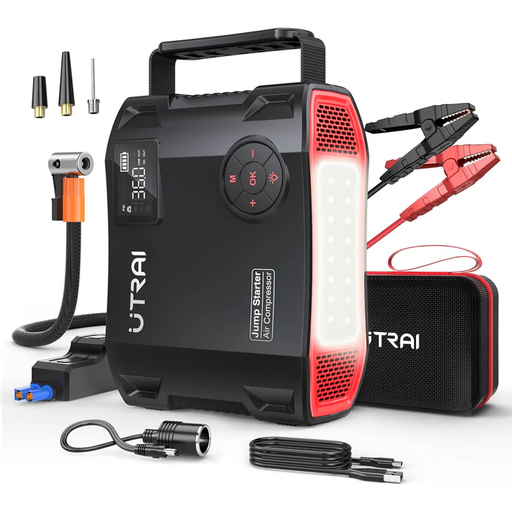
Why This Fits Their Persona: This is the complete solution for UK families, campers and SUV owners who want total peace of mind. It combines a powerful jump starter with a genuinely functional air compressor, covering the two most common roadside emergencies in one robust unit.
It counters the weak compressor pitfall with a high 45L/min airflow, inflating tyres quickly without overheating. The 6000A peak current is supported by a large 27,000mAh battery, providing genuine starting power for large petrol and diesel engines up to 10.0L.
True all-in-one functionality. Features a powerful 160W DC output to power other 12V accessories like car vacuums or portable fridges and a bright 1600-lumen LED work light.
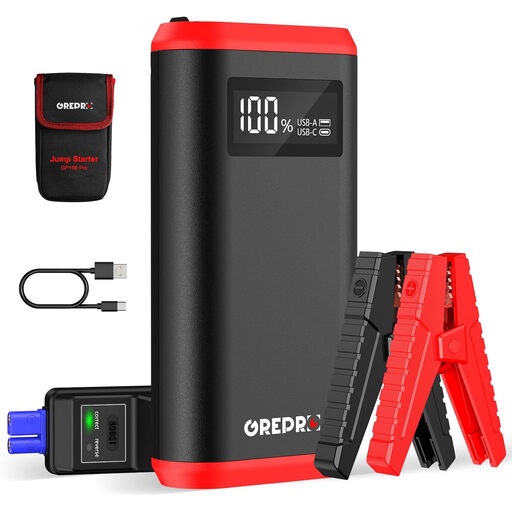
Why This Fits Their Persona: Ideal for owners of large diesel trucks, vans or RVs (up to 8.0L diesel) where maximum cranking power is the absolute priority. This user likely already has a dedicated tyre inflator and needs a specialised tool for starting the most demanding 12V engines.
It avoids the "peak amps" illusion by focusing its design on one job: delivering a powerful and reliable starting current for large-displacement engines. It doesn't compromise its core function with other integrated tools, ensuring all its power is dedicated to jump-starting.
Specialised high-amperage output for engines up to 10.0L petrol and 8.0L diesel. The clear LCD screen provides precise power level information, avoiding the guesswork of simple LED indicators.
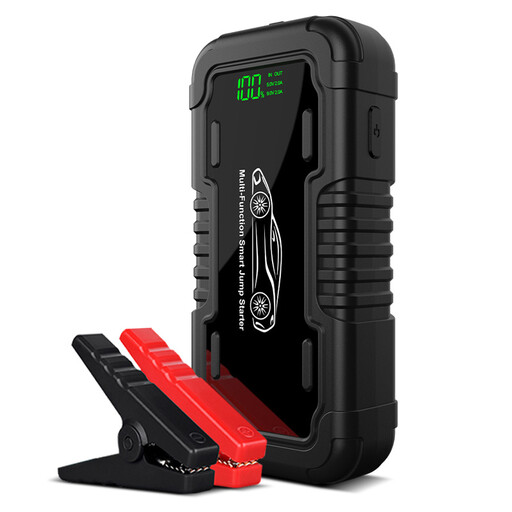
Why This Fits Their Persona: Perfect for the daily commuter with a standard petrol or smaller diesel car. This user values a compact design that fits in a glovebox and doubles as a high-capacity, fast-charging power bank for their phone, tablet and other gadgets on the go.
It sidesteps the "useless power bank" pitfall by incorporating genuine QC3.0 18W fast charging. Its large 20,000mAh battery (16,000mAh rated) ensures it can fully charge multiple devices and still have ample power for a jump start.
Excellent balance of power and portability. The 2000A peak current is more than sufficient for most passenger cars, while its compact form factor and fast-charging outputs make it a highly practical daily companion.
We have compiled a complete, real-time list of products that fully satisfy these strict selection criteria and UK safety regulations.
A quality unit should provide reliable service for 3 to 5 years, or even longer with proper care. The lifespan is primarily determined by the battery's health and the number of charge cycles it endures. To maximise its life, it is highly recommended to recharge the device every 3 to 4 months, even if it hasn't been used. This prevents the battery from deep discharging and maintains its ability to hold a charge.
Yes, these devices are designed to be stored in a vehicle. Look for models that specify a wide operating temperature range, such as -20°C to 60°C, which is suitable for UK climate extremes. While they are built to withstand the cold, be aware that battery performance can decrease in very low temperatures. For this reason, always ensure the unit is fully charged before the winter months and if possible, store it in the passenger cabin rather than the boot during severe cold snaps.
While a 6000A car battery booster would have no trouble starting a Ford Fiesta, it is significantly more powerful than what is required for a small petrol engine. A more compact and affordable unit with a peak current between 1200A and 2000A would be perfectly adequate. However, opting for a higher-amperage model offers benefits such as more jump-starting attempts on a single charge and the versatility to assist friends or family with larger vehicles.