
24/7 Customer Support

Free returns

Same-day & Next-day Delivery

Quality Guaranteed

Unlock Your Welcome Offers: FREE Delivery | Up to 80% OFF | Free 30-day JoyPlus trial
Download the APP
A flat battery or a soft tyre can turn a routine journey into a stressful ordeal, leaving you stranded and waiting for roadside assistance. A multi-function car jump starter with air compressor seems like the perfect all-in-one solution. However, the market is filled with devices that promise much but deliver little, leading to wasted money and a false sense of security.
As a Joybuy Product Recommendation Officer, my role is to help you navigate the technical jargon and marketing hype. This guide focuses on the critical features that matter, helping you avoid common purchasing mistakes and find a reliable tool for your emergency car kit.
Many UK drivers invest in these gadgets only to find them useless when needed most. Here are the most common traps to watch out for:
To ensure you get a device that works, focus on these non-negotiable specifications.
The power of a portable car battery booster is its ability to deliver a strong burst of current.
A jump starter with tyre inflator is only as good as its compressor.
The internal battery is the core of the unit, functioning as a power bank with jump starter.
Instead of a single "best" model, the right choice depends on your specific needs and vehicle. Here are our recommendations matched to different UK driver profiles.
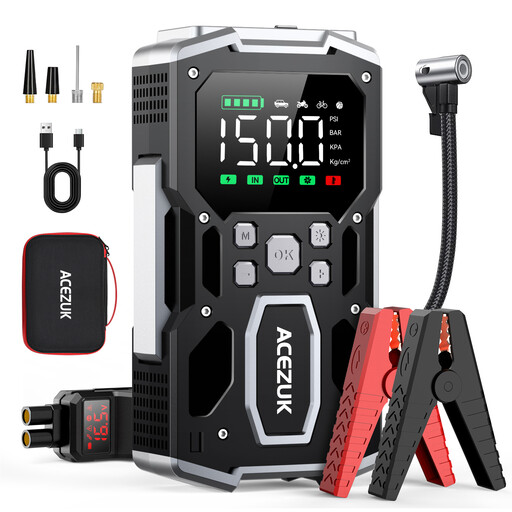
Why This Fits Their Persona: This user wants a single, powerful device to handle any common roadside issue. The ACEZUK M03 combines a high-amperage jump starter with a capable air compressor, a power bank and an emergency light, making it a complete emergency solution for family cars, SUVs and vans.
Its 7000A peak current is backed by compatibility with large diesel engines (up to 8.0L), avoiding the "inflated amps" pitfall. The compressor is specified to inflate a standard tyre in 6 minutes, indicating a practical flow rate, not just a high PSI rating.
True 4-in-1 Functionality: A powerful jump starter, a fast air compressor, a QC3.0 fast-charging power bank and a multi-mode LED torch. The clear LCD screen shows real-time air pressure and battery status.
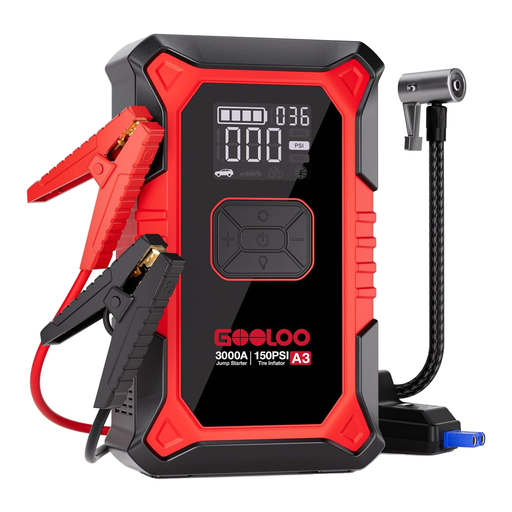
Why This Fits Their Persona: Ideal for drivers of small to mid-sized petrol or diesel cars who value user-friendliness. The GOOLOO A3 offers ample power for most UK vehicles and features pre-set inflation modes (car, bike, ball) that simplify the process of topping up tyres.
It tackles the "impractical compressor" issue with a specified 35L/Min airflow and a claim of inflating a tyre from 30 to 36 PSI in one minute. This focus on speed, not just pressure, is a sign of a well-engineered compressor.
User-Friendly Interface: The smart LED screen and pre-set inflation modes make it very easy to use, even for someone not technically inclined. It also includes a "BOOST" function for starting vehicles with extremely low battery voltage.
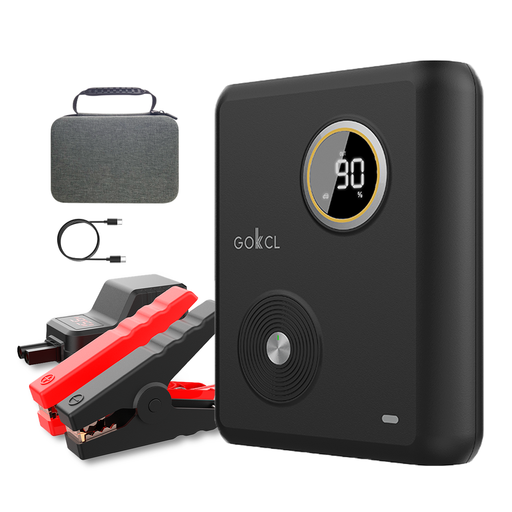
Why This Fits Their Persona: This user prioritises the jump-starting function above all else. They want a device that is guaranteed to work after years of storage, even in extreme UK weather. While it lacks a compressor, its advanced battery technology is its standout feature.
It directly solves the "poor battery standby" pitfall. The sodium-ion battery has a very low self-discharge rate, with the manufacturer stating a 5-year standby time. This makes it a true "store and forget" emergency tool, unlike many lithium-ion models.
Exceptional Durability: Operates in a very wide temperature range (-40°C to 80°C) and offers a vastly longer cycle life (6,000+ cycles) than lithium batteries. It can also be recharged from 0V, a state that can permanently damage lithium cells.
Many modern emergency tools feature a clear LED power display to keep you informed. We have compiled a complete, real-time list of products that satisfy these strict selection criteria and UK safety regulations.
This varies significantly. Most standard lithium-ion models should be checked and topped up every 3 to 6 months to ensure they are ready for use. However, newer technologies are changing this. For example, models with sodium-ion batteries have a much lower self-discharge rate and can potentially hold a usable charge for several years, requiring far less maintenance. Always refer to the manufacturer's specific recommendations.
Yes, most are designed for this. However, extreme cold can temporarily reduce a battery's efficiency. It is wise to choose a model with a good operational temperature range (e.g., down to -20°C). During prolonged, severe cold snaps, storing the unit in the cabin rather than the boot can help preserve its performance.
Not at all. Think of the peak amperage as a safety margin. A higher rating does not mean the device will damage your car's electronics; the starter will only draw the amount of current it needs. Having a more powerful unit provides peace of mind, ensuring it can handle your car's needs even when the battery is very low or on a particularly cold day. It is always better to have more power than you need than not enough.