
24/7 Customer Support

Free returns

Same-day & Next-day Delivery

Quality Guaranteed

Unlock Your Welcome Offers: FREE Delivery | Up to 80% OFF | Free 30-day JoyPlus trial
Download the APP
A flat battery or a soft tyre can turn a routine drive into a roadside headache. While a combined car jump starter with air compressor seems like the perfect all-in-one solution, the market is filled with devices that over-promise and under-deliver. Many UK drivers invest in an emergency tool only to find it fails when needed most.
As the Joybuy Product Recommendation Officer, my role is to help you see past the marketing clutter. Before you buy, be aware of these common purchasing pitfalls that catch out even savvy shoppers:
To ensure your investment is a reliable one, focus on the practical specifications that matter for UK driving conditions. This will help you choose a dependable emergency car tool kit that works when you need it.
This is the single most important factor for the jump-starting function. Don't just look at the number; match it to your vehicle's engine.
The internal battery determines the device's lifespan, safety and how often you need to charge it.
For the 12v jump starter with tyre inflator function, look beyond the maximum PSI.
Based on these practical criteria, here are a few options tailored to different types of UK drivers.
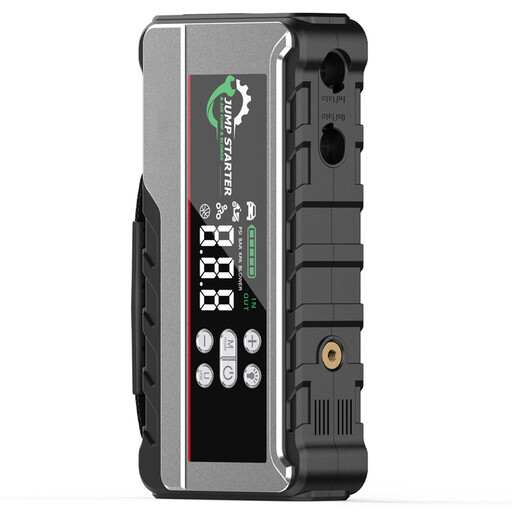
Why This Fits Their Persona: This is a strong all-rounder for the majority of UK cars, including family SUVs and standard diesel models. Its 3000A peak current provides ample power, and the PD65W fast-charging output means it doubles as a genuinely useful power bank for laptops and tablets on family trips.
It offers a realistic 3000A peak current, sufficient for most UK vehicles, avoiding the trap of underpowered units with inflated marketing numbers. The 150 PSI compressor is functional for typical tyre pressures.
The inclusion of PD65W fast charging makes it highly versatile for powering modern electronics, not just starting your car. It also features an air blower function for inflatables.
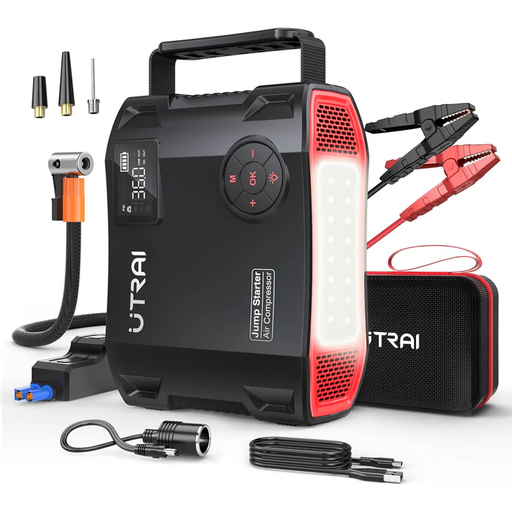
Why This Fits Their Persona: If you drive a large diesel van, 4x4 or even a vehicle with an engine up to 10.0-litre, you need serious power. This unit's 6000A peak current is designed for exactly that, providing the grunt needed to start large, stubborn engines without hesitation.
It directly counters the 'Peak Amp Myth' by delivering genuine high-end power. Its compressor also avoids the 'High PSI' trap with a specified 45L/min airflow, ensuring fast inflation for large tyres.
Unmatched starting power for large engines and a fast, high-airflow compressor. The 160W DC output can also power other 12V accessories like a car fridge or vacuum cleaner.
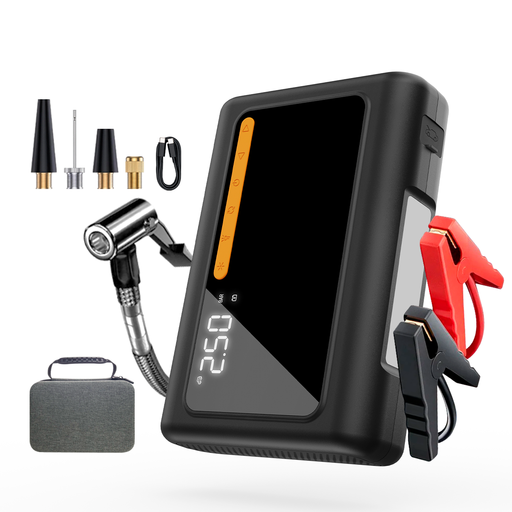
Why This Fits Their Persona: For the driver who values ultimate reliability and minimal maintenance. The innovative sodium-ion battery can be left in the car for years without needing a top-up charge and it operates safely in extreme temperatures where lithium units can struggle or become hazardous.
It completely sidesteps the 'Store and Forget' fallacy. With a claimed 5-year standby time and a ~1% monthly self-discharge rate, it's designed to be a truly maintenance-free emergency tool.
Superior safety and longevity. The sodium-ion chemistry is inherently more stable and less prone to fire risk than lithium and it can be fully discharged to 0V and recharged without permanent damage.
We have compiled a complete, real-time list of products that fully satisfy these strict selection criteria and UK safety regulations.
The lifespan depends on the battery technology and usage. A typical lithium-ion unit may last 3-5 years, but its performance can degrade, especially if not recharged regularly. Models with sodium-ion batteries are designed for a much longer lifespan, with some manufacturers claiming up to 6,000 charge cycles, potentially lasting 10 years or more with minimal degradation.
You can, but it's important to check the manufacturer's specified operating temperature range. Standard lithium-ion batteries can lose significant charge and performance in freezing temperatures. For peace of mind, look for a model with a wide operating range (e.g., -20°C to 60°C). Devices with sodium-ion batteries are particularly well-suited for this, as they remain stable and effective in temperatures as low as -40°C.
For most modern diesel cars and SUVs in the UK (typically with engines up to 6.0-litre), a 3000A jump starter should provide sufficient power. However, if you own an older diesel vehicle, a large commercial van or live in an area with particularly cold winters, opting for a more powerful unit (4000A or higher) is a sensible precaution to ensure a reliable start every time.