
24/7 Customer Support

Free returns

Same-day & Next-day Delivery

Quality Guaranteed

Unlock Your Welcome Offers: FREE Delivery | Up to 80% OFF | Free 30-day JoyPlus trial
Download the APP
A flat battery and a low tyre can turn a routine commute into an expensive recovery call. A car jump starter with air compressor combines two useful emergency tools in one portable unit, but headline figures can be misleading if you do not check compatibility, charging requirements and inflation performance.
Before choosing a portable car battery booster, watch for these common buying pitfalls.
A high peak-current figure does not automatically mean the unit suits every vehicle. Petrol and diesel engines place different demands on a starter, while larger SUVs, vans and older vehicles may require more starting support.
Always check the stated limits for engine size and fuel type. Also confirm that the product is designed for a 12V system. A 12V jump starter should not be connected to a 24V heavy-duty vehicle or a 6V system.
A rating such as 150 PSI tyre inflator describes the maximum pressure the compressor may reach; it does not tell you how quickly it inflates a normal car tyre. Look for airflow information, pressure presets, automatic shut-off and the manufacturer’s stated inflation example.
For regular UK cars, the recommended pressure is usually far below 150 PSI. The useful features are accurate monitoring and stopping at the selected pressure, rather than the largest number printed on the box.
Lithium battery packs gradually lose charge while stored. A jump starter power bank left in a boot for months may not have enough power when needed, particularly after cold weather. Choose a model with a digital display jump starter screen or clear battery indicator, then check and recharge it periodically according to the instructions.
Do not leave the unit in direct sunlight or near heat sources. A boot organiser or protective case can help keep the clamps, air hose and charging leads together.
Check the manufacturer’s listed petrol and diesel capacity rather than relying only on the peak amperage. For example, the ACEZUK M03 is listed for 12V vehicles, including petrol engines and diesel engines up to 8.0 litres. The WOLFBOX 2000A model is specified for petrol engines up to 5.0 litres but is not suitable for diesel vehicles.
If you drive a family SUV, pick-up or small van, allow some margin between your engine size and the product’s stated limit. For occasional use on a small petrol car, a compact battery booster pack may be sufficient.
A suitable tyre inflator and jump starter should have:
The ACEZUK M03 includes a 150 PSI compressor, pressure monitoring and selectable PSI, bar, kPa and kg/cm² units. The TREKURE Beta07 lists a 160 PSI compressor, five preset pressure modes and an airflow figure of 45 litres per minute. These specifications are more useful for comparison than maximum PSI alone.
Never inflate a tyre beyond the vehicle manufacturer’s recommended pressure. Check the pressure information in the vehicle handbook, fuel flap or door frame.
Useful safeguards include reverse-polarity protection, short-circuit protection, over-current protection and over-temperature protection. These features reduce the risk of incorrect connection, but they do not replace careful operation.
Before using any car emergency starter:
An LED emergency light with steady, strobe or SOS modes is helpful for roadside visibility. USB outputs can charge a phone, making a USB car charger function useful on long journeys. Check the charging input as well: USB-C fast charging can reduce the time needed to prepare the unit for use.
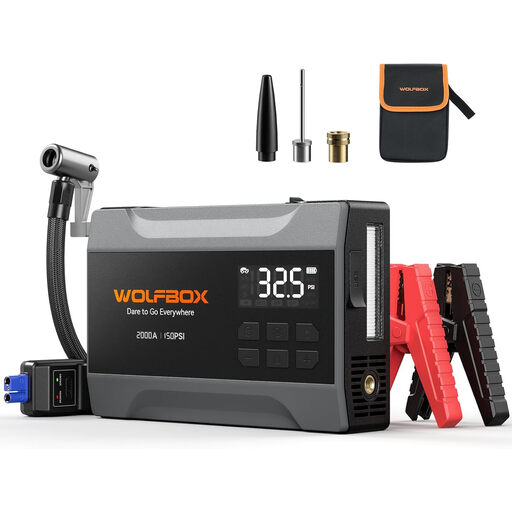
Why This Fits Their Persona: A practical option for drivers with a 12V petrol car up to 5.0L who want one compact device for occasional starting support and tyre top-ups.
The specification clearly states that it is not suitable for diesel or 24V systems, avoiding vague compatibility assumptions. Its automatic pressure shut-off helps prevent over-inflation.
150 PSI maximum inflator rating, 12V jump-start function and LED illumination with SOS mode.
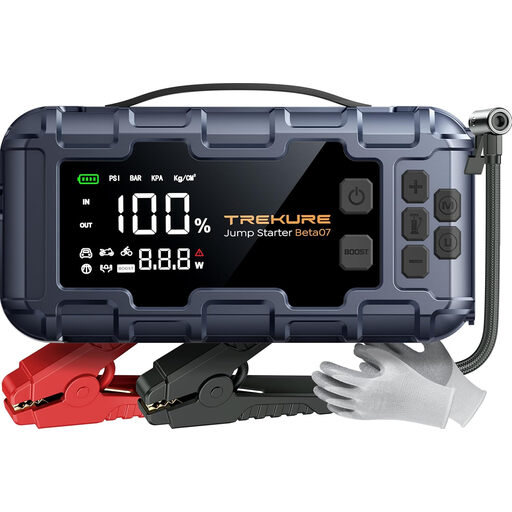
Why This Fits Their Persona: Suits commuters and families who value a larger display, faster device charging and additional roadside accessories.
It provides stated compressor airflow, preset modes and a 3.3-inch display rather than relying on a PSI figure alone. The listed protection features address common connection and charging risks.
160 PSI compressor, 45W USB-C PD input/output, dual USB-A ports and a 600-lumen LED light.
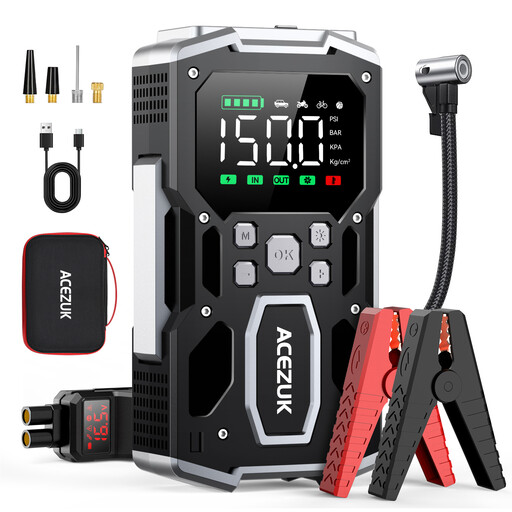
Why This Fits Their Persona: A multi-function choice for long-distance motorists, SUV owners and drivers who want starting, inflation, lighting and device charging in one unit.
The product listing specifies 12V compatibility, engine limits, pressure units and automatic pressure monitoring, making it easier to match the device to your vehicle.
7000A peak current, 150 PSI compressor, LCD pressure display and two fast-charging USB outputs.
We have compiled a complete, real-time list of products that fully satisfy these strict selection criteria and UK safety regulations.
Keep the unit charged and inspect the clamps, cable and air hose before travelling. Inflate tyres with the vehicle parked safely away from traffic, and allow the compressor to cool between extended sessions. A jump starter is an emergency aid, not a replacement for a worn battery, damaged tyre or professional roadside assistance.
Some can, but not all. Check the product’s stated diesel engine limit. The ACEZUK M03 lists diesel support up to 8.0L, while the WOLFBOX 2000A listed above is specified for petrol engines only.
Follow the supplied instructions. If the device is stored for a long period, check its battery indicator regularly and recharge it before journeys. Avoid storing it in extreme heat or leaving it completely discharged.
Inflation uses considerable power, especially when raising a tyre from very low pressure. The time required depends on tyre size, starting pressure and compressor output. Recharge the unit after substantial use and do not run the compressor continuously beyond its stated operating guidance.