
24/7 Customer Support

Free returns

Same-day & Next-day Delivery

Quality Guaranteed

Unlock Your Welcome Offers: FREE Delivery | Up to 80% OFF | Free 30-day JoyPlus trial
Download the APP
By Joybuy Product Recommendation Officer
A car jump starter with air compressor can cover several roadside problems in one compact device: a flat 12V battery, under-inflated tyres, a low phone battery and poor visibility after dark. For UK drivers, it may be particularly useful during winter commutes, long motorway journeys and trips where roadside assistance is not immediately available.
However, headline figures do not tell the whole story. A portable car jump starter needs to match your vehicle, remain charged in storage and provide practical controls when you are standing beside a car in rain or darkness.
A large peak-current figure may look impressive, but it does not automatically mean a product is suitable for every vehicle. Check the stated compatibility for 12V petrol and diesel engines, including the maximum engine size. A device designed for a small petrol car may not be appropriate for a large diesel van.
Also check whether the manufacturer specifies a minimum charge level before use. Many battery booster packs require the unit to be charged before an emergency, rather than being left in the boot until needed.
A portable tyre inflator advertised as 150 PSI can reach a high maximum pressure, but normal car tyres are generally inflated to a much lower vehicle-recommended pressure. Inflation speed, hose design, display accuracy and automatic shut-off are more useful shopping considerations.
Look for a digital pressure display, selectable units such as PSI, bar or kPa and a preset function. Always use the pressure shown in your vehicle handbook or on the tyre information label, rather than the compressor’s maximum rating.
Jump starters and compressors generate heat. A product may be compact, but continuous inflation can require rest periods. For example, the AstroAI S8 AIR advises a 10-minute rest after 10 minutes of compressor operation, while its air tube may remain hot after use.
Check the instructions for:
A carrying case, built-in accessory storage and smart safety clamps can be more useful than an extra attachment that you are unlikely to use.
Choose a 12V jump starter that exceeds your vehicle’s stated requirements. Petrol and diesel engines have different starting demands, and diesel vehicles often need a higher-capacity unit. Owners of SUVs, vans, pick-ups and larger engines should compare the stated litre capacity carefully.
A high peak-current rating can provide additional headroom, but it should be considered alongside clamp quality, cable thickness, battery capacity and the manufacturer’s vehicle guidance.
For regular tyre top-ups, prioritise:
The maximum pressure alone does not show how quickly a tyre will inflate. Some models state airflow figures such as 25L/min or 45L/min, but actual results can vary according to tyre size, starting pressure and operating conditions.
Battery capacity is commonly shown in mAh, while some products also list watt-hours. These figures should not be compared without considering voltage and rated capacity. A jump starter power bank with USB outputs may charge a phone, but that does not mean it can run high-draw equipment continuously.
Useful additional features include:
CE and RoHS markings may appear on products, but buyers should still follow the supplied instructions and check the product’s stated vehicle compatibility. These labels should not be treated as a substitute for safe operation.
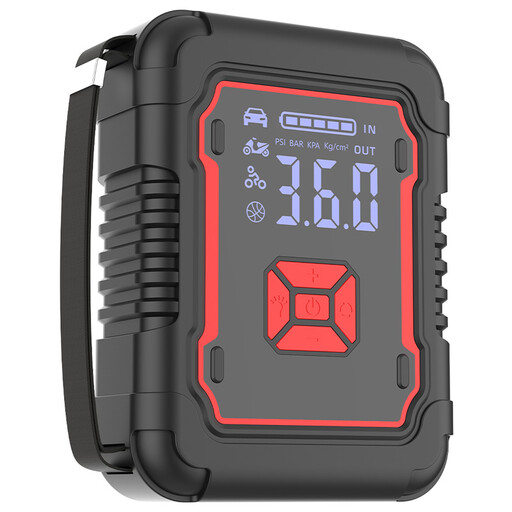
Why This Fits Their Persona: A compact option for commuters and families wanting one device for everyday car emergencies, tyre inflation and USB charging.
Its stated vehicle range covers 12V petrol and diesel vehicles, while the built-in compressor includes a 150 PSI maximum rating and auto-stop function.
3000A peak current, 20,000mAh battery specification, QC3.0 18W USB output and three LED modes.
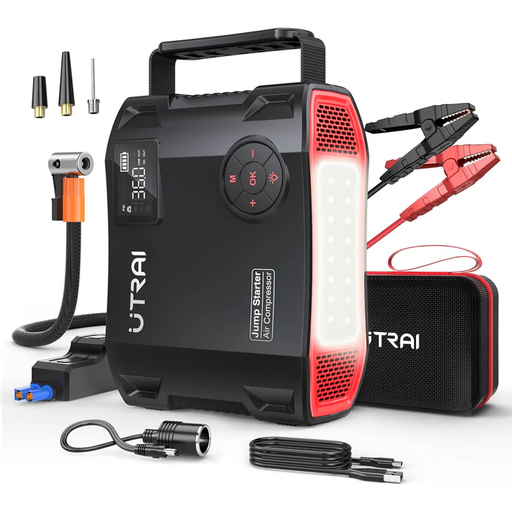
Why This Fits Their Persona: Suitable for drivers who want a higher-capacity roadside emergency kit for larger petrol vehicles and diesel engines up to the stated limit.
It provides a digital pressure display, preset inflation and auto shut-off rather than relying only on a high PSI headline.
6000A peak current, 27,000mAh listed capacity, 45L/min stated airflow and a 1600-lumen LED light.
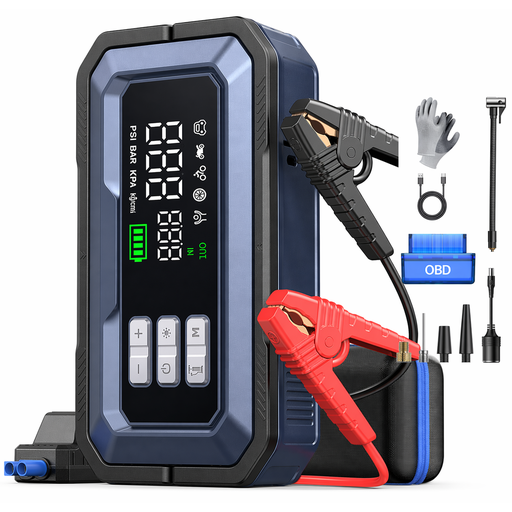
Why This Fits Their Persona: A multifunctional choice for van drivers, outdoor users and owners of larger 12V vehicles who may value diagnostic and 12V accessory support.
The stated compatibility, temperature guidance and protection features give buyers more information than peak current alone.
7000A peak current, 150 PSI compressor, 160W DC output and an included OBD2 fault-code reader.
We have compiled a complete, real-time list of products that fully satisfy these strict selection criteria and UK safety regulations.
A jump starter is intended as an emergency aid, not a replacement for diagnosing a failing battery or repairing a puncture. Check tyre condition and pressure regularly and contact a qualified breakdown service if the vehicle remains unsafe to drive.
Some can, but compatibility varies considerably. Check the product listing for diesel engine capacity, 12V system compatibility and any minimum charge requirement. Do not use a 12V device with a 24V vehicle system.
Follow the supplied manual. Depending on the model, guidance may range from every few months to once a year. Checking the battery before a long journey is sensible, particularly after extended storage or cold weather.
The compressor draws power from the internal battery, so there is no separate fuel cost. Its practical limitation is battery capacity and operating time. Repeated or prolonged inflation will reduce the remaining charge and may require a cooling break, so recharge the device after substantial use.