
24/7 Customer Support

Free returns

Same-day & Next-day Delivery

Quality Guaranteed

Unlock Your Welcome Offers: FREE Delivery | Up to 80% OFF | Free 30-day JoyPlus trial
Download the APP
A flat car battery is an unwelcome surprise, often happening at the worst possible moment—on a cold morning, in a dark car park or when you are miles from home. Waiting for a breakdown service can be time-consuming and costly. A modern, portable car jump starter is a practical solution, giving you the independence to get back on the road in minutes.
However, the market is filled with options, each with different specifications. This guide is designed to help you understand the key features to look for and to present some carefully considered options, allowing you to choose a reliable emergency car starter for your vehicle.
Before looking at specific models, it helps to understand what makes a good car battery booster. Consider these points to find a device that matches your needs.
The most critical specification is the amperage (A). This measures the power the jump starter can deliver.
A small petrol car might only need 400-600A, but a larger SUV or a jump starter for diesel engine will require 1000A or more due to higher compression. Always check the jump starter’s specifications against your vehicle’s engine size (measured in litres) to ensure compatibility. A 12v jump starter is standard for most cars, vans and motorcycles in the UK.
A jump starter power bank is a multi-functional tool. The battery capacity, measured in milliamp-hours (mAh), determines how many times you can start a vehicle or charge your devices. A higher mAh rating means more power in reserve. Many units now include USB ports to charge phones and tablets, as well as built-in LED torches with steady, strobe and SOS modes, which are invaluable during a nighttime breakdown.
Look for a battery jump pack with built-in safety protections. Essential features include protection against reverse polarity (connecting the clamps to the wrong terminals), short circuits, over-current and overheating. These safeguards protect both you and your vehicle’s electronics. Additionally, consider the unit's size and weight. A compact, lightweight design is easier to store in your glove box or boot, ensuring it’s always on hand.
Here are a few portable jump starters that offer a strong combination of power, features and reliability for UK drivers.
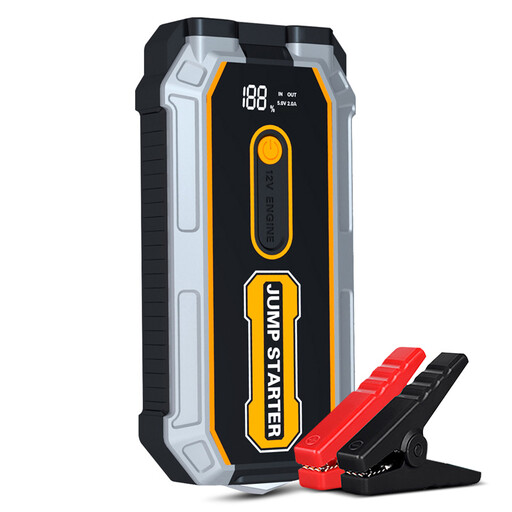
Why It Stands Out: The Porbi S306 strikes an excellent balance between power and portability. It’s compact and lightweight enough to be stored anywhere, yet its 1200A peak current provides enough power for a wide range of common 12V petrol and diesel vehicles.
Pros:
Who is it for? This is a great all-round option for daily commuters and families with standard petrol or smaller diesel cars who want a reliable, no-fuss emergency tool that doesn't take up much space.
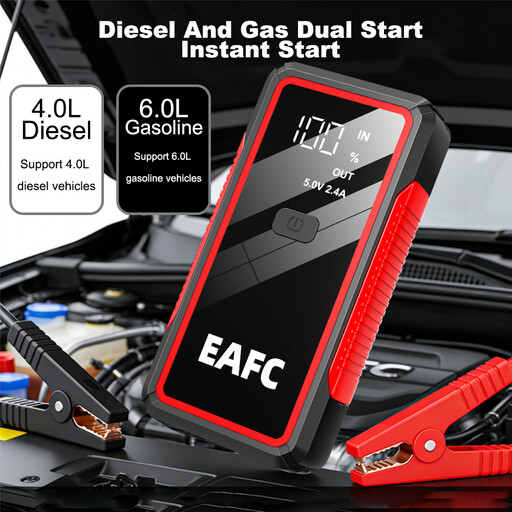
Why It Stands Out: The EAFC model is built for performance and resilience. With a higher peak current and a wide operating temperature range, it offers dependability for larger engines and in more challenging weather conditions.
Pros:
Who is it for? Drivers of larger petrol vehicles, SUVs or mid-sized diesel vans who need a more powerful and robust car battery booster that can perform reliably throughout the year.
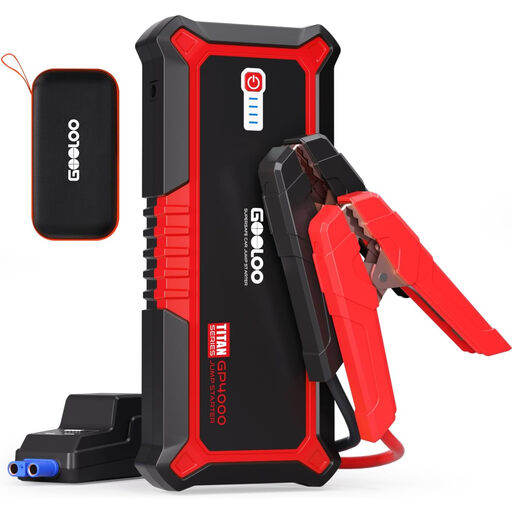
Why It Stands Out: The GOOLOO GP4000 is a powerhouse. Its massive 4000A peak current is designed to handle demanding tasks, including starting large diesel engines and commercial vehicles, making it a top-tier choice for heavy-duty applications.
Pros:
Who is it for? Owners of large vehicles like pickup trucks, RVs, tractors or vans with large-capacity diesel engines. It is also ideal for anyone who wants the peace of mind that comes with having maximum power available.
A jump starter is a key part of any roadside emergency kit, but good visibility is just as important for safety. Upgrading your vehicle's lighting can make a significant difference during night-time repairs or when navigating poorly lit areas. For everything from interior cabin lights to external work lamps, explore our range of efficient 12V LED Lights.
Modern portable jump starters are equipped with multiple safety systems. Features like reverse polarity protection, over-voltage protection and short-circuit prevention are designed to safeguard your vehicle’s sensitive electronics. To ensure safety, always connect the clamps correctly as per the manufacturer's instructions before attempting to start the vehicle.
A quality battery jump pack can hold its charge for several months. However, battery performance can be affected by storage temperature. Most manufacturers recommend checking the charge level and recharging the unit every 2-3 months to ensure it is fully prepared for an emergency.
Often, yes. Diesel engines have a higher compression ratio than petrol engines and require significantly more power to turn over, especially in cold weather. When choosing a jump starter for diesel vehicles, it is crucial to select a model with a high peak and starting amperage that is explicitly rated for your engine's size.