
24/7 Customer Support

Free returns

Same-day & Next-day Delivery

Quality Guaranteed

Unlock Your Welcome Offers: FREE Delivery | Up to 80% OFF | Free 30-day JoyPlus trial
Download the APP
A flat battery is one of the most common and frustrating reasons for a vehicle breakdown in the UK. That click-click-click sound on a cold, dark morning is a moment no driver wants to experience. A modern car jump starter is the solution, offering a compact and powerful way to get back on the road without relying on another vehicle or roadside assistance.
However, the market is flooded with devices making bold claims. Many drivers end up with a gadget that fails when it's needed most. As a Joybuy Product Recommendation Officer, my role is to help you see past the marketing jargon. Here are the common pitfalls to avoid and the key features to look for.
Before you add any device to your basket, be aware of these widespread issues that can lead to a wasted purchase:
To make a smart choice, focus on these three non-negotiable specifications.
Ignore the peak amp figure alone and check the manufacturer's recommended engine size. This is a much more reliable indicator of a 12V jump starter's real-world capability.
The type of battery inside the jump starter dictates its safety and how long it will hold a charge.
Never purchase a jump starter that does not come with "smart clamps". These clamps contain circuitry that provides critical safety protections. Look for a unit that explicitly lists:
We've analysed the specifications of various models to match them with different UK driver profiles.
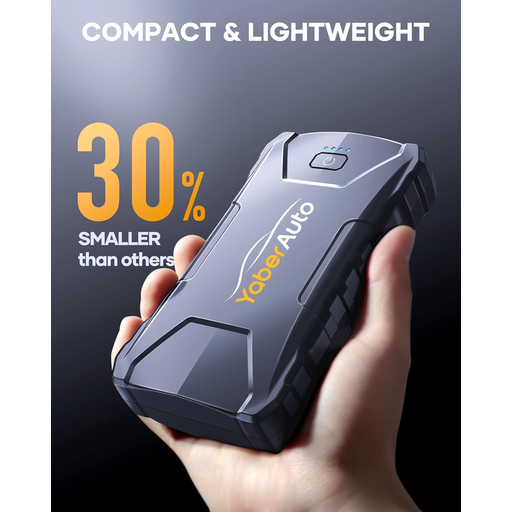
Why This Fits Their Persona: This unit is ideal for drivers of standard petrol or smaller diesel cars who need a reliable, no-fuss solution. Its ultra-compact size means it fits easily in a glovebox or door pocket, ensuring it's always within reach for a roadside emergency.
It avoids the "all-in-one compromise" by focusing on its core functions: jump-starting and acting as a simple power bank. It doesn't include a low-quality air compressor, keeping the design compact and the cost down.
Its main advantage is its portability. Weighing just 340g, it's one of the lightest options available that still provides enough power for most UK cars (up to 7.0L petrol / 5.5L diesel).
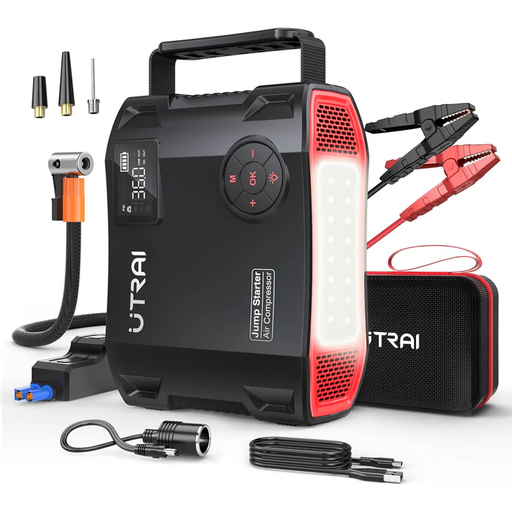
Why This Fits Their Persona: For those with larger vehicles like SUVs and vans, or anyone who enjoys camping and outdoor trips, this is a complete emergency solution. It combines a very powerful jump starter with a genuinely useful air compressor, making it perfect for family holidays and adventures.
This unit successfully avoids the "all-in-one compromise". Its 150 PSI air compressor is powerful enough to inflate a car tyre in minutes, and the 160W DC output can power other 12V devices like a car fridge, making its secondary features truly functional.
Its versatility is its greatest strength. The high peak current can handle large diesel engines (up to 10.0L), while the integrated tyre inflator and large 27,000mAh battery capacity make it an indispensable tool for road trips.
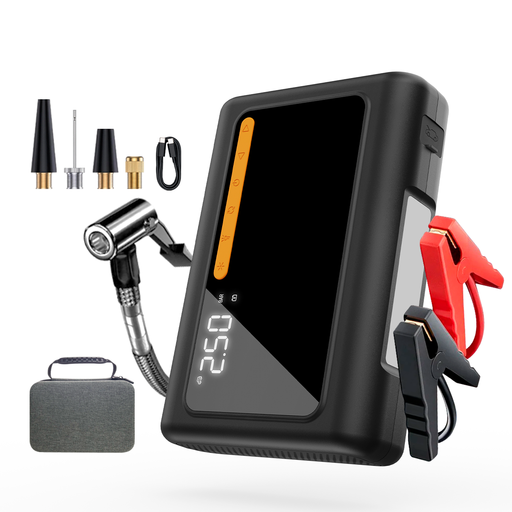
Why This Fits Their Persona: This is for the driver who prioritises ultimate reliability and safety. If you worry about leaving a lithium battery in a hot or cold car, or simply want a device you can charge once and trust for years, the sodium-ion technology here is the solution.
It directly solves the "standby myth". With an ultra-low self-discharge rate, it can genuinely hold its charge for up to 5 years, eliminating the need for constant maintenance charging. Its chemical stability also removes the fire risk associated with damaged lithium batteries.
Its sodium-ion battery provides unparalleled safety and longevity. The ability to operate from -40°C to 80°C and hold a charge for years makes it the definitive maintenance-free option for long-term peace of mind.
We have compiled a complete, real-time list of products that fully satisfy these strict selection criteria and UK safety regulations.
Yes, but with caution depending on the type. Standard lithium-ion jump starters can lose efficiency in freezing temperatures and should ideally be stored in a warmer environment if possible. However, models with sodium-ion batteries are specifically designed to operate effectively in extreme cold (down to -40°C) and are much safer to leave in your vehicle year-round.
This depends on the jump starter's battery capacity (measured in mAh or Wh), the size of your car's engine and the ambient temperature. A fully charged, good-quality unit should be able to start a typical petrol car 10-20 times. For larger diesel engines, you might get 5-10 starts. The key is to recharge the device after each use to ensure it's always ready.
For many people, yes. It combines two essential emergency tools into one, saving space in your boot. A model with a high-quality, integrated tyre inflator can be a lifesaver for slow punctures or simply for routine tyre maintenance. If you frequently travel long distances or have a family, the convenience often outweighs the cost of buying two separate devices.