
24/7 Customer Support

Free returns

Same-day & Next-day Delivery

Quality Guaranteed

Unlock Your Welcome Offers: FREE Delivery | Up to 80% OFF | Free 30-day JoyPlus trial
Download the APP
That dreaded silence when you turn the key is a moment every UK driver fears, especially on a cold, dark morning. A flat battery can ruin your day, leaving you stranded and waiting for roadside assistance. A modern car jump starter is a compact, powerful solution that puts you back in control.
However, the market is flooded with options, and it's easy to make a costly mistake. As a Joybuy Product Recommendation Officer, my role is to help you see past the marketing clutter and identify the features that truly matter. Before you buy, be aware of these common pitfalls that catch out many UK buyers.
1. The "Peak Amps" Myth: Many products boast enormous peak amperage (e.g., 6000A), but this figure can be misleading. It often represents a theoretical maximum output for a fraction of a second, not the sustained power (cranking amps) needed to turn over a cold engine. A unit with an inflated peak amp rating but poor internal components may fail to start your car.
2. The Rapid Self-Discharge Trap: There is little point in having an emergency car starter if its own battery is dead when you need it. Lower-quality lithium cells can lose their charge within a few months of sitting in your glovebox. A reliable jump pack should hold a usable charge for at least 6-12 months.
3. Flimsy Clamps and Cables: The power from the jump starter is delivered through its clamps and cables. If these are made from thin, plastic-coated metal with weak springs, they can fail to make a secure connection, overheat or even break, rendering the entire device useless and potentially unsafe.
To ensure you get a device that works when you need it most, focus on these three core parameters.
The single most important factor is matching the jump starter's power to your vehicle's engine. Ignore the peak amp figure alone and look for the manufacturer's stated engine size compatibility.
A jump starter's internal battery capacity, measured in milliamp-hours (mAh) or watt-hours (Wh), determines how many times it can start a car or how long it can function as a jump starter power bank to charge your devices.
A jump starter handles a large amount of electrical current, so safety is paramount. Do not consider any model that lacks modern safety protections.
Based on these practical criteria, here are several car jump starters suited for different types of UK drivers.
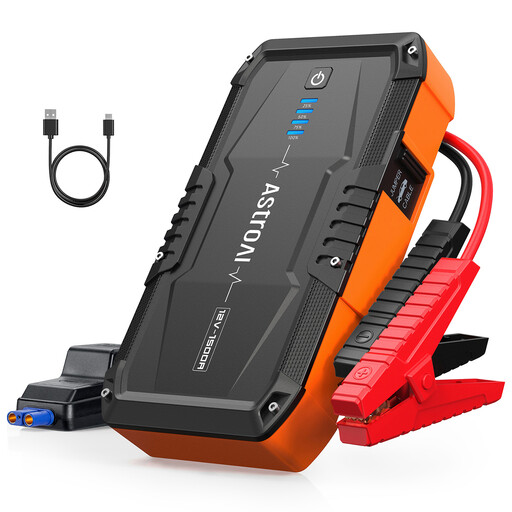
Why This Fits Their Persona: Ideal for drivers of standard UK petrol or small diesel cars (e.g., Ford Focus, VW Golf, Vauxhall Corsa). It's compact enough for the glovebox and provides straightforward, reliable power for common roadside emergencies without unnecessary complexity.
It avoids the "peak amp" myth by clearly stating its realistic engine compatibility (up to 6.0L petrol/3.0L diesel), giving buyers a practical metric rather than just a large, confusing number.
Features a "BOOST" mode for starting fully drained batteries and includes 8 integrated safety protections for user confidence. Its compact and lightweight design makes it easy to store and handle.
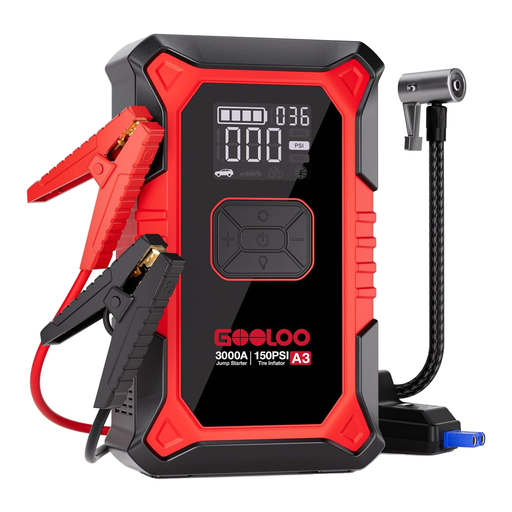
Why This Fits Their Persona: Perfect for the family SUV or people carrier. This is for the driver who values preparedness for more than just a flat battery, offering a solution for flat tyres too. It's an ideal all-in-one tool for road trips and camping holidays.
This unit combines a powerful car battery booster with a genuinely useful jump starter with air compressor (150 PSI), saving you from buying two separate, potentially lower-quality gadgets.
Its 7-in-1 functionality includes a digital tyre inflator with auto-shutoff, a power bank and an LED torch. It has enough power for large petrol (9.0L) and diesel (6.5L) engines.
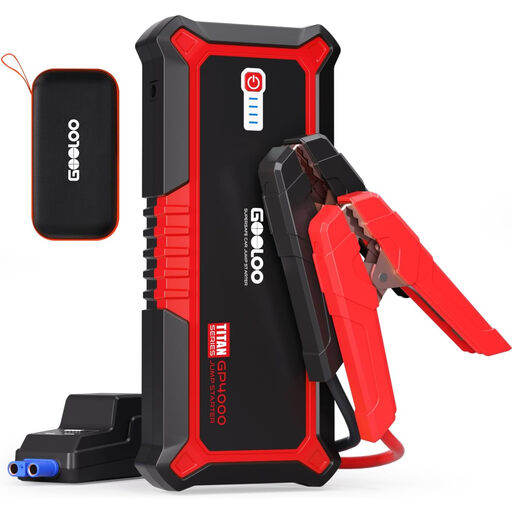
Why This Fits Their Persona: For the owner of a large diesel pickup truck, van, RV or boat. This user cannot afford to compromise on power and needs a truly heavy duty jump starter that will perform reliably on large-displacement engines, even in cold weather.
This unit sidesteps the flimsy clamp trap by using durable, all-metal smart clamps designed to handle the high current needed for large engines without overheating or failing, ensuring the 4000A peak power is delivered effectively.
Its immense power can start all petrol engines and diesel engines up to 10.0L. The rugged, rubberised casing is built to withstand drops, making it a durable tool for demanding environments.
We have compiled a complete, real-time list of products that fully satisfy these strict selection criteria and UK safety regulations.
Even if you don't use it, it's good practice to recharge your jump starter every 3 to 6 months. This helps to maintain the health of the internal lithium battery and ensures it has enough power when an emergency arises. Some newer models with low self-discharge rates may last longer, but it's wise to check the manufacturer's specific guidance.
Yes, most modern jump starters are designed to be stored in a vehicle and have a wide operating temperature range (e.g., -20°C to 60°C). Cold weather can reduce a battery's effectiveness, so it's important to choose a quality unit rated for low temperatures. Storing it fully charged will give you the best performance on a frosty morning.
It depends on your engine size. A 2000A jump starter is often sufficient for smaller diesel engines (up to around 4.0L - 6.0L, depending on the model). However, for larger diesel engines found in trucks, large SUVs and vans (3.0L and above), it is safer to opt for a more powerful unit, such as one rated at 3000A or 4000A, to ensure you have enough cranking power. Always check the manufacturer's recommended engine compatibility.