
24/7 Customer Support

Free returns

Same-day & Next-day Delivery

Quality Guaranteed

Unlock Your Welcome Offers: FREE Delivery | Up to 80% OFF | Free 30-day JoyPlus trial
Download the APP
There are few things more frustrating for a UK motorist than the dead click of an engine that will not turn over, especially on a cold, dark morning. A flat battery can disrupt your entire day, leaving you stranded and waiting for roadside assistance. A modern car jump starter is a compact and powerful solution, but the market is flooded with options, making it difficult to choose the right one.
As a Joybuy Product Recommendation Officer, my role is to help you navigate the marketing jargon. Many drivers end up with a device that fails when they need it most. This is often due to a few common purchasing pitfalls that are easy to fall into.
To avoid these traps, focus on the specifications that genuinely impact performance. Understanding these core parameters will ensure you get a reliable emergency car starter that works for your specific vehicle.
When you see a jump starter advertised with a high peak amp rating, it is important to understand what that means. Peak Amperage is the maximum current the unit can discharge in a very short burst. While a higher number can be an indicator of power, the more practical figure is the Starting or Cranking Amperage, which is the power it can sustain for a few seconds to turn your engine over.
Always check the engine compatibility (e.g., "up to 7.0-litre petrol, 5.5-litre diesel") to ensure the 12V jump starter has enough power for your vehicle.
A large mAh number on a jump starter power pack looks impressive, but it doesn't tell the whole story. A more accurate measure of a battery's energy storage is Watt-hours (Wh). This value is calculated by multiplying the amp-hours (Ah) by the voltage (V), giving you a standardised unit of energy. If Wh is not listed, look for the rated capacity, which is often a more realistic figure than the advertised total capacity. This is especially important if you plan to use the device as a power bank to charge phones and tablets.
Connecting a power source directly to your car's battery carries risks. A quality battery jumper starter pack should include a comprehensive set of safety features built into its smart clamps. Do not consider a model without these protections:
These features make the process much safer, even for those who are not mechanically minded.
Instead of a one-size-fits-all approach, the right choice depends on your vehicle and lifestyle. Here are a few recommendations matched to common UK driver profiles.
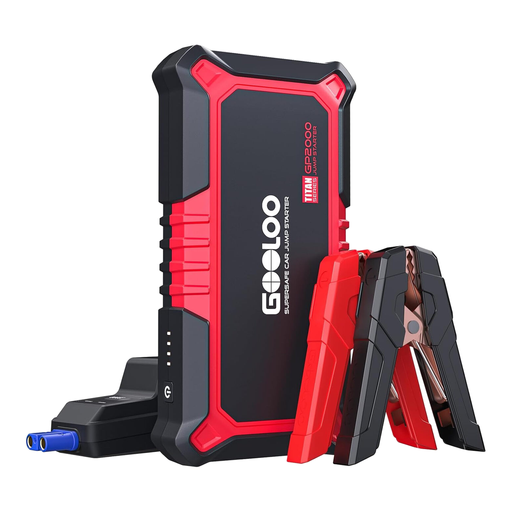
Why This Fits Their Persona: Ideal for drivers of standard UK hatchbacks, saloons or small SUVs (up to 8.0-litre petrol/6.0-litre diesel). It is compact enough to live in the glovebox and provides peace of mind for daily commutes and school runs without a hefty price tag.
It offers a genuine 2000A peak current, providing more than enough power for most cars on UK roads, avoiding the trap of underpowered units with inflated marketing claims.
Excellent balance of power, portability and affordability. Includes 10 safety protections and dual USB ports for charging devices, making it a practical tool for any car.
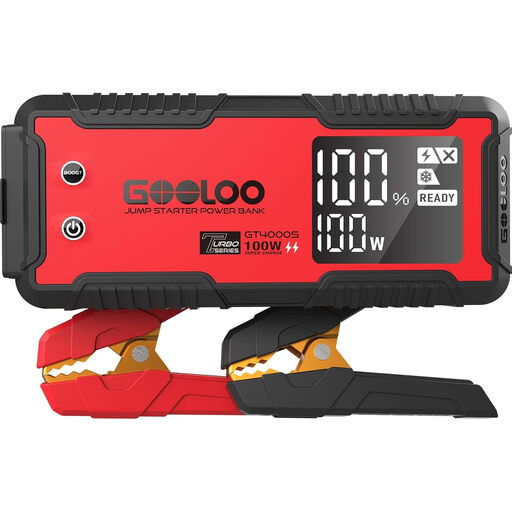
Why This Fits Their Persona: For the driver of a large SUV, van or high-performance car who values speed and convenience. The powerful 4000A output handles large diesel engines (up to 10-litre), and its rapid charging means it is always ready to go.
Instead of just a big amp number, its standout feature is tangible: 100W two-way fast charging. It can be fully recharged in about 1.2 hours, solving the problem of finding your jump starter is flat when you need it.
The 100W fast charging is a game-changer for busy people. A large 3.2-inch screen provides clear, intuitive status information, removing any guesswork.

Why This Fits Their Persona: This is for the van driver, camper or outdoor adventurer who needs a complete roadside assistance kit. It combines a very powerful 4500A jump starter with a 150 PSI tyre inflator, solving two of the most common roadside issues in one rugged unit.
Its value is not just in a single specification but in its genuine multi-functionality. This is a true 5-in-1 tool, not just a basic jump box with a dim torch attached.
The integrated 150 PSI digital air compressor with auto-shutoff is its defining feature. It also has a massive 4500A peak current for starting large engines (up to 9.0-litre petrol/8.0-litre diesel).
We have compiled a complete, real-time list of products that fully satisfy these strict selection criteria and UK safety regulations.
To ensure it is ready for an emergency and to maintain the health of the internal lithium battery, it is good practice to recharge your jump starter every 3 to 6 months, even if it has not been used. Most models have indicator lights or an LCD screen to show the current charge level.
Yes, most modern jump starters are designed to be stored in a vehicle and have an operating temperature range that can handle typical UK winters (e.g., -20°C to 60°C). However, extreme cold can temporarily reduce battery output. For optimal performance, check the manufacturer's recommended storage temperatures and consider bringing it indoors to charge fully before a particularly cold spell.
A car jump starter is designed to deliver a very high burst of current for a few seconds to start an engine with a flat battery. It is a rescue device. A battery charger, on the other hand, is designed to slowly recharge a flat battery over several hours by plugging into a mains socket. It cannot start a car instantly.