
24/7 Customer Support

Free returns

Same-day & Next-day Delivery

Quality Guaranteed

Unlock Your Welcome Offers: FREE Delivery | Up to 80% OFF | Free 30-day JoyPlus trial
Download the APP
A flat car battery is an unwelcome surprise that can disrupt your day, whether you're on the morning commute, heading out for a family trip or in a remote car park late at night. While roadside assistance is an option, waiting for help can be time-consuming and costly. A modern car jump starter offers a quick, self-reliant solution, getting you back on the road in minutes.
However, the market is flooded with options, and it's easy to fall for marketing hype. Many UK drivers invest in a device only to find it fails when needed most. Before you buy, let's look at the common pitfalls to avoid.
To ensure you're getting a reliable roadside assistance tool, focus on these non-negotiable specifications.
The first rule is to match the jump starter to your vehicle. Nearly all passenger cars in the UK use a 12-volt system, so you'll need a 12V jump starter. The next step is to check its power output against your engine size.
A jump starter is useless if it's dead when you need it or unsafe to operate.
We've filtered through the options to find devices that meet these practical criteria, matching them to different UK driver profiles.
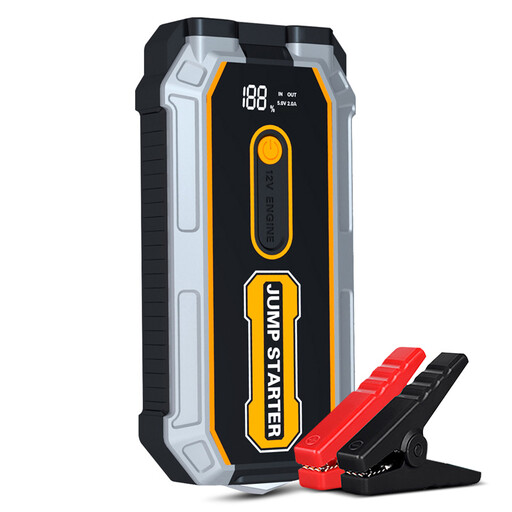
Why This Fits Their Persona: Ideal for drivers of standard petrol cars or smaller diesel vehicles. Its compact design fits easily into a glovebox, and the 12800mAh capacity is ample for both emergency starts and keeping a smartphone charged on the go. It's a straightforward, no-fuss solution for everyday peace of mind.
It avoids feature-bloat, focusing on being a reliable jump starter and power bank. The smart LCD display clearly shows the remaining battery, so you're never caught out with a depleted unit.
Compact & Lightweight: Weighing around 330g, it's highly portable.
Clear Status Display: The LCD screen provides at-a-glance battery monitoring.
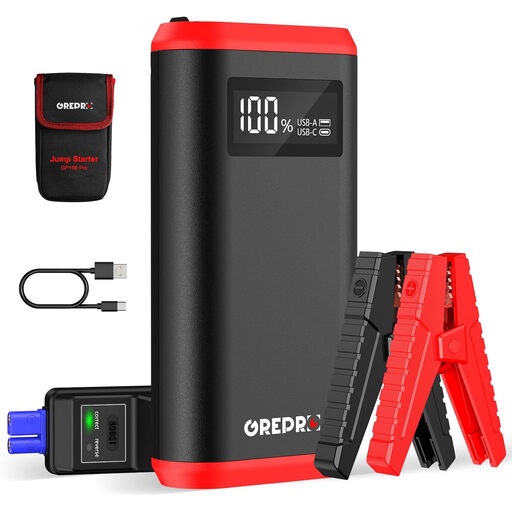
Why This Fits Their Persona: For those with larger vehicles, like SUVs, people carriers or diesel cars, who need serious power. This unit is specified for engines up to 10.0L petrol and 8.0L diesel, providing confidence that it can handle demanding situations, even in cold weather.
It cuts through the "peak amps" myth by clearly stating its compatibility with large engine sizes. It also details its ten built-in safety protections, prioritising user safety over flashy but vague specifications.
High Power Output: Capable of starting large petrol and diesel engines.
Wide Temperature Range: Designed to operate reliably from -20°C to 55°C.
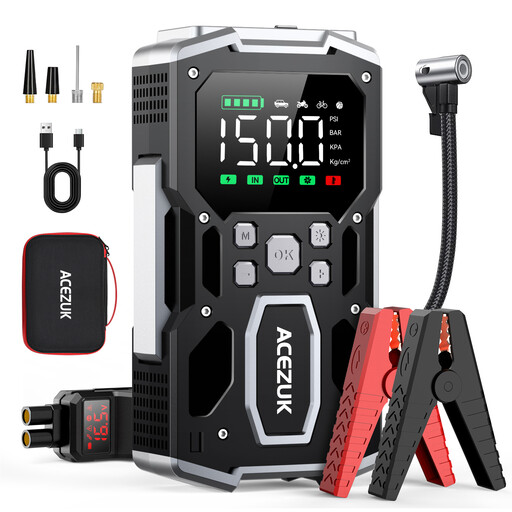
Why This Fits Their Persona: For the driver who wants a complete **emergency car kit** in one package. This device combines a very powerful 7000A peak jump starter with a 150 PSI air compressor, covering the two most common roadside issues: a flat battery and a flat tyre. It's the ultimate tool for self-sufficiency.
It defies the "master of none" trap by offering strong, verifiable performance in both its core functions. The 7000A peak current is suitable for large engines, and the specified inflation time (6 mins for a standard tyre) is practical for roadside use.
Dual Functionality: A powerful car battery booster and a capable tyre inflator in one unit.
Informative Display: The LCD shows battery level and real-time tyre pressure.
We have compiled a complete, real-time list of products that fully satisfy these strict selection criteria and UK safety regulations.
This depends on the jump starter's capacity, your vehicle's engine size and the battery's condition. A quality unit with over 10,000mAh capacity should be able to start a standard petrol car multiple times (often 10-20) on a full charge. However, it's good practice to recharge the jump starter after each use to ensure it's always ready.
Yes, most modern lithium-ion jump starters are designed to be stored in a vehicle. However, you should check the manufacturer's specified operating and storage temperature range. In the UK, temperatures generally fall well within these limits. Avoid leaving it in direct, intense sunlight on a hot day, and remember to recharge it every 3-6 months to maintain battery health.
No, a jump starter is not a battery charger. It is designed to provide a short, powerful burst of energy to start the engine. Once your car is running, the alternator will begin to recharge the car's battery. A jump starter cannot and should not be left connected to the battery to charge it.