
24/7 Customer Support

Free returns

Same-day & Next-day Delivery

Quality Guaranteed

Unlock Your Welcome Offers: FREE Delivery | Up to 80% OFF | Free 30-day JoyPlus trial
Download the APP
A flat battery can leave you stranded outside your home, at work or on a dark rural road. A car jump starter can provide independent backup without waiting for another vehicle, but choosing the right model requires more than comparing peak-amp figures.
Marketing often highlights the largest number on the box while leaving out important limitations. Before buying a portable car battery jump starter, check the following common pitfalls.
A high peak current may look impressive, but it does not automatically mean a jump starter is suitable for your vehicle. Engine size, fuel type and system voltage remain essential.
A compact 12V jump starter rated for a large petrol engine may not support a diesel engine of the same size. Diesel vehicles typically require a model specifically rated for diesel use. Always compare the product’s stated compatibility with your vehicle handbook and engine size.
A jump starter with an air compressor can be useful for topping up tyres, but maximum pressure is not the same as inflation speed. Look for practical details such as preset modes, automatic shut-off, pressure display and recommended rest periods.
For example, some tyre inflator jump starters should not run continuously for more than 10 minutes and may need to cool before the hose is removed. This matters during a roadside emergency.
A vehicle battery booster is only useful if it has sufficient charge when needed. Some products require charging every few months, while others list a longer standby period. However, storage temperature, battery condition and charging habits can affect readiness.
Do not leave a lithium battery pack in prolonged high heat or freezing conditions without checking its instructions. Store the unit, clamps and cables together so essential parts are not missing when you need an emergency car starter.
Most portable jump boxes are designed for 12V vehicles, including cars, SUVs, motorcycles and some vans. They should not be connected to 24V systems unless the manufacturer specifically states otherwise.
Check both:
A model listed for up to 5.0-litre petrol engines may not be appropriate for a diesel van, even if both vehicles use 12V electrics.
Peak current is one useful comparison point, but also consider the stated starting current, cable quality and clamp design. Smart clamps with reverse-polarity warnings, short-circuit protection, over-current protection and spark prevention can help reduce connection mistakes.
These features do not replace careful use. The red clamp should connect to the positive terminal and the black clamp to the negative terminal, following the supplied instructions. Disconnect the clamps promptly after the engine starts.
Battery capacity is commonly shown in mAh or Wh. Wh can make comparisons between products easier because it indicates stored energy more directly. A jump starter power bank may also include USB outputs, LED lighting or a 12V socket.
Consider whether these functions are genuinely useful for your driving routine. A built-in compressor may be worthwhile for long-distance travel, while a compact jump starter without an air pump may take up less space in a small hatchback.
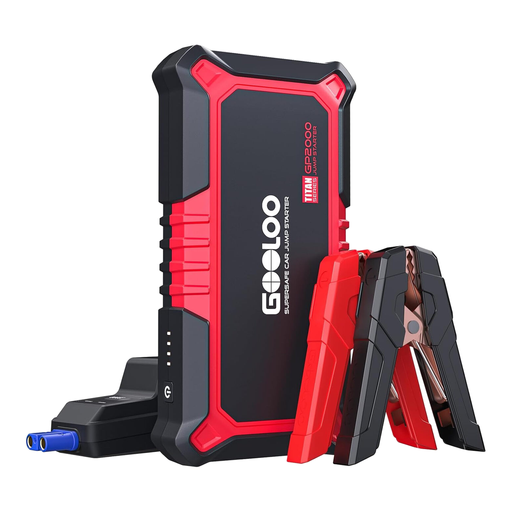
Why This Fits Their Persona: A compact option for motorists who want a portable car battery jump starter for a 12V car, SUV, motorcycle or van without adding an air compressor.
Its stated compatibility covers up to 8.0L petrol and 6.0L diesel engines, making the fuel-type limit clearer than a peak-current figure alone.
2000A peak current, dual USB outputs, LED torch and a listed weight of approximately 1.2 lb.
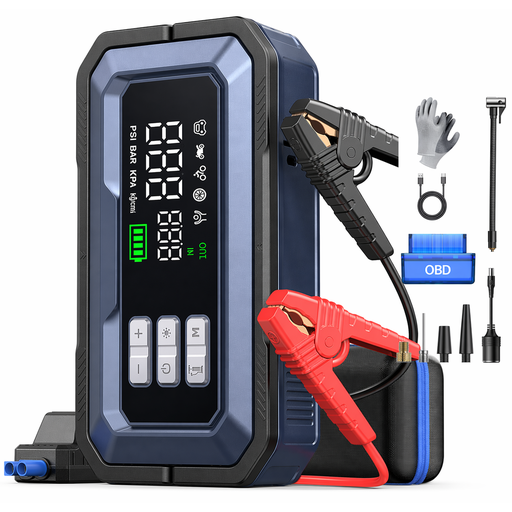
Why This Fits Their Persona: Suited to drivers who want one roadside device for larger vehicles, tyre inflation, USB charging and 12V accessories.
The listing states compatibility with 12V petrol vehicles, diesel engines up to 14L and hybrid vehicles; buyers should still confirm their exact model before purchase.
7000A peak current, 150 PSI compressor, OBD2 fault-code reader, 160W DC output and a two-year warranty listed by the supplier.
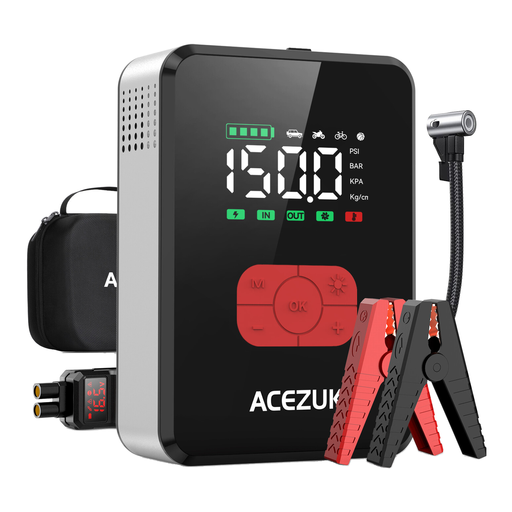
Why This Fits Their Persona: A practical match for SUV, van and diesel drivers who want a jump starter with air compressor functionality in one storage case.
It provides stated petrol and diesel engine limits alongside a compressor display and automatic shut-off, rather than relying on a single headline number.
7000A peak current, 26,800mAh capacity, 150 PSI inflator, LCD screen and smart-clamp alerts.
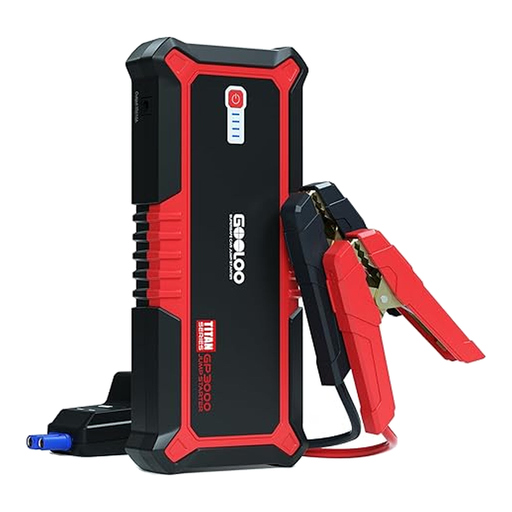
Why This Fits Their Persona: Suitable for motorists carrying one emergency kit for a family car, larger petrol vehicle or diesel SUV during longer journeys.
The product information states support for up to 9L petrol or 7L diesel engines, plus reverse-polarity and spark-proof clamp features.
3000A peak current, USB-C and USB quick-charge ports, LED light and a stated 18-month warranty.
We have compiled a complete, real-time list of products that fully satisfy these strict selection criteria and UK safety regulations.
Never connect clamps together, use damaged cables or attempt to start a vehicle outside the product’s stated voltage and engine limits.
This varies by model and storage conditions. Some products recommend recharging every two to three months, while others list longer standby periods. Check the battery indicator regularly and recharge before long journeys.
Yes, but only if diesel compatibility and engine capacity are stated. A petrol-only model should not be used for a diesel engine. Confirm that the jump starter supports your vehicle’s 12V system and displacement.
It can be useful for drivers who want one device for battery emergencies and tyre top-ups. However, compressors can be heavier and may require cooling breaks. If you only need emergency starting, a smaller vehicle battery booster may be easier to store.