
24/7 Customer Support

Free returns

Same-day & Next-day Delivery

Quality Guaranteed

Unlock Your Welcome Offers: FREE Delivery | Up to 80% OFF | Free 30-day JoyPlus trial
Download the APP
A flat battery or a soft tyre can turn a routine journey into a roadside headache. While breakdown services are an option, the wait times and costs can be considerable. This has led many UK drivers to seek a more self-reliant solution: a car jump starter with air compressor. These multi-functional devices promise to get you back on the road without needing another vehicle or a separate tyre pump.
However, the market is flooded with models that make bold claims. As a Product Recommendation Officer at Joybuy, my role is to help you see past the marketing jargon. Many drivers invest in a unit only to find it fails when needed most. Before you buy, be aware of these common purchasing pitfalls.
To avoid these traps, focus on the core specifications that determine real-world performance. Understanding these will help you choose a reliable portable battery booster with tyre inflator that suits your vehicle.
The power you need is directly related to your engine's size and type. Diesel engines, for example, require more cranking power than petrol ones.
Always check the manufacturer's recommended engine compatibility, as this is a more reliable indicator than the peak amp figure alone.
For the air compressor function to be useful, you need a balance of pressure and speed.
The internal battery powers everything. Its capacity, measured in milliampere-hours (mAh), determines how many jump starts or phone charges you can get from a single charge. More importantly, a quality 12V car battery charger must have robust safety features. Non-negotiable protections include:
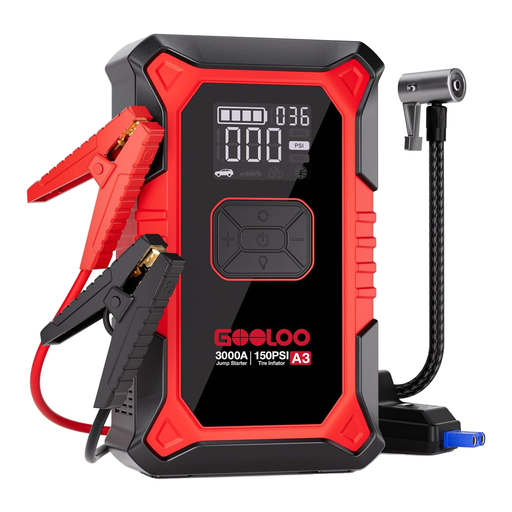
Why This Fits Their Persona: This user wants a single, reliable tool for both flat batteries and tyres. They drive a family SUV, van or larger petrol car and value the convenience of an all-in-one solution for road trips and daily peace of mind.
It combines a genuine 3000A jump starter, suitable for large engines, with a practical 150 PSI compressor. The digital screen and preset modes prevent the slow, frustrating inflation common in lesser models.
True 7-in-1 functionality. The powerful jump-starting capability is matched by a genuinely useful tyre inflator with automatic shut-off, making it a complete emergency tool.
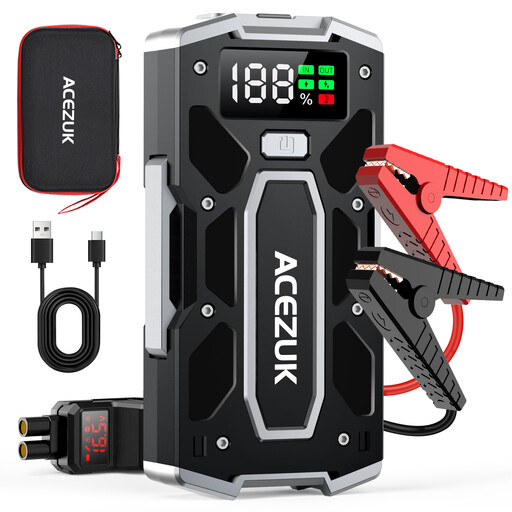
Why This Fits Their Persona: This user drives a high-displacement vehicle, like a large truck, van or performance car (up to 10-litre petrol/8-litre diesel). Their primary concern is having overwhelming starting power on demand. An air compressor is not their priority.
It avoids the "inflated amps" trap by delivering a genuinely high peak current (8000A) specifically for large engines. It focuses on doing one job—starting—exceptionally well, rather than compromising on a weak secondary feature.
Unmatched starting power for consumer-grade boosters. The large, clear LCD display provides vital information at a glance. Note: This unit does not include an air compressor.
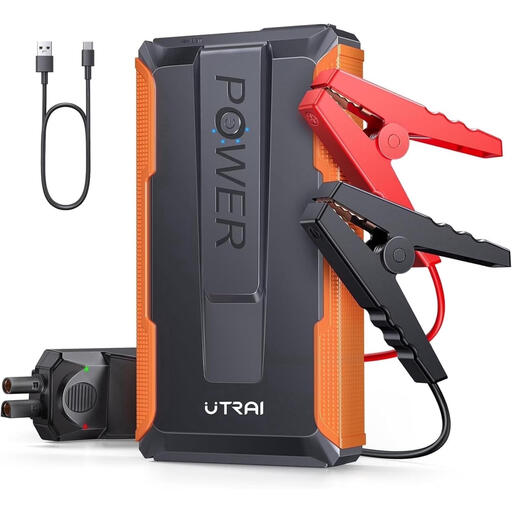
Why This Fits Their Persona: This driver has a standard petrol or diesel car and prioritises a compact, easy-to-store device. They want a reliable jump starter that fits in the glovebox and doubles as a fast-charging power bank for their phone on long journeys.
It avoids the trap of poor battery health with a robust casing and a specified operating temperature range (-20°C to +60°C), making it suitable for UK weather. Its 2000A peak is a realistic and effective rating for its target vehicles.
Excellent balance of power and portability. The smart clamp with audible error alerts provides peace of mind for less experienced users. Note: This unit does not include an air compressor.
We have compiled a complete, real-time list of products that fully satisfy these strict selection criteria and UK safety regulations.
A quality unit should hold a significant portion of its charge for 3 to 6 months. However, performance is affected by temperature. It is good practice to check the battery level and top it up every 2-3 months to ensure it is ready for an emergency.
Yes, most are designed for this. Look for models with a specified operating temperature range that covers typical UK winter conditions (e.g., down to -20°C). Extreme cold can reduce battery efficiency, so a unit with a 'boost' or 'force start' function for very cold or completely dead batteries is a valuable feature.
While it is more power than a small car needs, it is not harmful. The car's starter motor will only draw the current it requires. The advantage of a more powerful unit is versatility—it can help a friend with a larger vehicle—and it will jump-start your smaller car with less strain, potentially leading to a longer lifespan for the device.