
24/7 Customer Support

Free returns

Same-day & Next-day Delivery

Quality Guaranteed

Unlock Your Welcome Offers: FREE Delivery | Up to 80% OFF | Free 30-day JoyPlus trial
Download the APP
A flat battery or a soft tyre can turn a routine journey into a roadside headache. While a combined car jump starter with air compressor seems like the perfect all-in-one solution, the market is flooded with devices that often over-promise and under-deliver. Many UK drivers invest in these gadgets for peace of mind, only to find them failing when needed most.
As the Joybuy Product Recommendation Officer, my role is to help you navigate the marketing jargon. Before you make a purchase, be aware of these common pitfalls that lead to wasted money and frustration.
To avoid these traps, focus on the specifications that determine real-world performance. Here’s what to check before you buy.
The single most important factor is whether the device can start your specific vehicle. Don't just look at the peak amps; look for the manufacturer's stated engine compatibility.
For the air compressor function to be useful, you need a balance of pressure and speed.
The internal battery determines how many jump-starts you can perform and how long it can function as a portable power bank for your devices.
Based on these practical criteria, we've identified several models that align with the needs of different UK drivers.
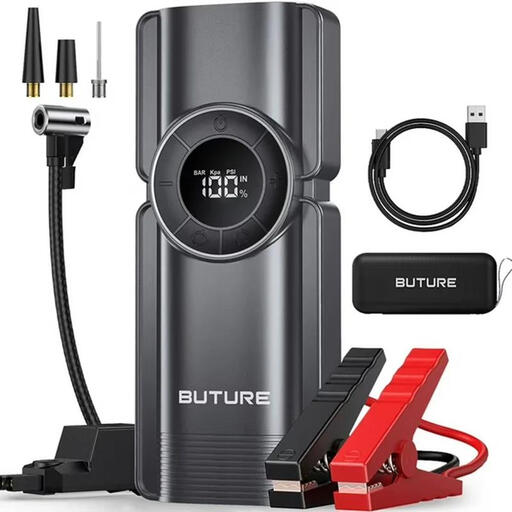
Why This Fits Their Persona: An excellent all-rounder for drivers of typical UK family cars, hatchbacks and smaller SUVs (e.g., Ford Focus, Nissan Qashqai). It offers a strong balance of starting power and compressor utility without the overkill of a professional-grade unit.
The 3500A peak rating is backed by clear compatibility for up to 8.0L diesel engines, providing genuine power. The 150 PSI compressor includes a preset auto-off function, preventing it from being just a slow, basic inflator.
Features a clear digital display for battery level and tyre pressure, removing guesswork. Comes with a neat storage case to keep everything organised in your boot.
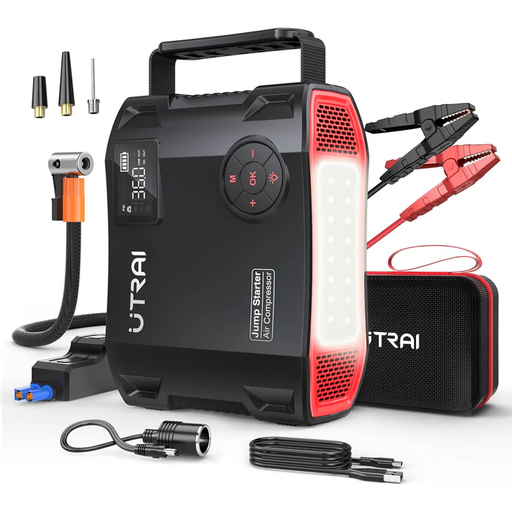
Why This Fits Their Persona: Built for those who drive large diesel vehicles, vans or 4x4s. If your livelihood or travels depend on a powerful engine, you need an emergency car starter that can deliver serious cranking power without hesitation, even on a cold morning.
It tackles the "Peak Amp" illusion by offering a genuinely high 6000A rating with compatibility for up to 10.0L diesel engines. It also avoids the slow compressor trap with a specified 45L/min airflow, capable of inflating a tyre in just 4 minutes.
The 27000mAh battery provides substantial capacity. Its 160W DC output can power other 12V accessories like a car fridge or vacuum, making it a versatile tool for campers and tradespeople.
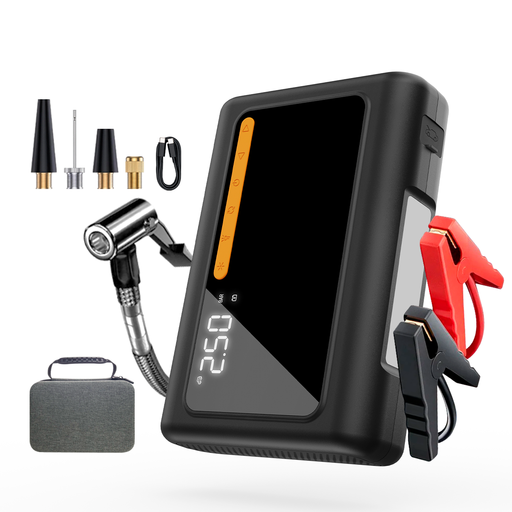
Why This Fits Their Persona: Ideal for the "set it and forget it" owner who values long-term reliability and safety above all. This person wants a device they can store in the car year-round without worrying about constant recharging or safety risks in extreme temperatures.
It directly solves the "dead battery" problem. The sodium-ion battery has an ultra-low self-discharge rate, allowing it to hold a charge for up to 5 years. It also operates safely in a wide temperature range (-40°C to 80°C), unlike some lithium units.
The underlying battery chemistry is a major advantage, offering a much longer cycle life (up to 6,000 cycles) and improved safety, as it doesn't release oxygen at high temperatures, reducing fire risk.
We have compiled a complete, real-time list of products that fully satisfy these strict selection criteria and UK safety regulations.
For traditional lithium-ion jump starters, it is good practice to check the charge level and top it up every 2-3 months. Battery health degrades if left completely discharged for long periods. Some newer models with sodium-ion batteries have much lower self-discharge rates and may only require checking annually, but always refer to the manufacturer's specific guidance.
Most jump starters are designed to operate in cold conditions, typically down to -20°C. However, extreme cold can reduce battery performance. It is safe to store it in your car, but for optimal performance on a freezing day, it helps if the unit is not stored in a completely discharged state. Always check the product's specified operating temperature range.
It depends on the engine size. A 2000A unit might be sufficient for a small diesel car (e.g., 1.6L - 2.0L), but it will likely struggle with a larger van, such as a Ford Transit or Mercedes Sprinter, which typically have engines from 2.0L to 3.0L or more. For these vehicles, a heavy duty jump starter with a rating of 3000A or higher is a much more reliable choice. Always prioritise the manufacturer's stated engine displacement compatibility over the peak amp figure alone.