
24/7 Customer Support

Free returns

Same-day & Next-day Delivery

Quality Guaranteed

Unlock Your Welcome Offers: FREE Delivery | Up to 80% OFF | Free 30-day JoyPlus trial
Download the APP
A flat battery or a soft tyre can turn a routine journey into a roadside headache. While many UK drivers carry jump leads or a separate tyre pump, a modern car jump starter with air compressor combines both essentials into one compact device. However, the market is filled with confusing specifications and overblown claims. Choosing the wrong one means you could be left with a gadget that fails when you need it most.
As a Joybuy Product Recommendation Officer, my role is to help you navigate these choices. This guide cuts through the marketing jargon, focusing on the critical features that ensure you get a reliable tool for your car, not just another piece of plastic in your boot.
Before you buy, be aware of a few common traps that lead to buyer's remorse. Understanding these will help you spot a genuinely useful tool from a poorly designed one.
To avoid these issues, focus on three non-negotiable specifications. These will determine whether your emergency car starter is a dependable companion or a frustrating liability.
Your vehicle requires a certain amount of power to start, especially from cold. A 12v jump starter must be able to deliver this consistently.
A good battery booster pack with compressor should inflate your tyres quickly and efficiently.
The internal battery determines the device's lifespan, safety and how long it holds a charge.
Based on these practical criteria, here are a few options suited to different UK driver profiles.
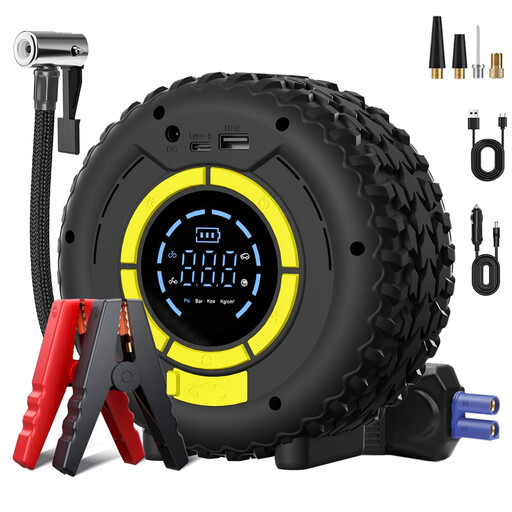
Why This Fits Their Persona: Ideal for drivers of standard petrol and diesel cars who need a straightforward, compact and affordable solution for common roadside issues. Its lightweight design (600g) makes it easy to store in a glovebox or door pocket.
It features a clear digital display for both battery level and tyre pressure, preventing the guesswork that comes with more basic models. The 150 PSI compressor is capable enough for standard car tyres, avoiding the "afterthought" compressor problem.
Combines jump-starting, tyre inflation and power bank functions in an extremely compact and portable unit. Includes an auto-shutoff feature for the compressor to prevent over-inflation.
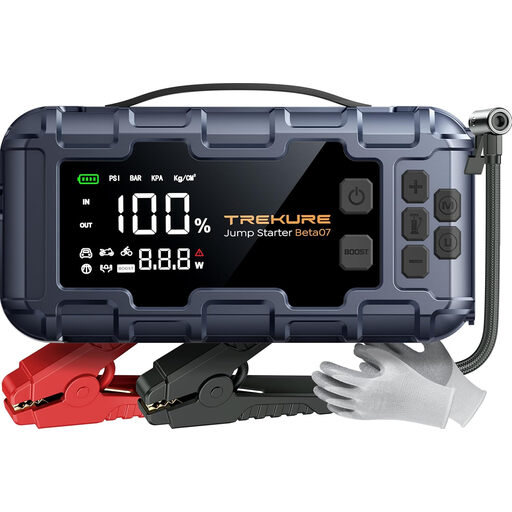
Why This Fits Their Persona: Built for those with larger vehicles like SUVs, vans or trucks with high-displacement engines (up to 12-litre). The powerful compressor is also well-suited for high-pressure tyres found on these vehicles.
This unit directly counters the "underpowered" pitfall. Its high 6000A peak current rating is matched with a stated capacity for large engines and the 160 PSI, 45 LPM compressor provides the performance needed for bigger tyres, avoiding slow inflation times.
Features high power output for both functions and supports 45W PD fast charging, allowing the unit itself to be recharged quickly. The large 3.3-inch smart display provides clear, at-a-glance information.
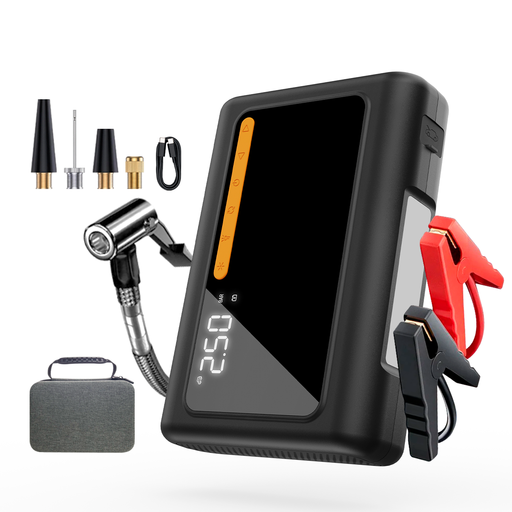
Why This Fits Their Persona: Perfect for the driver who prioritises long-term reliability and safety. This user wants a "set and forget" tool they can trust to work after years in the boot, without worrying about battery degradation or safety in extreme temperatures.
It directly solves the "unreliable battery" problem. According to the manufacturer, its sodium-ion battery has an ultra-low self-discharge rate (~1% per month), meaning one charge can provide standby power for years. It also operates safely in a much wider temperature range.
Exceptional long-term reliability and safety due to its sodium-ion battery chemistry. It is designed to be stored in a car year-round without the maintenance or safety concerns associated with some lithium-ion units.
We have compiled a complete, real-time list of products that fully satisfy these strict selection criteria and UK safety regulations.
This depends heavily on the battery technology. Most conventional lithium-ion units have a self-discharge rate that requires you to recharge them every 3 to 6 months to ensure they are ready for an emergency. However, models with newer battery chemistry, such as sodium-ion, have a much lower self-discharge rate and can hold a usable charge for a year or even longer, reducing maintenance.
You should always check the manufacturer's specified operating and storage temperature range. Standard lithium-ion batteries can be damaged or lose performance in extreme cold or heat. Some models are specifically designed for in-car storage, using more stable battery chemistry and housing materials that can withstand a wider temperature range, such as -20°C to 60°C or even broader.
Not on its own. While peak amps indicate the maximum theoretical power burst, it's more practical to match the jump starter's recommended engine compatibility (e.g., "for up to 8.0-litre petrol/6.0-litre diesel") with your vehicle's engine. A unit that is properly rated for your engine size is a far better indicator of real-world performance than a high peak amp number alone.