
24/7 Customer Support

Free returns

Same-day & Next-day Delivery

Quality Guaranteed

Unlock Your Welcome Offers: FREE Delivery | Up to 80% OFF | Free 30-day JoyPlus trial
Download the APP
A flat battery rarely happens at a convenient time. It may be a cold morning before work, a supermarket car park after leaving the lights on, or a remote lane where roadside assistance could take time to arrive. A car jump starter can provide a portable way to restart a compatible vehicle without relying on another driver.
However, comparing a portable car battery jump starter by its headline amp figure alone can lead to an unsuitable purchase. The practical differences are found in vehicle compatibility, battery capacity, safety controls, charging requirements and whether extra functions such as a tyre inflator are genuinely useful for your driving routine.
A large peak-current number may attract attention, but it does not automatically mean that the unit suits your vehicle. Check the manufacturer’s stated petrol and diesel engine limits, as diesel engines generally require more starting power than petrol engines of a similar size.
Also confirm that your vehicle uses a 12V system. Most UK cars, SUVs, motorcycles and small vans do, but heavy-duty vehicles may use 24V electrical systems. A 12V jump starter should not be connected to a 24V vehicle.
Some products are marketed as multifunctional battery booster packs, while others only provide jump-starting and USB charging. If you need a jump starter with air compressor, check the stated maximum pressure, pressure display, hose arrangement and automatic shut-off function.
A claimed 150 PSI air compressor is a maximum specification, not necessarily the pressure at which it operates most efficiently. For normal car tyres, the pressure recommended in your vehicle handbook or on the driver’s door placard is the figure to use.
A jump box left in a boot for months may not be ready when needed. Before buying, check how the product indicates remaining charge and how frequently it should be recharged during storage. Lithium battery units should also be protected from excessive heat, moisture and accidental short circuits.
A compact product with an LCD display, storage case or built-in cable compartment can be easier to maintain than a larger unit with loose accessories.
Look for three details:
A car battery booster pack is intended to assist starting; it does not repair a failed battery, alternator or starter motor. If the vehicle repeatedly needs a boost, arrange a mechanical inspection.
Peak current provides an indication of the electrical output available during starting, but it should be considered alongside the unit’s watt-hour capacity, clamp design and protection system. For occasional use in a small petrol car, a lower-capacity portable emergency car starter may be sufficient. Larger engines, diesel vehicles and frequent outdoor use justify comparing higher-rated models.
Do not select solely by the word “8000A” or “12000mAh”. Read the full compatibility statement and included instructions.
For a portable tyre inflator, compare:
For example, some units specify a rest period after continuous inflation. This is important if you expect to inflate more than one tyre during a roadside stop.
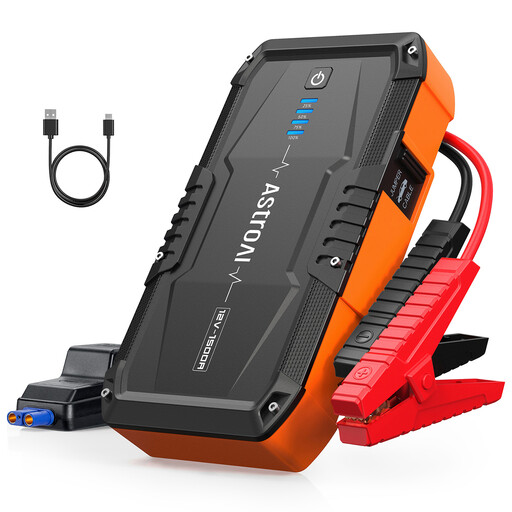
Why This Fits Their Persona: A compact option for commuters and owners of smaller petrol cars who want a basic 12V jump box for the boot.
Its stated rating is up to 6.0L petrol and 3.0L diesel engines, so buyers can compare those limits rather than relying only on the product name.
1500A peak current, dual USB-A outputs and three LED modes, including SOS.
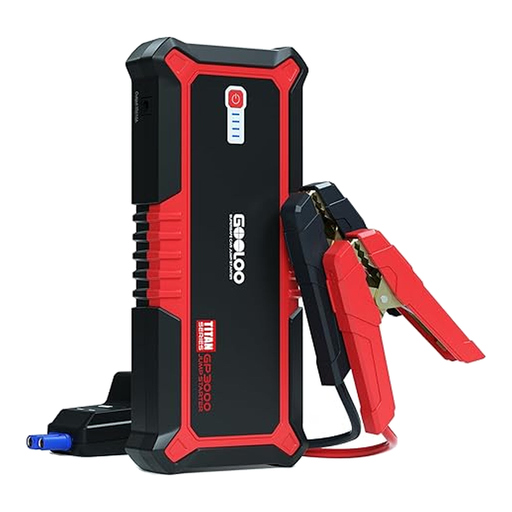
Why This Fits Their Persona: Suitable for drivers who want a sturdier unit for cars, SUVs, motorhomes, boats or occasional outdoor trips.
The stated compatibility is up to 9L petrol or 7L diesel, while the product description lists spark-proof clamps and reverse-polarity alerts.
3000A peak current, USB-C and USB quick-charge functions, plus a 15V DC port for a separate inflator.
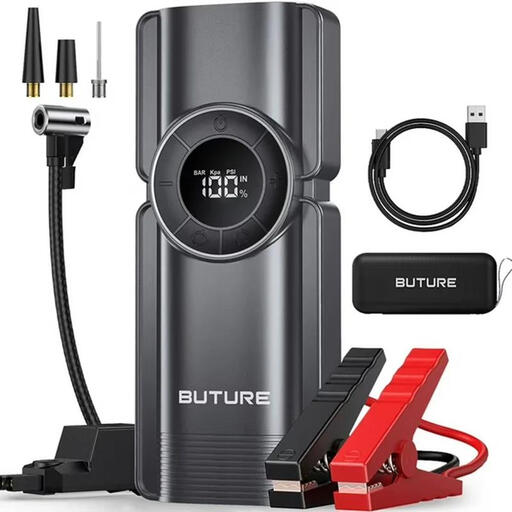
Why This Fits Their Persona: A multifunctional choice for families, MPV owners and small-van drivers who want starting assistance, tyre inflation and device charging in one case.
The listing specifies both petrol and diesel limits, a digital display, automatic inflation shut-off and multiple connection protections.
3500A peak current, compatibility up to 8.5L petrol and 8.0L diesel, and a 150 PSI compressor with presets.
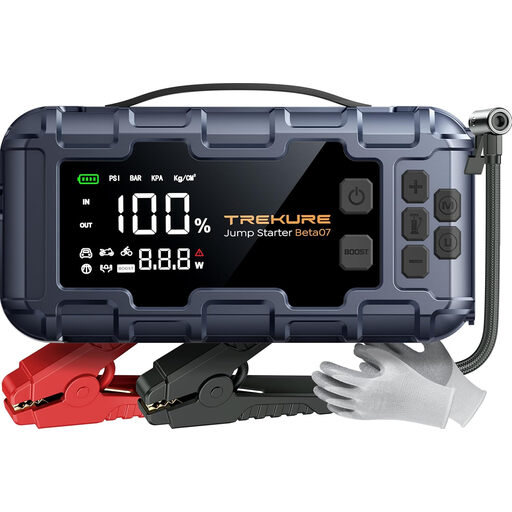
Why This Fits Their Persona: Designed for drivers of larger vehicles who prioritise higher stated engine coverage and a built-in inflator for frequent travel.
The product information states 12V petrol and diesel compatibility, while also listing compressor operating details rather than only a headline amp figure.
6000A peak current, 160 PSI compressor, 3.3-inch display, 45W USB-C charging and four LED modes.
We have compiled a complete, real-time list of products that fully satisfy these strict selection criteria and UK safety regulations.
Before connecting any battery booster pack:
If the engine does not start, avoid repeated attempts. Wait for the interval specified in the instructions and investigate other possible faults.
Some models include a boost function for very low-voltage batteries, but performance depends on the vehicle, battery condition, temperature and connection quality. A jump starter cannot resolve a damaged or internally failed battery.
Follow the product manual. Several models recommend checking or recharging every three to six months. Recharge the unit after use and store it away from prolonged heat, damp conditions and direct sunlight.
It can be useful if you regularly drive long distances, use rural roads or want a backup portable tyre inflator. If you already carry a separate compressor and only need emergency starting, a simpler car power bank may be smaller and easier to store. Ensure the compressor’s operating limits match your intended use.