
24/7 Customer Support

Free returns

Same-day & Next-day Delivery

Quality Guaranteed

Unlock Your Welcome Offers: FREE Delivery | Up to 80% OFF | Free 30-day JoyPlus trial
Download the APP
Upgrading to car LED bulbs seems like a straightforward way to modernise your vehicle, improve visibility and reduce maintenance. However, the market is flooded with options, and many UK drivers find themselves disappointed with flickering lights, dashboard error messages, or bulbs that fail within months. As a Joybuy Product Recommendation Officer, my role is to help you navigate past the marketing clutter and identify what truly matters for a successful upgrade.
Before you spend your money, be aware of these common pitfalls that catch out even savvy buyers:
Canbus error free LED bulbs, yet they still trigger warning lights on the dashboards of many modern European cars common in the UK. This happens because the LED's low power consumption makes the car's computer think the bulb has blown. A truly compatible bulb needs more than just a label; it requires specific integrated circuitry.To ensure your new bulbs are an upgrade, not a downgrade, focus on these three core parameters.
Your car's Controller Area Network (Canbus) is its central nervous system, monitoring all electronic functions, including your lights. Standard halogen bulbs have a specific electrical resistance. Because LEDs use far less power, the Canbus system can misinterpret this as a fault.
A genuinely Canbus error free LED bulb has an intelligent IC driver or built-in resistor that mimics the power draw of a halogen bulb. This "tricks" the computer into thinking everything is normal, preventing flickering and eliminating dashboard warning lights. Look for products that specify compatibility with a high percentage (e.g., 99%) of vehicles, as this often indicates a more robust Canbus solution.
Getting the fitment right is non-negotiable. Your vehicle owner's manual will specify the exact code you need, whether it's an H4 LED upgrade for your headlights, a 9006 HB4 LED for fog lights or the common T10 W5W 501 LED bulbs for interior and number plate lights.
For headlights, the physical design is just as important. A quality bulb will feature a 1:1 halogen design, meaning the LED chips are positioned exactly where the filament would be in a traditional bulb. This ensures the light is projected into the headlight housing correctly, creating a sharp, focused beam pattern with a clear cut-off. This is crucial for maximising road visibility without dazzling other road users and for passing your annual MOT.
The colour of light is measured in Kelvin (K). For a modern, crisp look, most drivers opt for bright white car bulbs in the 6000K to 6500K range. This provides excellent contrast and illumination.
However, be mindful of UK law. For forward-facing headlights, only white or yellow light is permitted. Using blue or other colours will result in an MOT failure and could attract unwanted attention from the police. While coloured bulbs can be used for car interior LED lights to create a custom ambiance, ensure your exterior lights, especially LED number plate bulbs, are a road-legal white.
Instead of a generic list, we've matched specific bulbs to the needs of different UK drivers.
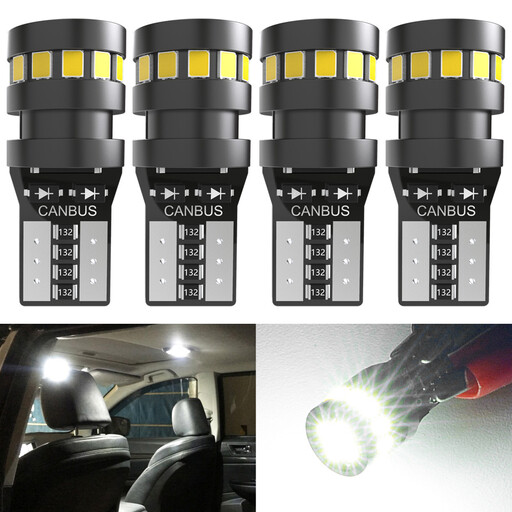
Why This Fits Their Persona: Ideal for upgrading the most common bulbs in a typical UK car—interior lights, side markers or number plate lights. It's a simple, cost-effective way to get a modern, bright white look without complex installation.
This bulb features a built-in intelligent IC driver designed to be error-free on a high percentage of vehicles, directly addressing the "Canbus Ready" mirage for these smaller, sensitive bulb replacements.
Plug-and-Play: Sized to be a direct replacement for standard T10/W5W halogen bulbs. Efficient Cooling: The full aluminium body helps dissipate heat, contributing to a longer operational life.
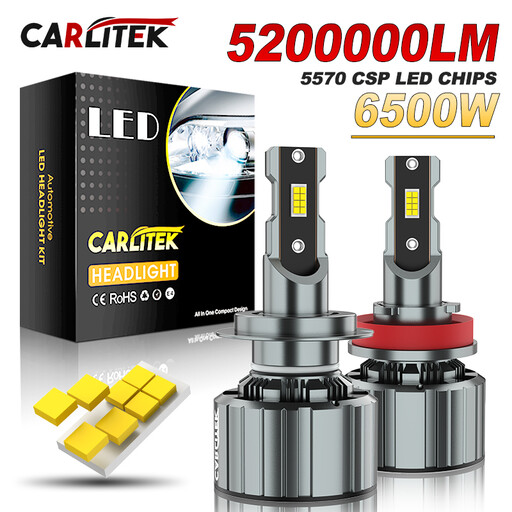
Why This Fits Their Persona: For the driver of a modern car who demands a significant, safe and error-free headlight upgrade. This H4 kit is designed for performance, focusing on beam pattern and reliability for both high and low beam functions.
It tackles the "glare trap" head-on with a 1:1 halogen filament position design, ensuring a super-focused, MOT-friendly beam. It also counters the overheating flaw with a powerful 10,000 RPM internal fan for active heat dissipation.
Superior Beam Control: The design focuses on replicating the original beam pattern to prevent dazzling others. Robust Build: Features an IP68 waterproof rating and an aluminium alloy shell for durability in all UK weather conditions.
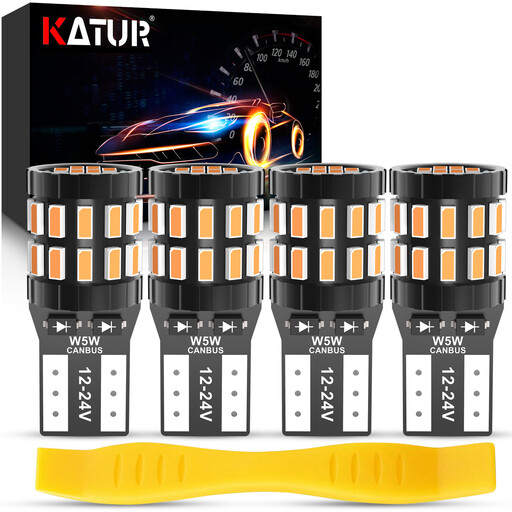
Why This Fits Their Persona: Perfect for those looking to add a custom touch to their vehicle, such as amber side markers or unique interior lighting. This bulb provides a vibrant colour while retaining the essential technical features for a hassle-free installation.
Even as a style-focused product, it includes a Canbus error-free design. This prevents the common frustration of dashboard warnings that often accompany aesthetic-only modifications, ensuring the custom look doesn't create electronic headaches.
Vibrant Colour: Offers a rich amber yellow light for a distinct look. Wide Compatibility: The 12-24V operating voltage and extensive cross-reference list (T10, 501, 168, etc.) make it suitable for a wide range of cars and motorcycles.
We have compiled a complete, real-time list of products that fully satisfy these strict selection criteria and UK safety regulations.
For many applications like car interior LED lights or number plate bulbs (using T10 W5W fittings), the process is often a direct swap. For headlights (e.g., H4, H7), bulbs with a 1:1 design are also typically plug-and-play. The most important factor is ensuring you purchase a Canbus error free model specifically suited to your vehicle to prevent dashboard warnings. Always consult your owner's manual to confirm the correct fitment code before buying.
This is a critical consideration. An LED headlight bulb will only pass an MOT if it produces the correct beam pattern with a sharp, clear cut-off that does not cause glare or dazzle for other drivers. This is why selecting a bulb that explicitly states it has a design mimicking the original halogen filament is essential. Bulbs that scatter light will fail. Furthermore, UK regulations only permit white or yellow light for headlights, so coloured options are not road-legal for this purpose.
Many manufacturers claim significant increases in brightness, such as 300% or more. While LED technology is inherently more efficient and produces more light for less power, the most noticeable improvement for drivers is the quality of the light. The crisp, bright white car bulbs (around 6000K) enhance contrast and definition on the road at night. A well-defined beam pattern is far more important for safety and visibility than a raw lumen number, as scattered light is both ineffective and dangerous.