
24/7 Customer Support

Free returns

Same-day & Next-day Delivery

Quality Guaranteed

Unlock Your Welcome Offers: FREE Delivery | Up to 80% OFF | Free 30-day JoyPlus trial
Download the APP
Replacing tired halogen or HID lighting can improve the appearance and day-to-day usability of a vehicle, but choosing car LED bulbs is not simply a case of selecting the highest lumen figure. Incorrect fitting, poor heat management and dashboard errors can turn a seemingly affordable upgrade into wasted money.
This guide explains the specifications that matter, common marketing traps and suitable options for different types of UK driver.
Large brightness figures can be difficult to compare because manufacturers may quote figures for a pair, theoretical LED output or a peak measurement rather than measured illumination on the road. A bulb can appear bright while producing an unfocused beam that causes glare or leaves dark patches.
For headlamp upgrades, look for a 1:1 filament or chip position, correct beam alignment and a compact design that suits the original reflector or projector. Always check the beam after installation and avoid using a product that dazzles approaching drivers.
A bulb may fit the socket but still be unsuitable for the housing, dust cover or vehicle electronics. Common examples include T10 W5W LED bulbs, 194/501/168 bulbs and H4 LED headlight bulbs, which can look similar but have different bases, lengths and applications.
Confirm the original bulb code in the owner’s manual or on the removed bulb. For headlamps, also check whether the vehicle uses halogen, HID or another system. D1S, D2S and D3S LED bulbs are not interchangeable simply because they share a similar appearance.
CANbus error-free LED bulbs include circuitry intended to imitate the electrical load expected by the vehicle. This can reduce flickering or bulb-out warnings, but compatibility varies between vehicles. Some cars may still require a decoder, resistor or coding adjustment.
Treat “error-free” as a useful design feature rather than a universal guarantee. Test the bulb with sidelights, dipped beam, main beam, indicators and reversing lights before completing the installation.
Match the exact code first. Relevant examples include:
Check the bulb’s overall length, base orientation and heat-sink or fan clearance. A plug-and-play car bulb is only genuinely straightforward when there is enough space behind the lamp cover.
Many products list 6000K white LED headlights or 6500K white light. These create a cool white appearance, but colour temperature alone does not determine useful visibility. Beam position and road conditions matter more.
For interior or styling applications, amber, red, blue and white options may be appropriate. For exterior lamps, confirm the required colour for the vehicle function and UK road-use requirements. The lamp must remain visible and must not create confusion with another vehicle signal.
LEDs use less power than equivalent incandescent bulbs in many applications, but they still generate heat at the LED and driver. Aluminium housings, heat sinks and cooling fans can help manage this. Fan-equipped bulbs need clearance and may produce a small operating noise.
An IP rating such as IP68 indicates a stated level of protection against dust and water under defined test conditions. It does not remove the need to fit the dust cover and seal correctly. After installation, check for flickering, condensation and loose connections.
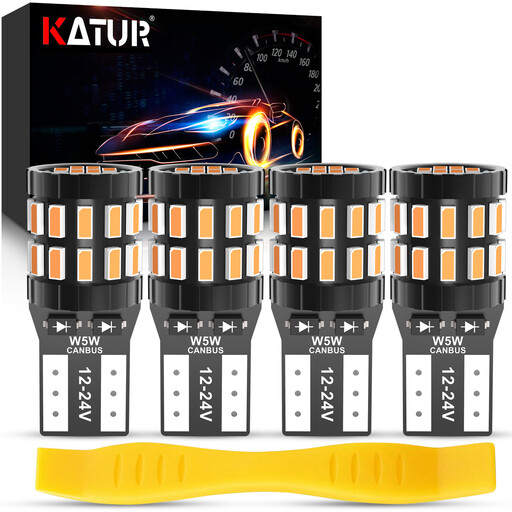
Why This Fits Their Persona: A four-pack suits drivers refreshing interior, map, door or number plate lighting without changing the full exterior lighting system.
The listing identifies T10, W5W, 194, 501 and 168 fittings, 12–24V operation and CANbus design, helping buyers compare the key details before ordering.
Amber-yellow colour, 30 SMD chips per bulb, aluminium construction and a stated 450-lumen output.
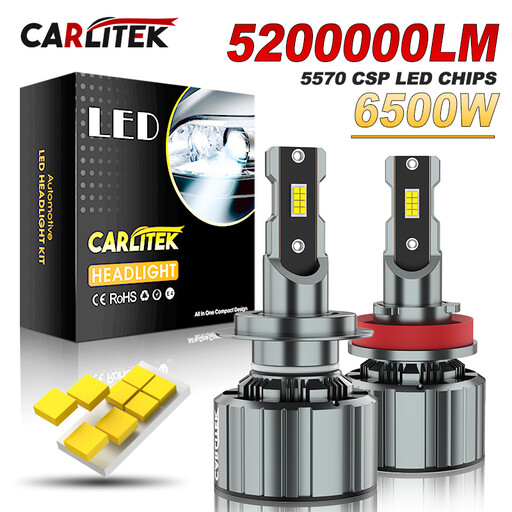
Why This Fits Their Persona: A suitable choice for owners seeking a compact front-light upgrade with integrated electronics rather than extra wiring.
The product information specifies a 1:1 design, built-in CANbus and IP68 water resistance. Buyers should still confirm the socket and available rear clearance.
12V operation, plug-and-play installation, aluminium housing and an integrated 10,000 RPM cooling fan.
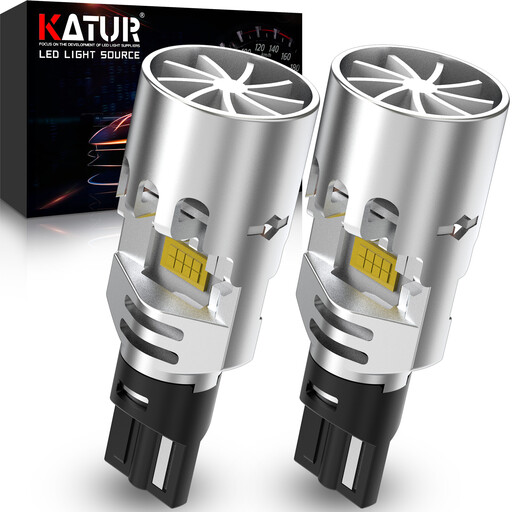
Why This Fits Their Persona: Useful for drivers who regularly reverse at night or want a stronger, whiter appearance from compatible reversing lamps.
The stated fitting includes T15, W16W, 921 and 912, while the 1:1 design helps avoid ordering a bulb that cannot lock into the original socket.
6500K white colour, stated 12–24V operation, fan cooling and CANbus-compatible design.
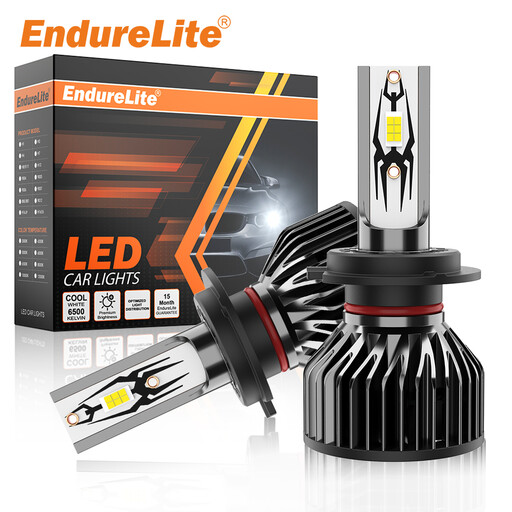
Why This Fits Their Persona: Designed for vehicles using an H4 combined high- and low-beam socket, subject to checking the original fitting and lamp approval requirements.
The listing identifies H4 high/low-beam use, 1:1 beam-pattern positioning and built-in CANbus. Beam height must still be checked after fitting.
6000K cool white colour, stated 50,000-hour operating life and integrated fan cooling.
For vehicles requiring other fittings, compare compatible D1S/D2S/D3S, 9006/HB4 or H8/H9/H11 options carefully. Interior and exterior alternatives can also be found through the broader range of CANbus error-free LED bulbs.
We have compiled a complete, real-time list of products that fully satisfy these strict selection criteria and UK safety regulations.
Before replacing a bulb, switch off the vehicle and allow the original lamp to cool. Wear gloves where appropriate, avoid touching LED chips and keep fan blades clear. Check that the seal, dust cover and connector are secure.
For headlamps, confirm that the replacement is suitable for the vehicle and lamp housing, then check alignment. UK roadworthiness requirements include appropriate beam aim, secure fitting and correct lamp operation. Product legality can depend on the vehicle, lamp type and approval status, so consult the vehicle handbook, manufacturer guidance and current MOT requirements before using a retrofit on public roads.
Many LED bulbs have lower stated wattage than incandescent equivalents, so they may use less electrical power. The actual saving depends on the number of bulbs, driving time and vehicle charging system. Choose based on compatibility and safe light output rather than energy claims alone.
Listings commonly state operating lives ranging from 50,000 to 60,000 hours. These are product specifications, not a guarantee of service life in every UK vehicle. Heat, vibration, moisture, voltage variation and frequent switching can affect durability.
Some do not require coding, particularly simple interior or number plate replacements. However, modern vehicles can monitor bulb resistance and may display an error after installation. A CANbus-compatible design can help, but always test the vehicle and follow the supplied instructions.