
24/7 Customer Support

Free returns

Same-day & Next-day Delivery

Quality Guaranteed

Unlock Your Welcome Offers: FREE Delivery | Up to 80% OFF | Free 30-day JoyPlus trial
Download the APP
Replacing standard halogen lamps with car LED bulbs can refresh your vehicle’s lighting, reduce electrical load and make interior fittings easier to see. However, choosing by colour or advertised lumen figures alone can lead to wasted money, warning lights or an unsuitable beam pattern.
The safest approach is to confirm the bulb code, check the intended fitting position and understand whether the upgrade is suitable for use on public roads.
T10, W5W, 194, 501 and 168 LED bulbs are often listed together because they share similar wedge-style dimensions. That does not guarantee they will fit every vehicle or every lamp housing. Socket depth, polarity, retaining clips and available space can differ.
For headlamps, H7, HIR2/9012 and HB4/9006 are different fitting types. An H7 LED headlight bulb should not be treated as a substitute for an HIR2 or HB4 bulb simply because the connector looks similar.
Advertised lumen figures may refer to a pair, theoretical chip output or a maximum rather than measured light delivered on the road. A high number does not automatically mean a properly controlled beam. In a reflector or projector housing, an incorrectly positioned LED chip can create glare, dark areas or an unfocused beam.
For headlight replacement bulbs, inspect the chip position, bulb orientation and housing compatibility. After installation, check the beam alignment rather than relying solely on packaging claims.
CANbus error-free LED bulbs include electronics intended to reduce dashboard warnings, flickering or bulb-out messages. Vehicle electrical systems vary, however, and some sensitive models may still need a decoder or resistor. A product described as compatible with a percentage of vehicles is not a guarantee for your specific registration, trim or lighting circuit.
Start with the original bulb, owner’s manual or a reliable vehicle fitment guide. Common applications include:
The same T10-style bulb may fit several positions, but colour requirements and road-use rules can differ. White is generally selected for interior and number plate lighting, while amber or red may be intended for specific signalling or marker applications. Do not fit a coloured bulb where it could display an incorrect legal light colour.
Most listed replacement bulbs are designed for 12V vehicle systems, while some T10 products specify a 12–24V operating range. Check whether the product is suitable for your car, van or other vehicle before ordering.
LEDs are polarity-sensitive. A plug-and-play car bulb may need to be removed and rotated if it does not illuminate on the first attempt. Switch off the vehicle before installation and allow hot halogen bulbs to cool.
LED chips produce less wasted energy than halogen filaments, but they still generate heat at the LED junction. Aluminium housings, heat sinks and cooling fans are used to manage it.
Measure the available space behind the headlamp dust cover. Fan-equipped HIR2 or HB4 bulbs may require clearance for the fan and wiring. Fanless designs can be quieter and simpler, but their heat dissipation depends on the housing and surrounding airflow.
For headlamp upgrades, also verify the beam pattern and road legality. Many aftermarket LED headlight replacement bulbs are intended for off-road or private-land use unless the particular product and vehicle combination has the required approval. Consult the manufacturer, your vehicle manual and current UK MOT and road-use requirements before using them on public roads.
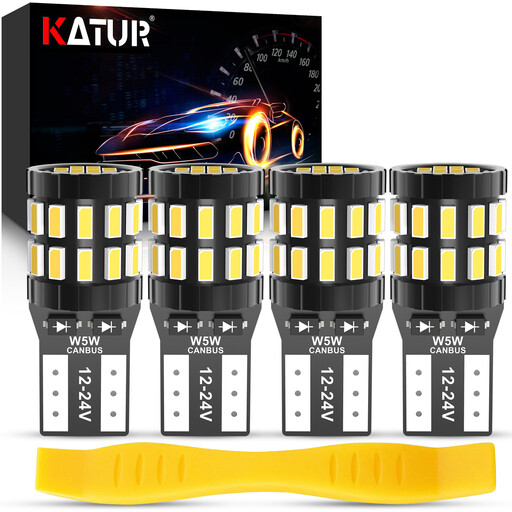
Why This Fits Their Persona: A practical four-pack for drivers replacing several interior, map, courtesy or number plate bulbs in one go.
The listing clearly groups T10, W5W, 194, 501 and 168 codes, while still requiring buyers to confirm the original bulb before purchase.
12–24V operation, 3W power rating, 450LM listed output per bulb and 30 3014 SMD chips.
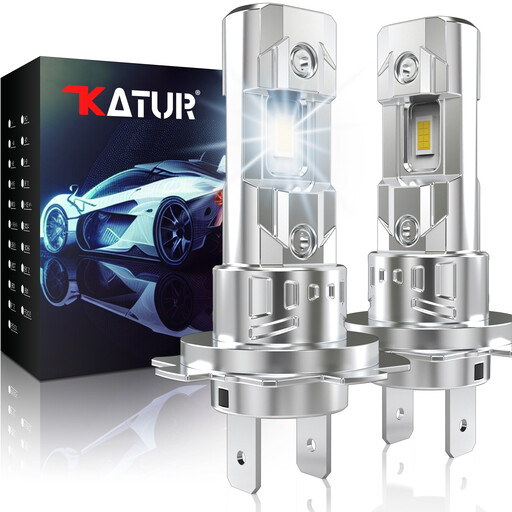
Why This Fits Their Persona: Suits owners who prioritise a compact all-in-one design and want to review the technical details carefully before considering a headlamp conversion.
Its 1:1 mini halogen-style form is designed for direct socket fitting, reducing the risk of bulky external drivers occupying the housing.
Fanless construction, 6000K white colour temperature and 80W listed per pair. Confirm legal road use and beam alignment first.
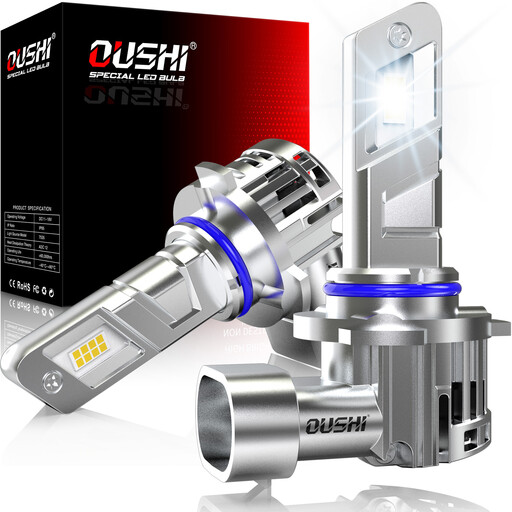
Why This Fits Their Persona: Intended for owners whose vehicle specifically uses the HIR2/9012 socket and who need an integrated cooling system for regular driving.
The product identifies the HIR2/9012 fitting and notes that some sensitive vehicles may still require a CANbus decoder.
6500K colour temperature, 1:1 mini sizing, built-in turbo fan and a listed maximum output of 30,000 lumens per pair.
Many LED replacement bulbs have a lower stated wattage than equivalent incandescent or halogen lamps. This can reduce the electrical load for the relevant circuit, although the saving for occasional interior lighting is normally modest. Compare the listed wattage rather than assuming every LED bulb uses the same amount of power.
Product listings commonly state operating-life figures such as 50,000 or 60,000 hours. These are manufacturer-listed specifications, not a guarantee of service life in every vehicle. Heat, vibration, moisture, voltage fluctuations and the quality of the vehicle housing can affect real-world durability.
Not always. A CANbus-compatible bulb may prevent warnings on many vehicles, but compatibility is vehicle-specific. If a bulb flickers, stays dimly lit or triggers a dashboard message, check the product instructions and vehicle requirements. An additional decoder or resistor may be necessary, and resistors can become hot, so they must be installed securely and safely.