
24/7 Customer Support

Free returns

Same-day & Next-day Delivery

Quality Guaranteed

Unlock Your Welcome Offers: FREE Delivery | Up to 80% OFF | Free 30-day JoyPlus trial
Download the APP
Upgrading your vehicle’s lighting is one of the most impactful changes you can make, enhancing both safety and style. However, the market for car LED lights is flooded with options, and it's easy to make a costly mistake. Many products promise incredible performance but fail to deliver, leaving you with flickering lights, dashboard error warnings or a beam pattern that's a hazard to other drivers.
As a Joybuy Product Recommendation Officer, my role is to help you navigate this complex market. We'll look past the marketing buzz and focus on the practical details that determine whether a car lighting upgrade is a worthwhile investment or a waste of money. Let's illuminate the common pitfalls and what to look for instead.
Before you add any kit to your basket, be aware of these frequent issues that catch out UK drivers:
To ensure you get a reliable and effective car lighting upgrade, focus on these three non-negotiable factors.
Your vehicle's manufacturer specifies the exact bulb type for each socket (e.g., H7 LED bulb, H11, 9006). This is not just a suggestion; it ensures the light source is positioned correctly within the headlamp housing to create a safe and legal beam pattern. Always confirm your car's required fitment before purchasing. For a straightforward upgrade, look for plug and play LED bulbs that are designed with a 1:1 size ratio to the original halogen bulbs, eliminating the need for extra adapters or modifications to the dust cover.
Colour temperature is measured in Kelvin (K) and determines the colour of the light. Factory halogen bulbs are typically around 3000K (warm yellow), while most xenon white headlights are in the 6000K to 6500K range, offering a crisp, modern look. While this is largely a matter of preference, be aware that lights with a strong blue tint (above 7000K) may not be road legal in the UK and can reduce visibility in rain or fog.
For car interior ambient lighting, the considerations are different. Here, you're looking for customisation and ease of installation. High-quality RGB car lights often use acrylic or uniform fibre optic strips rather than simple spaced-out LEDs, providing a seamless, high-end glow. Look for kits that offer app control for colour selection, dynamic modes and music synchronisation. A good LED strip lights for car kit should also have a modular design, allowing for a tidy installation without a mess of visible wires.
Based on these practical criteria, here are a few options tailored to different types of UK drivers.
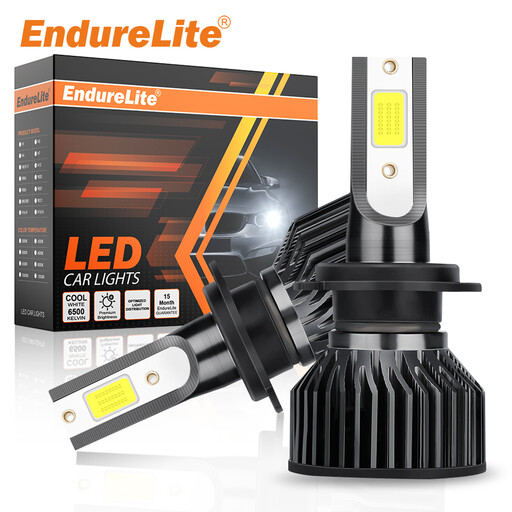
Why This Fits Their Persona: This is for the driver who wants a straightforward, effective safety upgrade without the fuss. They need improved night-time visibility for their daily commute or family car but aren't interested in complex modifications.
Its 1:1 size and plug-and-play design directly counter the installation trap. The built-in fan and aluminium body address the heat dissipation pitfall, while its CANbus-ready driver is designed to prevent error messages on most vehicles.
The beam pattern is designed to simulate the original halogen bulb, providing a focused beam that improves visibility without creating dangerous glare for other road users.
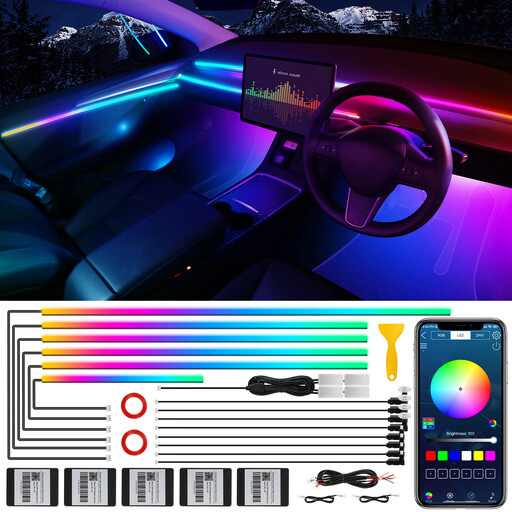
Why This Fits Their Persona: This user sees their car as an extension of their personality. They want to create a unique cabin atmosphere with dynamic, app-controlled lighting for car meets or simply to enjoy on a night drive.
Unlike cheap kits with dim, spotty lighting, this system uses acrylic strips that diffuse the light for a uniform, premium glow. The modular controller system also allows for a much cleaner and more organised installation.
It offers dual-zone control, allowing different colours and effects for the dash/doors and the footwells simultaneously. The sound-active function that syncs the lights to music is a major feature for this user profile.

Why This Fits Their Persona: This driver owns a modern vehicle, possibly a premium European brand, and demands high performance and reliability. They want a significant increase in brightness for maximum road visibility and are willing to invest in a product built for longevity.
It specifically targets the CANbus trap by incorporating an advanced system designed for compatibility with sensitive vehicle computers. The high-speed turbo fan and aviation aluminium housing directly combat the heat dissipation pitfall, crucial for maintaining high brightness.
Its main advantage is the enhanced compatibility with complex onboard systems, reducing the risk of errors. The robust cooling system is designed to support sustained high-lumen output over a long lifespan.
We have compiled a complete, real-time list of products that fully satisfy these strict selection criteria and UK safety regulations.
1. Are aftermarket car LED lights legal in the UK? The legality of aftermarket LED bulbs in the UK depends on their use and certification. For an LED headlight bulb to be road legal, it must be E-marked and installed in a headlamp unit designed for it, producing a beam pattern that does not dazzle other drivers and passes an MOT. Interior lights like RGB car lights are generally legal, provided they are not visible from the outside in a way that could distract other drivers or be mistaken for emergency lights. Always check the latest DVSA guidelines.
2. Will I need a CANbus decoder for my LED headlight bulbs? It depends on your vehicle. Many cars built after the mid-2000s, especially from brands like Volkswagen, BMW, Audi and Mercedes-Benz, have sensitive computer systems. While many LED headlight bulbs are now sold as "CANbus ready," some vehicles may still require an additional decoder to prevent dashboard errors or flickering. It is wise to check the product description for any specific exclusions.
3. How long do car LED lights actually last? Manufacturers often quote lifespans of 50,000 hours or more, but this is usually based on ideal laboratory conditions. In the real world, the lifespan of a car LED light is determined almost entirely by its heat management system. A bulb with a high-quality, high-speed fan and a well-designed aluminium heat sink will run cooler and last significantly longer than a cheap alternative with poor cooling.