
24/7 Customer Support

Free returns

Same-day & Next-day Delivery

Quality Guaranteed

Unlock Your Welcome Offers: FREE Delivery | Up to 80% OFF | Free 30-day JoyPlus trial
Download the APP
A car polisher can help apply wax, improve gloss and tackle suitable paint defects, but choosing the wrong machine can waste money or damage a vehicle’s finish. UK buyers often compare RPM figures and accessory counts without checking how the tool actually works on different panels.
The most useful choice depends on whether you want a car buffer for waxing, a dual action machine for general paint care or a compact car detailing polisher for wheels, mirrors and narrow bodywork.
A higher speed is not automatically more suitable. A rotary car polisher transfers direct rotational force to the pad, which can remove defects quickly but may create excess heat or uneven marks if used incorrectly. A dual action car polisher or random orbital polisher moves the pad in an eccentric orbit as well as rotating, generally offering more forgiving control for many DIY users.
Check the operating mode, speed range and whether the machine has a soft start or variable speed control. These features are more useful than a headline maximum RPM alone.
A rechargeable car polisher is convenient around driveways, outdoor sockets and awkward areas, but battery runtime varies significantly. Some compact tools are intended for spot correction rather than continuous bonnet-to-boot polishing.
Check the number and capacity of batteries, charging time, stated runtime and any thermal protection. For example, a mini tool may be practical for door handles and wheel spokes but inefficient for polishing an entire SUV.
A large accessory bundle can appear attractive, yet the included polishing pads may not match the backing plate size or the compound you intend to use. Before buying, confirm:
A well-matched pad and compound normally matter more than having numerous unused accessories.
For general vehicle paint polishing, a dual action (DA) polisher is often a practical starting point. Its orbital movement can help spread wax, refine gloss and work on light defects with a more controlled action.
A rotary car polisher uses a direct circular motion. It can suit experienced users, workshops and targeted correction, but requires careful speed, pressure and pad management. A dual-system tool that switches between DA and rotary modes can provide flexibility for different jobs, although it may involve more setup and accessory changes.
Choose a machine with several speed settings rather than relying on a single operating speed. Lower speeds are commonly used for spreading waxes, sealants and glazes, while higher settings may be used for selected correction or oxidation-removal tasks.
RPM values should be compared within the same operating mode. A mini polishing head can have a much higher RPM range than a five-inch DA machine because it is designed for small pads and detailed areas. Start at the lowest suitable setting, keep the pad moving and follow the compound and pad manufacturer’s instructions.
Mains-powered tools provide continuous operation, which can be useful for full vehicle polishing. A 1100 W wired car polishing machine, for example, avoids battery changes but requires safe access to a suitable socket and careful cable management.
Cordless models offer easier movement and are useful for mobile detailing, motorcycles and tight areas. Weight, grip design and balance also affect fatigue. Look for a side handle or D-shaped handle on larger machines and a secure one-handed grip on mini polishers.
For electrical products in the UK, check the listing, packaging and instructions for relevant UKCA or CE marking, supply information, charger specifications and safety guidance. Do not use a tool in wet conditions unless the manufacturer specifically states that it is suitable.
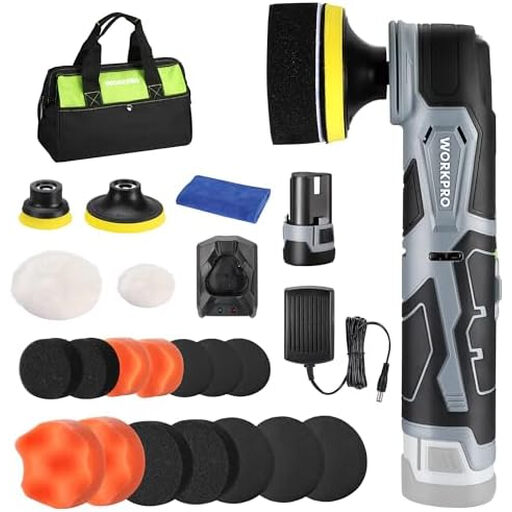
Why This Fits Their Persona: A lightweight 0.85 kg cordless tool suits occasional driveway waxing, spot polishing and small detailing jobs where portability matters.
Its five speed settings, battery indicator and standard-sized replacement parts make the specification easier to understand before purchase.
Includes a 2.0 Ah battery, fast charger, carrying bag, sanding discs and multiple wool and sponge pads.
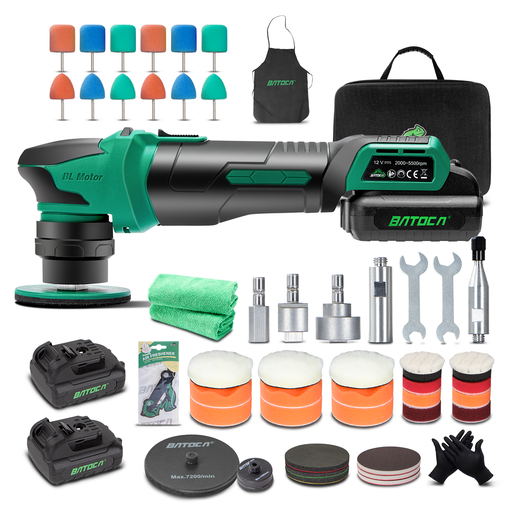
Why This Fits Their Persona: The brushless motor, dual polishing systems and two 12 V 2.5 Ah batteries suit detailers who want a compact but adaptable cordless setup.
It clearly specifies 25 mm and 75 mm backing plates, rotary and orbital modes and a 2,000–5,500 RPM range.
Includes an extension rod and mini pads for bumpers, mirrors, wheels and confined areas.
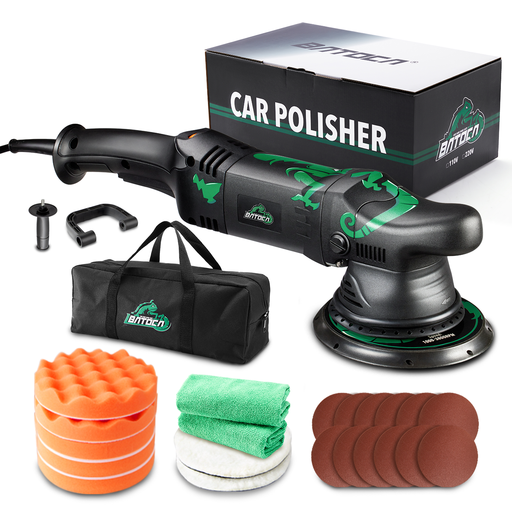
Why This Fits Their Persona: The wired format is suitable for users polishing larger vehicles, boats, motorcycles or multiple panels without stopping to recharge.
Its 1100 W motor, six speed levels and 5-inch pad format provide measurable information beyond a vague “powerful” label.
The 2,500–5,500 RPM range and removable side and D-shaped handles support different polishing positions.
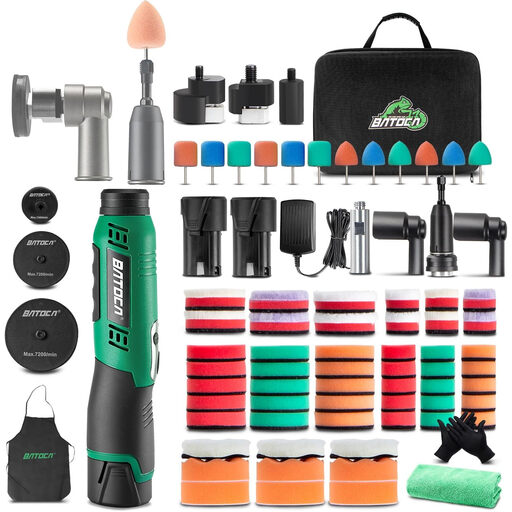
Why This Fits Their Persona: This compact cordless machine is designed for motorcycles, rims, mirror housings, door jambs and other areas that larger tools may not reach comfortably.
It uses separate backing plate sizes and switchable DA and rotary modes, rather than presenting one large pad as a solution for every task.
Includes two 12 V 2.0 Ah batteries, 25 mm, 50 mm and 75 mm backing plates, plus speeds up to 21,000 RPM for mini heads.
We have compiled a complete, real-time list of products that fully satisfy these strict selection criteria and UK safety regulations.
A DA machine is often easier to control than a rotary tool because its orbital movement can reduce the likelihood of concentrated heat in one spot. Beginners should still use the lowest practical speed, avoid excessive pressure and follow the pad and compound instructions.
Runtime depends on battery capacity, speed, pressure, pad size and workload. Some models provide a stated no-load runtime, which is not the same as continuous polishing under load. Two batteries can be useful for larger jobs, while a compact tool may be more appropriate for short detailing sessions.
A mains-powered tool adds a small electricity cost but can operate continuously. Cordless models require charging and may eventually need replacement batteries. Factor in polishing pads, compounds, backing plates and batteries when comparing the total ownership cost rather than focusing only on the initial price.