
24/7 Customer Support

Free returns

Same-day & Next-day Delivery

Quality Guaranteed

Unlock Your Welcome Offers: FREE Delivery | Up to 80% OFF | Free 30-day JoyPlus trial
Download the APP
Achieving a flawless, mirror-like finish on your car's paintwork is a satisfying goal for any enthusiast. A quality car polisher is the key to removing swirl marks, light scratches and oxidation, restoring that showroom shine. However, the market is filled with options, and it's easy to make a costly mistake. As a Joybuy Product Recommendation Officer, my role is to help you navigate the choices and find a tool that delivers results without the risk.
Before you invest, be aware of three common pitfalls that can lead to disappointment, wasted money or even damaged paintwork:
To avoid these traps, it's essential to understand a few key parameters. Focussing on these will ensure you select a machine that is safe, effective and suited to your skill level.
This is the single most important factor to consider.
Your choice here depends on a trade-off between consistent power and ultimate manoeuvrability.
For dual action polishers, the 'throw' refers to the size of the orbit the pad makes, measured in millimetres (mm). A larger throw (e.g., 15mm or 21mm) covers more surface area with each rotation, allowing for faster correction on large, flat panels like a bonnet or roof. A smaller throw (e.g., 8mm or 12mm) offers more control and is better suited to curved body panels and more intricate areas.
Based on these practical considerations, here are a few options from our catalogue, matched to different user needs.
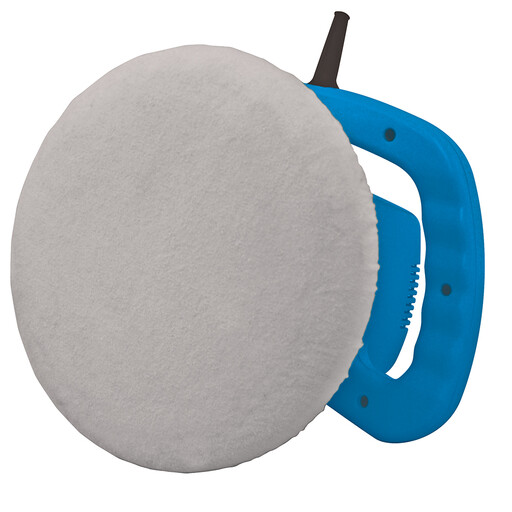
Why This Fits Their Persona: An ideal entry point for those new to machine polishing. It's a straightforward, corded tool that prioritises safety over aggressive power, allowing you to learn the craft of paint correction without the fear of causing damage.
Its random orbit action is specifically designed to eliminate the risk of swirl marks and paint burn (avoiding Pitfalls 1 & 3). As a corded model, it completely bypasses any concerns about battery life (Pitfall 2).
The 240mm dual-density foam pad conforms well to vehicle contours. The kit includes both polishing and finishing bonnets, so it's ready to use straight out of the box.
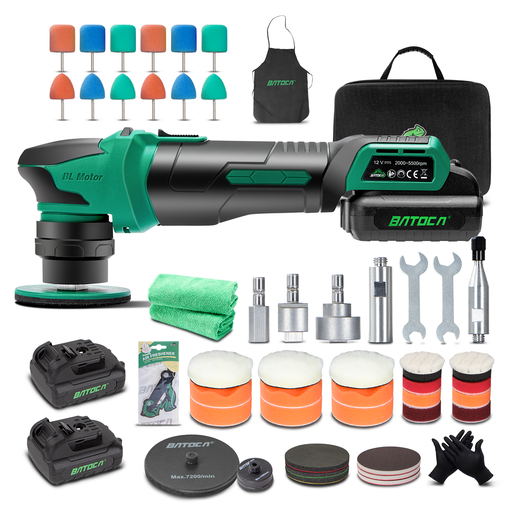
Why This Fits Their Persona: For the enthusiast or professional who needs to perfect the details. This mini polisher for detailing is built to tackle intricate areas like A-pillars, mirror housings, bumpers and wheels where a full-size machine cannot fit.
This is a specialised tool where cordless freedom is a genuine necessity for manoeuvrability. It includes two 2.5Ah batteries, addressing the runtime pitfall for its intended use case. Its dual rotary/orbital function provides professional-level flexibility.
The kit includes 25mm and 75mm back plates and an extension rod for unparalleled access. The brushless motor provides efficient power delivery and a longer tool lifespan.

Why This Fits Their Persona: For the user who wants to tackle a full vehicle correction without being tethered by a cord. This machine offers a strong balance of power, runtime and ergonomic design for completing larger jobs efficiently.
It directly solves the cordless runtime pitfall (Pitfall 2) by including two high-capacity 5.0Ah batteries, each providing around 60 minutes of use. The LCD screen gives a clear indication of remaining power, preventing unexpected shutdowns.
Features a versatile 8mm orbit and a standard 125mm pad size. The intelligent LCD display for speed and battery status provides excellent user feedback and control during operation.
We have compiled a complete, real-time list of products that fully satisfy these strict selection criteria and UK safety regulations.
In the UK, the terms are often used interchangeably. Generally, a "polisher" is a machine used with abrasive compounds for car paint correction to remove imperfections. A "buffer" or "waxer" can sometimes refer to a less aggressive orbital machine used only for applying a final layer of wax or sealant. Most modern dual action polishers are versatile enough to perform both tasks effectively.
This varies significantly between models. A key specification to check is the battery's Amp-hour (Ah) rating. For light, detailed work, a 2.0Ah battery might suffice for 20-30 minutes. For polishing larger panels, a 4.0Ah or 5.0Ah battery is much more practical, often providing 45-60 minutes of runtime. Many comprehensive car polishing kits include a second battery, which is a major advantage for uninterrupted work.
Yes, it is possible to damage paint, particularly with an aggressive rotary polisher if you lack experience. For anyone other than a seasoned professional, a dual action (DA) polisher is a much safer choice. It generates less focused heat and is far more forgiving, minimising the risk of burning through the clear coat. Always start on the lowest speed setting, use light pressure and test on a small, inconspicuous area first.