
24/7 Customer Support

Free returns

Same-day & Next-day Delivery

Quality Guaranteed

Unlock Your Welcome Offers: FREE Delivery | Up to 80% OFF | Free 30-day JoyPlus trial
Download the APP
A suitable car polishing kit can make paint maintenance, waxing and small-area correction more manageable. However, the wrong machine or pad combination may create more work than it saves, particularly when working on a daily driver, classic vehicle or hard-to-reach trim.
Joybuy Product Recommendation Officer guidance focuses on practical specifications rather than inflated marketing language. Before purchasing, check the following common pitfalls and match the equipment to the type of detailing you actually carry out.
A high maximum speed can be useful for certain correction tasks, but it also increases the risk of heat build-up, uneven cutting and damage to delicate paint if the user applies too much pressure. A useful machine should offer a low starting speed and several adjustable settings, rather than only advertising a high top speed.
For waxing and spreading product, lower speeds are generally easier to control. Higher settings may be suitable for oxidation or paint defect work, but the correct pad, compound and technique remain important.
The terms rotary and orbital polisher describe different movements. A rotary polisher spins the pad around a fixed centre point, while an orbital machine also moves the pad in an eccentric or random orbit.
Rotary tools can offer precise spot work, but require careful handling. Orbital movement may be more forgiving for general DIY polishing and finishing. Some compact tools combine both systems, but you should confirm how the drive is changed and whether separate shafts or backing plates are included.
A cordless car polisher is convenient around driveways and garages because there is no trailing mains cable. However, battery capacity, charging time and the availability of replacement batteries affect how practical it is for longer sessions.
A kit with two batteries can reduce interruptions, while a smaller battery-powered polisher may suit occasional panel or trim work. Check whether the stated runtime is measured under no-load conditions, as polishing pressure and pad friction can reduce actual operating time.
Look for a clear speed-control system with multiple settings. The products listed here use speed ranges from around 2,000 to 5,500 revolutions per minute (RPM), while some compact rotary machines start at lower speeds for gentle application work.
Keep the machine moving and avoid pressing heavily in one area. Some models include thermal protection. For example, the WORKPRO unit is listed as entering overheat protection after approximately six to seven minutes of high-speed use. This is a useful operating limitation to understand before buying rather than treating it as a fault.
A mini car polisher is designed for smaller areas, such as bumpers, mirror housings, wheel details, emblems, headlights and narrow body lines. Check the supplied plate sizes carefully. Smaller plates improve access and control, while larger pads cover more surface per pass.
Also confirm whether the kit includes hook-and-loop backing plates, direct-clamp pads or a drill adapter. These fittings are not automatically interchangeable. Replacement car polishing pads should match the backing plate diameter and attachment method.
Pad hardness affects how aggressively the tool interacts with the surface:
Use separate pads for cutting compounds, finishing polish and wax. Wash reusable pads promptly after use, allow them to dry fully and replace any pad that is torn, contaminated or heavily worn. Always follow the compound and pad manufacturer’s instructions and try the least aggressive combination on an inconspicuous area first.
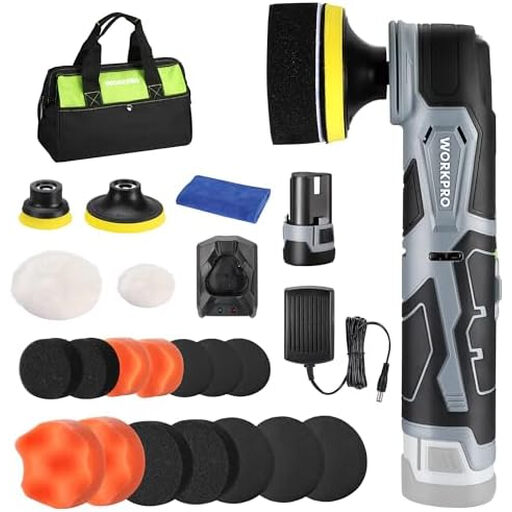
Why This Fits Their Persona: Its compact format and included accessories suit UK vehicle owners handling occasional waxing, spot polishing and light sanding at home.
The five speed settings run from 600 to 3,000 RPM, giving beginners a lower-speed starting point instead of forcing high-speed operation.
Includes a 2.0 Ah battery, charger, wool and sponge pads, sandpapers, towel and carrying bag. The listed weight is 0.85 kg.
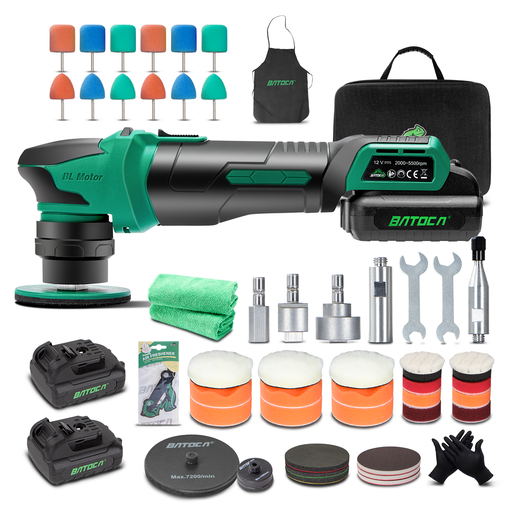
Why This Fits Their Persona: Detailers, classic-car hobbyists and careful DIY users may value its dual drive system and accessory selection for varied finishing work.
The system provides rotary, 3 mm orbital and 12 mm orbital options, so users can select movement according to the area and task.
It includes two 12 V 2.5 Ah batteries, a brushless motor, 25 mm and 75 mm plates, four speeds and an extension rod.
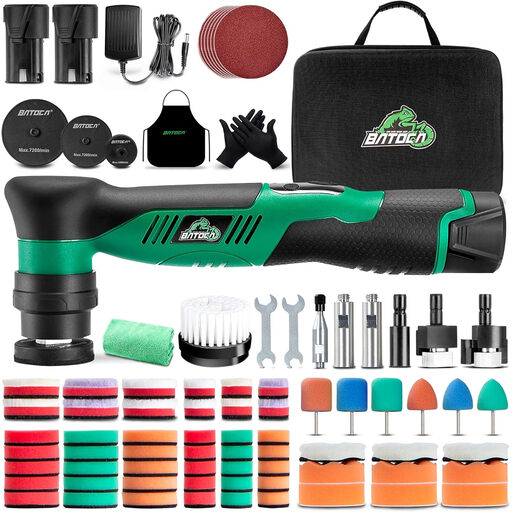
Why This Fits Their Persona: Users working on headlights, wheels, emblems, body lines and other confined areas can benefit from its small plates and changeable polishing modes.
Its stated 2,000–5,500 RPM range offers six settings, while the two-battery arrangement helps reduce downtime during multi-area detailing.
The kit includes 25 mm, 50 mm and 75 mm polishing pads, with rotary, 3 mm orbital and 12 mm orbital configurations.
A machine is only part of a practical car detailing polisher setup. A separate set of polishing sponge pads can provide different levels of firmness for cutting and finishing. The listed eight-piece pad set includes foam pads, a synthetic wool pad, a hook-and-loop base and an M10 drill adapter. Check the adapter and tool’s speed limits before use.
For hand application, the Turtle Wax Grip-It Car Detailing Applicator Pads include three pads with handles and hook-and-loop fastening. They are listed for polishing, waxing and cleaning surfaces such as painted metal, plastic and leather. These are useful when a machine would be excessive or unsuitable for trim and interior work.
A headlight polishing kit or small pad set can help with access around lamps, but cloudy or damaged lenses may require more than polishing. Follow product instructions, protect surrounding paintwork and avoid treating visibility-related damage as a simple cosmetic issue.
We have compiled a complete, real-time list of products that fully satisfy these strict selection criteria and UK safety regulations.
Yes, provided the machine supports a low speed and you use a compatible soft pad. Apply a small amount of wax, keep the pad moving and avoid pressing heavily. Some waxes are designed for hand application, so check the product instructions first.
There is no fixed lifespan. A pad may last through several detailing sessions when cleaned promptly, dried correctly and stored away from dust and heat. Replace it when the foam is compressed, torn, contaminated or no longer attaching securely to the backing plate.
An orbital polisher is often easier to control for general polishing because its movement is not limited to one fixed rotation point. A rotary system can be useful for concentrated work, but requires more attention to speed, pressure and heat. Whichever paint correction tool you choose, begin at a low setting on a test area.