
24/7 Customer Support

Free returns

Same-day & Next-day Delivery

Quality Guaranteed

Unlock Your Welcome Offers: FREE Delivery | Up to 80% OFF | Free 30-day JoyPlus trial
Download the APP
A car polishing machine can make paintwork, trim and wheels easier to maintain, but choosing the wrong type often leads to poor results, short battery life or a tool that is unsuitable for the surface. UK buyers also need to consider mains power, dust control, replacement pads and safe operating conditions before placing an order.
The most common purchasing mistakes are not always obvious from a product listing.
A high RPM figure may look impressive, but speed alone does not determine how suitable a machine is for vehicle polishing. A rotary polisher spins directly around the spindle and can remove material quickly, but it demands careful pressure and movement to avoid heat build-up.
An orbital polisher, including a dual action polisher, combines rotation with an eccentric movement. This can provide more forgiving control for general paint care and waxing. However, orbital movement, stroke size and pad diameter still matter. A machine designed for small details may be inefficient on a whole vehicle.
Battery capacity should be considered alongside the number of batteries supplied, charging time and the way the tool is used. A stated runtime may refer to light or no-load use rather than continuous polishing under pressure.
A cordless car polisher with two batteries can be more practical than a single-battery model, particularly when working outdoors, on a driveway or around a large SUV. Check whether replacement batteries are available and whether the charging arrangement suits UK mains use.
A random orbital sander and a car polishing machine may appear similar, but their pads, speed ranges and intended applications can differ. Sanders are generally designed for removing and smoothing material from wood, metal or painted surfaces. They may collect dust but are not automatically suitable for applying wax or polishing delicate automotive paint.
Likewise, a compact detail sander is useful for corners and small wooden surfaces, but its pointed sanding base is not a substitute for a round polishing pad.
For general car care, a dual-action or random orbital system is often easier to control than a direct-drive rotary polisher. An eccentric orbit such as 8 mm can provide a balance between coverage and movement, while smaller strokes are more appropriate for compact detailing areas.
Some mini polishing machines offer both DA and RO modes. This gives you a rotary setting for precise spot work and an orbital setting for more controlled polishing. Always start at a low speed, keep the pad moving and avoid pressing heavily on edges or raised body lines.
Variable speed is more useful than a single maximum speed. Look for clearly stated speed levels and a soft-start function, which can help reduce product splatter when beginning a pass.
For example, the BATOCA S2 lists six speeds from 2,000 to 4,500 RPM, while the BATOCA S4 lists four settings from 2,000 to 5,500 RPM. A mini polishing machine may show a much higher RPM figure because it uses a smaller pad; this does not make it directly comparable with a 125 mm machine.
A 125 mm pad is a practical size for larger painted panels, whereas 25 mm, 50 mm or 75 mm backing plates are more suitable for mirrors, bumpers, wheels, door jambs and narrow trim.
For sanding furniture or preparing wood, dust collection is a more important feature than it is for liquid car polish. An electric sander with a dust bag or vacuum adaptor can reduce loose debris, but it does not remove the need for eye protection and a suitable dust mask. Check that sanding discs have the correct diameter, hole pattern and hook-and-loop attachment.
Before use in the UK, check the supplied plug, charging requirements, operating instructions and any applicable UKCA marking or other required conformity information. Do not assume that a product is suitable for wet conditions unless its documentation specifically confirms this.
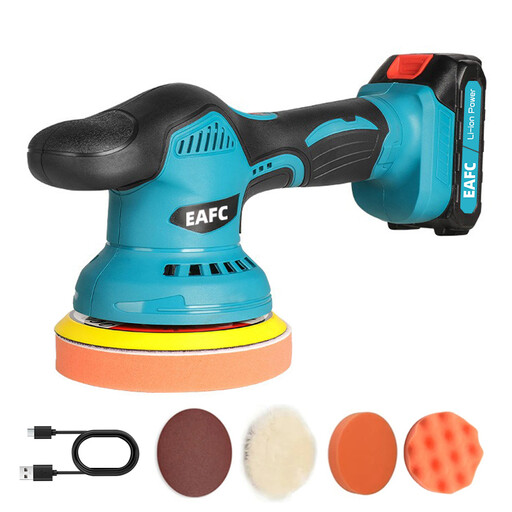
Why This Fits Their Persona: A cordless format suits occasional driveway users who want one machine for car waxing, light polishing and selected DIY jobs without managing a mains cable.
Its eight adjustable settings make the speed range clearer than a single headline RPM figure, while the 5 mm random orbit is intended for more uniform movement.
125 mm disc; 2,800–5,500 RPM range; supplied with polishing discs, sanding paper and a Type-C charging cable.

Why This Fits Their Persona: This option suits vehicle owners who want a dedicated battery polisher with visible operating information and enough capacity for larger detailing sessions.
The LCD display shows speed and battery information, while two batteries reduce dependence on stopping for a recharge.
Two 5 Ah batteries; approximately 60 minutes of runtime per battery as listed; 8 mm eccentric action; 125 mm pad.
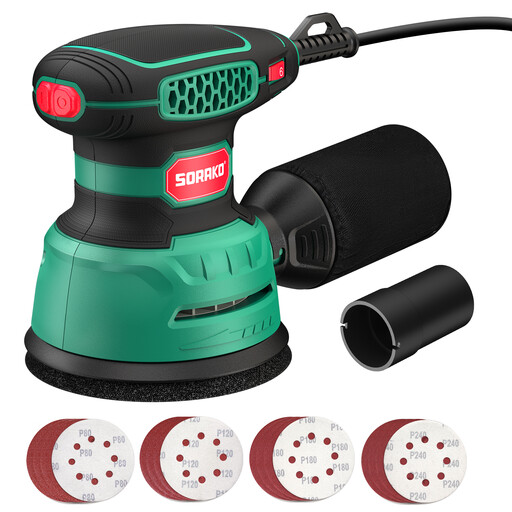
Why This Fits Their Persona: A suitable choice for DIY users working on furniture, wood, metal finishing or paint removal who need a corded car detailing machine alternative for workshop preparation tasks.
Its built-in extraction, dust bag and external collector adaptor address the common problem of sanding debris spreading around a home workshop.
350 W motor; six speeds up to 13,000 RPM; 8-hole suction base; electric brake; 16 sanding sheets included.
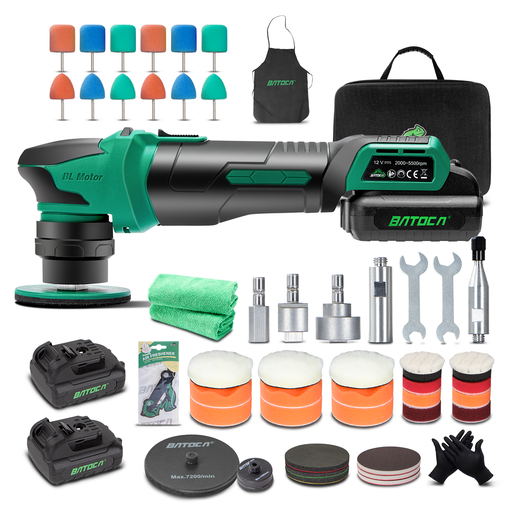
Why This Fits Their Persona: Designed for narrow areas such as wheels, bumpers, mirrors and interior corners where a full-size polisher can be difficult to control.
Rather than relying on one large pad, it provides 25 mm and 75 mm backing plates, plus rotary and orbital systems for different detail areas.
Brushless motor; two 12 V 2.5 Ah batteries; 2,000–5,500 RPM; 3 mm and 12 mm orbital options; extension rod included.
Avoid using a wood sander or detail sander on vehicle paint unless the manufacturer’s instructions specifically support that application. For furniture, rust removal and surface preparation, use the correct abrasive grade and allow the machine to do the work rather than forcing it into the material.
We have compiled a complete, real-time list of products that fully satisfy these strict selection criteria and UK safety regulations.
An orbital polisher is generally more forgiving because the pad moves on an eccentric path rather than only spinning around one fixed point. It can still generate heat, so low-speed operation, pad movement and moderate pressure remain important.
Some models are suitable for spreading waxes, sealants or glazes, but check the instructions and use a compatible soft pad. A machine marketed for sanding may have a different pad surface or speed range and should not automatically be used for vehicle finishing.