
24/7 Customer Support

Free returns

Same-day & Next-day Delivery

Quality Guaranteed

Unlock Your Welcome Offers: FREE Delivery | Up to 80% OFF | Free 30-day JoyPlus trial
Download the APP
A car polishing machine can reduce the time and effort required to apply wax, improve the appearance of tired paintwork and reach awkward areas around bumpers, mirrors and wheels. However, choosing a suitable model involves more than comparing RPM figures.
Many UK buyers encounter the same avoidable problems:
The right car polishing machine should match your work area, finish requirements, power preference and tolerance for cables, vibration and charging breaks.
An orbital car polisher, also called a DA polisher, moves the pad in an eccentric orbit. This distributes movement across the surface and is generally easier for beginners to control when waxing or carrying out light paint refinement.
A rotary polisher spins the pad around a fixed centre point. It can provide concentrated action for specific correction work, but requires careful speed, pad and compound selection. A dual-action model that can switch between DA and rotary modes offers more flexibility for detailing, although its accessories and operating instructions should be checked closely.
For small marks, trim areas, motorcycle parts and narrow panels, a mini car polisher can be easier to position than a full-size machine.
Variable speed settings are important because different tasks require different movement levels:
A machine with five or six settings may offer more practical control than one with a single high-speed rating. For example, the WORKPRO cordless car polisher offers five settings from 600 to 3,000 RPM, while the BATOCA S2 provides six settings between 2,000 and 4,500 RPM.
Do not use a high setting simply to finish faster. Work in small sections, keep the pad moving and follow the product instructions for the compound or wax.
A cordless car polisher removes the need to manage a mains cable around the vehicle, which can be useful on driveways or in shared parking areas. However, battery runtime varies according to speed, pressure, pad size and surface resistance.
Check:
A 125 mm pad can cover larger panels efficiently, while smaller backing plates are more suitable for door edges, alloy wheel details and tight spaces. A car detailing polisher should feel controllable rather than simply powerful.
The following selections use the listed specifications to match different types of users, rather than treating one machine as suitable for every job.
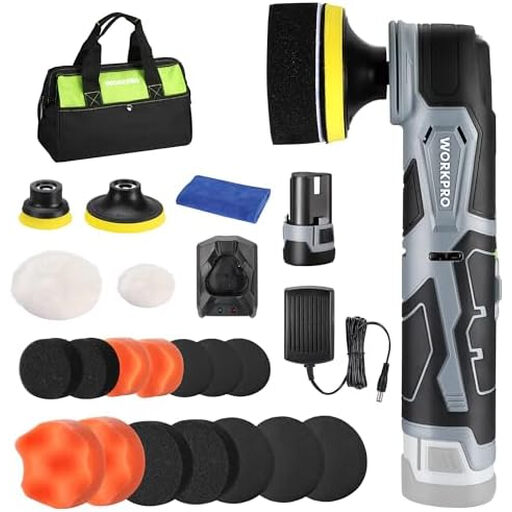
Why This Fits Their Persona: A compact battery car polisher suits occasional driveway detailing, small vehicles and users who want a portable tool without committing to a larger machine.
Its five speed settings avoid relying on one fixed speed, while the product information clearly notes a high-speed overheat protection pause after approximately 6–7 minutes.
Includes a 2.0 Ah battery, charger, carrying bag, multiple pads and a 0.85 kg compact body for one-handed detail work.

Why This Fits Their Persona: Suitable for users who value runtime information, speed visibility and a larger 125 mm polishing setup for repeated vehicle care.
The LCD display shows speed and battery information, and two 5 Ah batteries reduce the need to stop for an immediate recharge.
Offers six speed settings, an 8 mm eccentric orbit, 125 mm pad size, soft start and stated runtime of approximately 60 minutes per battery.
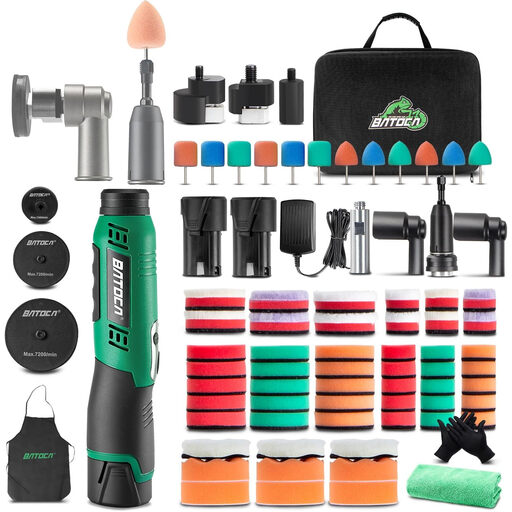
Why This Fits Their Persona: A practical match for detailers, motorcycle owners and vehicle enthusiasts handling wheel rims, mirror housings, door jambs and other confined areas.
It is designed around detail work rather than relying on a large pad, with switchable DA and rotary operation plus 25 mm, 50 mm and 75 mm backing plates.
Includes two 12 V 2.0 Ah batteries, six speed settings and separate RO/DA and mini polishing speed ranges.
Before using any polishing machine for cars, wash and dry the panel so grit does not create additional scratches. Inspect pads for embedded debris and keep compounds away from unpainted rubber or porous trim unless the product instructions permit it.
Use safety goggles and a suitable dust mask when sanding, stripping paint or removing rust. Keep hands away from moving parts, disconnect mains-powered tools before changing discs and avoid using electrical equipment in wet conditions. For cordless tools, charge batteries with the supplied charger and store them according to the manufacturer’s instructions.
A car polishing kit can also support furniture finishing, wood sanding and metal polishing, but sanding discs and polishing pads are not interchangeable by assumption. Check the backing system, diameter and attachment method first.
For detail sanding rather than polishing, the HYCHIKA 200 W detail sander includes a six-hole dust collection system and 12 hook-and-loop sanding sheets in P80, P120 and P240 grades. The HYCHIKA 300 W random orbital sander adds six speed settings from 6,000 to 13,000 RPM and a 125 mm disc. These are more suitable for wood, furniture, metal and paint-stripping tasks than conventional automotive paint polishing.
It can be, provided the battery runtime, charging time and pad size suit the job. Models with two batteries can reduce interruptions, while compact polishers are more convenient for spot correction and detailed areas than large panels.
A DA polisher combines rotation with an eccentric orbit, which can make it easier to control for general polishing and waxing. A rotary polisher uses fixed-axis rotation and can concentrate its action more strongly. Beginners should start at a low setting and use appropriate pads and compounds for the surface.
Service life depends on charging habits, storage, dust exposure, workload and maintenance. Clean the vents and exterior, avoid forcing the pad against the panel, allow overheating protection to operate and replace worn pads rather than continuing with damaged accessories.