
24/7 Customer Support

Free returns

Same-day & Next-day Delivery

Quality Guaranteed

Unlock Your Welcome Offers: FREE Delivery | Up to 80% OFF | Free 30-day JoyPlus trial
Download the APP
A car polishing machine can make waxing, paint correction and routine detailing faster, but the wrong model may create more work than it saves. UK car owners often encounter machines advertised with impressive speed figures, large accessory bundles or vague claims about “professional” performance. These descriptions do not always explain whether the tool suits delicate paintwork, tight areas or occasional driveway use.
Before buying a car polisher, look beyond the headline specification. Three common traps deserve particular attention:
A dual action car polisher, also called an orbital polisher, combines rotation with an eccentric movement. This can provide more forgiving operation for beginners and is suitable for waxing, light polishing and reducing the appearance of some surface marks when used with the correct compound.
A rotary polisher spins on a fixed axis. It can offer direct cutting action for demanding correction work, but it requires greater control. It is easier to overheat a panel or create uneven results if you remain in one area for too long.
Some compact machines combine both systems. The BATOCA S5, for example, offers a rotary setting plus 3 mm and 12 mm orbital movements, allowing the user to select a mode for larger panels or detailed areas.
Check the backing plate diameter before ordering car polishing pads. A 5-inch machine requires appropriately sized pads, while a compact headlight polishing kit may use 25 mm, 50 mm or 75 mm accessories.
Hook-and-loop fittings make pad changes convenient, but the backing plate still needs to be compatible. The 8-piece foam set listed below includes an M10 drill adapter, a hook-and-loop base and several foam and synthetic wool pads. It is intended for compatible drills, pneumatic polishers and electric polishers, so confirm your tool’s thread and attachment system first.
Variable speed is more useful than maximum speed alone. Lower settings are generally more appropriate for spreading wax or finishing, while higher settings may be selected for heavier correction work. Always follow the machine and compound instructions, and avoid applying excessive pressure.
For extended detailing, consider:
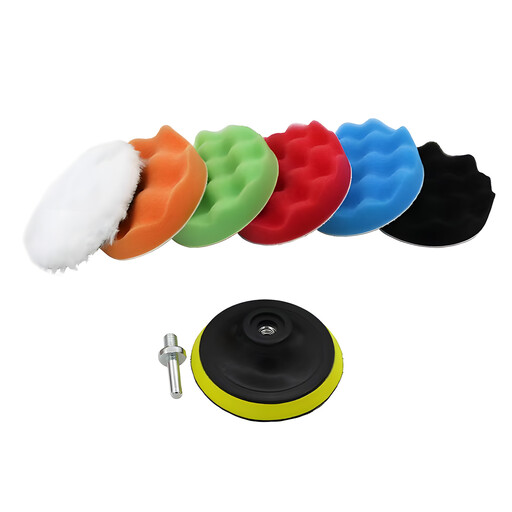
Why This Fits Their Persona: A practical choice for occasional driveway detailing, particularly if you already own a compatible drill or polisher and want several pad types without buying accessories separately.
The set lists its M10 adapter, hook-and-loop base and pad types, making the attachment arrangement clearer than an unspecified accessory bundle. Check the actual dimensions before use.
Includes five foam pads, one synthetic wool pad, an adapter, backing base and screw. The pads are washable and reusable according to the listing.
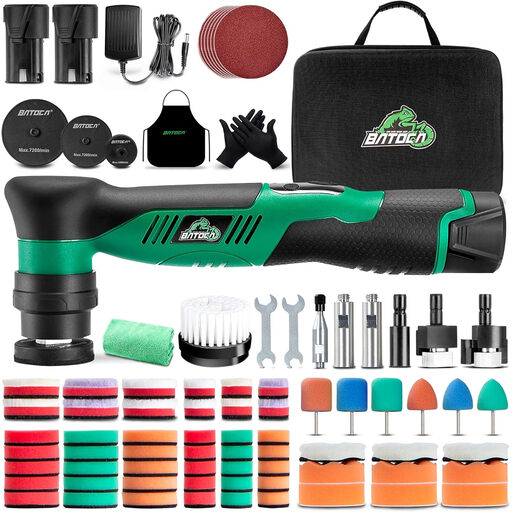
Why This Fits Their Persona: Its compact format suits detailers who work on headlights, wheels, emblems, window edges and other areas where a full-size machine may be awkward.
It states the available polishing movements, six speed settings from 2000 to 5500 RPM and the inclusion of two 12 V 2.0 Ah batteries.
Three shaft options and 25 mm, 50 mm and 75 mm pads support detailed work. The batteries are described as replaceable.
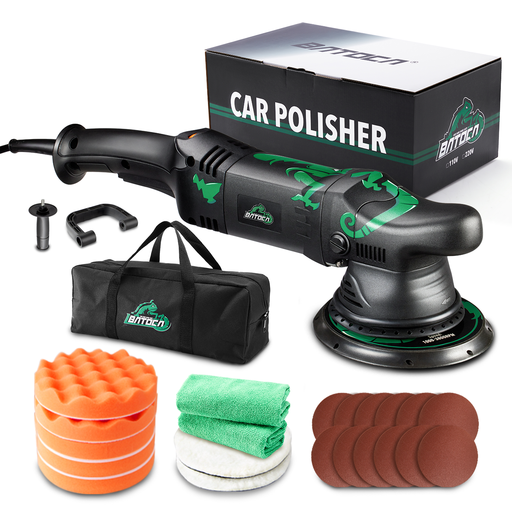
Why This Fits Their Persona: A wired 5-inch dual action machine is suited to users handling larger painted areas, regular vehicle maintenance or repeated waxing and correction sessions near a reliable UK power socket.
The listing specifies a 1100 W motor, six speed settings from 2500 to 5500 RPM and a dual action movement, rather than relying only on a broad “professional” label.
Includes foam pads and features a removable side handle, D-shaped handle and replaceable carbon brushes.
We have compiled a complete, real-time list of products that fully satisfy these strict selection criteria and UK safety regulations.
It can be a more manageable starting point than a rotary polisher because its eccentric movement is generally more forgiving. Begin at a low speed, use moderate pressure and work on small sections. The result still depends on paint condition, pad choice, compound and technique.
A compact machine with small backing plates can be useful for controlled headlight polishing, provided the pad, compound and surface are compatible. Protect surrounding paintwork and follow the instructions for any headlight polishing kit. Severe clouding, cracking or internal damage may not be corrected through polishing alone.
Running costs include electricity or replacement batteries, plus consumables such as foam polishing pads, wool pads, compounds and wax. A cordless model may reduce reliance on extension leads, while a corded machine avoids battery replacement. Washable, reusable pads can help reduce ongoing accessory costs when maintained correctly.