
24/7 Customer Support

Free returns

Same-day & Next-day Delivery

Quality Guaranteed

Unlock Your Welcome Offers: FREE Delivery | Up to 80% OFF | Free 30-day JoyPlus trial
Download the APP
A suitable car polishing machine can make waxing, paint refinement and oxidation removal more consistent than hand application. However, choosing by speed, battery size or the number of included pads alone can lead to disappointing results.
The right choice depends on the type of correction required, the available working space and your experience level. This guide explains the key specifications, common buying traps and our top recommendations for UK car owners, enthusiasts and valeters.
A high speed can help with heavy oxidation or stubborn defects, but it can also create excess heat when used with the wrong pad, compound or pressure. Paint thickness, clear-coat condition and the machine’s movement all affect the result.
A dual action car polisher or orbital car polisher is generally more forgiving for beginners because the pad both rotates and oscillates. A rotary polisher follows a more direct rotation and can provide faster correction, but it requires greater control to reduce the risk of concentrated heat or uneven finishing.
A battery-powered car polisher may appear convenient, but advertised capacity does not always translate into continuous polishing time. Runtime varies according to speed, pressure, pad size and load.
Check whether the package includes one or two batteries, how long charging takes and whether replacement batteries are available. For larger vehicles, caravans or boats, two interchangeable batteries can be more useful than a slightly higher quoted capacity.
A large pad can cover broad panels efficiently but may be difficult to control around door handles, badges, wheels and curved trim. Conversely, a mini car polisher is useful for details but inefficient for an entire bonnet or roof.
Before buying, compare the backing plate and pad sizes with the areas you intend to polish. A versatile car polishing kit should include pads or backing plates suited to both larger panels and tighter sections.
A useful machine should offer variable speed rather than a single output. Lower settings are generally more appropriate for spreading waxes, sealants and finishing products, while higher settings may be used for correction only when the pad and compound are suitable.
Look for a soft start, multiple speed levels and a clearly positioned control. An LCD or LED indicator can make it easier to repeat a preferred setting, but the display does not replace safe technique.
A cordless car polisher removes the need to manage a cable around the vehicle, which is convenient on driveways or outdoor detailing locations. A wired tool avoids battery charging interruptions but requires a safe, suitable extension arrangement.
Also consider weight, handle position and heat management. A machine that is uncomfortable to hold may encourage excessive pressure or uneven movement. Check the product instructions for ventilation requirements, overload protection and permitted operating conditions.
For UK use, inspect the supplied plug, charger information, conformity markings and instructions before operation. Do not use a product in wet conditions unless it is specifically rated for that environment.
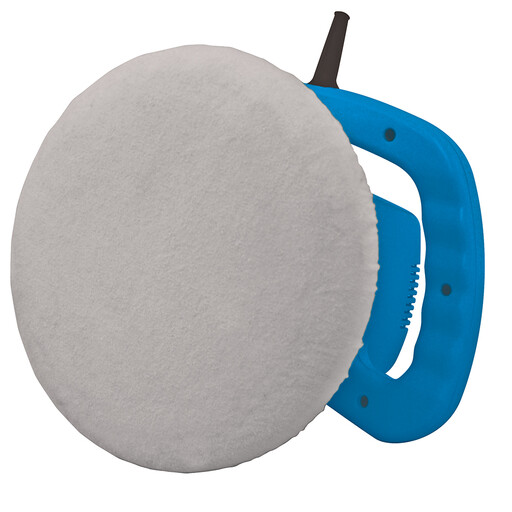
Why This Fits Their Persona: A straightforward wired option for occasional driveway polishing, waxing and broad panel work without battery management.
Its orbital movement is intended to spread pad action across the surface, while the cable provides continuous power for longer sessions.
240 mm pad, dual-handle design, and synthetic textile and wool-style bonnets included.
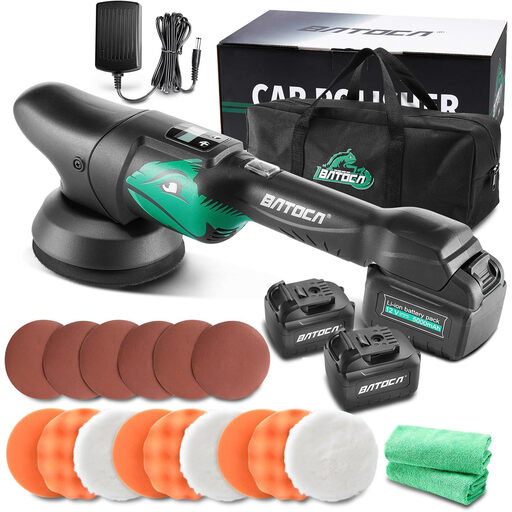
Why This Fits Their Persona: A cordless 8 mm eccentric machine for users who want adjustable control and freedom from a mains cable during vehicle detailing.
Two 5 Ah batteries address the interruption risk of a single-battery cordless tool, while six speed settings help avoid relying on maximum output.
LCD speed and battery display, 2,000–4,500 RPM range, 125 mm pad and stated approximately 60-minute runtime per battery.
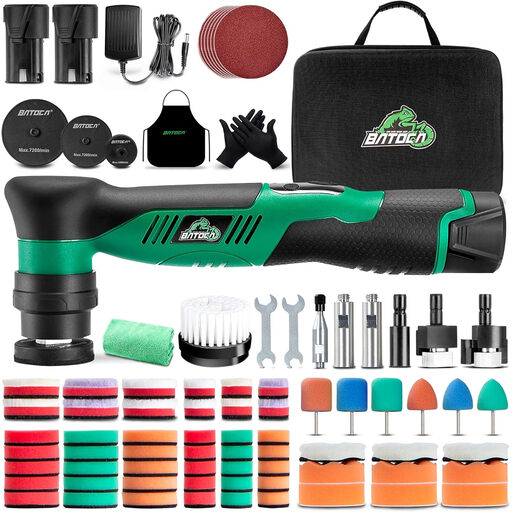
Why This Fits Their Persona: Suited to detailers working around headlights, wheels, emblems, mirrors and narrow body lines where a full-size car buffer machine is awkward.
Its interchangeable rotary, 3 mm orbital and 12 mm orbital shafts provide more control over different correction and finishing tasks.
Six speeds from 2,000–5,500 RPM, two 12 V 2 Ah batteries, and 25 mm, 50 mm and 75 mm polishing pads.
Before using any paint correction machine, wash and dry the vehicle, remove bonded contamination and inspect the paint in good lighting. Mask delicate trim where appropriate and test the compound and pad combination on a small, less visible section.
Keep the pad flat, use overlapping passes and avoid staying on one spot. Start at a lower speed and increase it only when necessary. Do not polish sharp edges, exposed plastic trim or recently applied paint unless the product instructions confirm it is suitable.
Wear suitable eye protection and follow the manufacturer’s instructions for dust, compound residue, battery charging and accessory changes. Remove the battery or disconnect the power before changing pads.
It can be a practical starting point because the oscillating movement is generally easier to manage than a fixed rotary motion. However, results still depend on pad choice, compound, pressure and movement. Always begin on a test area.
There is no universal runtime. It depends on battery capacity, speed, pressure and the material being polished. Two batteries can reduce waiting time, but check the stated runtime and charging period for the specific model.
A mini car polisher can reach headlight surfaces more easily than a large pad. Use products specifically intended for the headlight material, follow the surface-preparation instructions and confirm whether wet sanding or sealing is required.
We have compiled a complete, real-time list of products that fully satisfy these strict selection criteria and UK safety regulations.