
24/7 Customer Support

Free returns

Same-day & Next-day Delivery

Quality Guaranteed

Unlock Your Welcome Offers: FREE Delivery | Up to 80% OFF | Free 30-day JoyPlus trial
Download the APP
A suitable car polishing machine can make waxing, paint correction and routine detailing more consistent. However, choosing by advertised RPM or battery capacity alone can lead to disappointing results. UK car owners also need to consider working space, cable access, pad size, heat control and the condition of the vehicle’s paintwork.
Whether you are maintaining a daily driver, restoring a motorcycle or preparing vehicles for professional detailing, these are the main buying pitfalls and specifications to check before ordering.
A high maximum speed does not automatically remove scratches more effectively. Excessive speed, pressure or heat can create haze, damage a clear coat or make an uneven area more noticeable. A useful machine should offer a practical variable-speed range, allowing low settings for applying wax and higher settings for controlled polishing.
Also check whether the stated speed applies to a rotary head, orbital movement or a smaller mini polishing head. These figures are not directly interchangeable.
A dual action car polisher, also called an orbital car polisher, combines rotation with an eccentric movement. This spreads heat and is generally more forgiving for beginners working across larger painted panels.
A rotary car polisher spins on a fixed axis. It can provide focused cutting and spot correction, but it requires more careful control around edges and raised body lines. Some products, such as the BATOCA S6 and S4, allow users to switch between DA and rotary systems for different tasks.
A cordless car polisher removes the inconvenience of a trailing cable, which is useful on driveways or when working around wheels and bumpers. Yet advertised runtime may be measured without load. Actual polishing time depends on speed, pressure, pad type and the condition of the surface.
Before buying a battery car polisher, check the number and capacity of batteries, charging time, spare battery availability and whether the kit includes backing plates, pads, sandpaper and storage. A low-cost machine may become less economical if essential accessories need to be purchased separately.
For general vehicle care, a DA or random orbital movement can be a practical starting point because it supports polishing, buffing and waxing with controlled heat distribution. Orbit size affects the tool’s character:
A rotary setting is useful for precise work, but it should be used carefully and with the pad kept moving.
Look for at least four or five speed settings rather than a single fixed speed. Lower speeds are commonly used for waxes, sealants and finishing compounds, while higher settings may support oxidation or defect correction when used with the appropriate pad and compound.
A brushed motor can offer accessible replacement carbon brushes, while a brushless motor may reduce brush maintenance. Neither design removes the need for correct technique, ventilation and regular checks for heat build-up.
Pad diameter determines how much surface the car detailing machine can cover. A 125 mm or 5-inch backing plate is a flexible size for many bonnet and door panels. Smaller 25 mm, 50 mm or 75 mm plates are more suitable for mirror housings, wheel areas, bumpers and narrow contours.
Check how pads attach and whether replacement foam, wool or microfibre pads are readily available. A complete car buffer polisher kit is convenient, but replacement pad cost and availability affect long-term value.
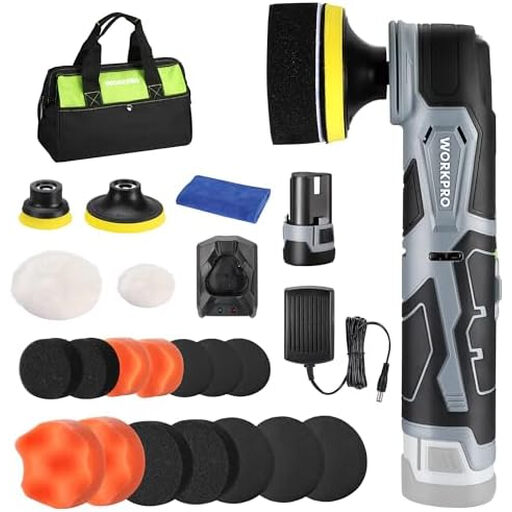
Why This Fits Their Persona: Its compact cordless format suits occasional driveway detailing, small vehicles and owners who want one portable kit for polishing, sanding and waxing.
The kit states its five speed levels, 2.0 Ah battery and overheat protection behaviour, making the operating limits clearer than an unspecified runtime claim.
0.85 kg stated weight, five speeds from 600–3000 RPM, and included pads, sandpapers, charger and carrying bag.
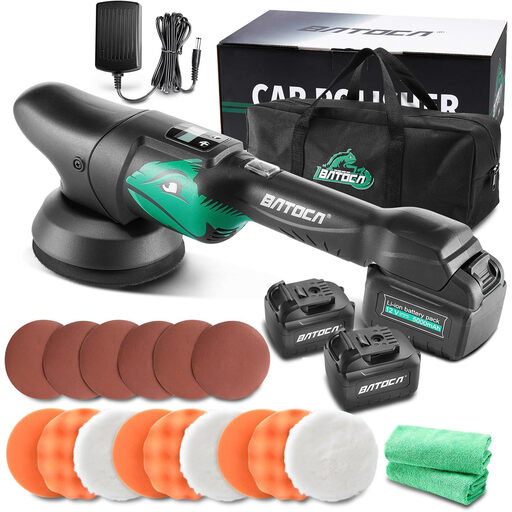
Why This Fits Their Persona: The dual-battery format is suited to owners who regularly maintain a car, SUV, boat or camper and prefer cordless operation with visible machine information.
Its LCD display shows speed and battery information, while two 5 Ah batteries reduce the need to stop for immediate recharging.
125 mm pad size, 8 mm eccentric orbit, six speed levels from 2000–4500 RPM and two stated 5 Ah batteries.
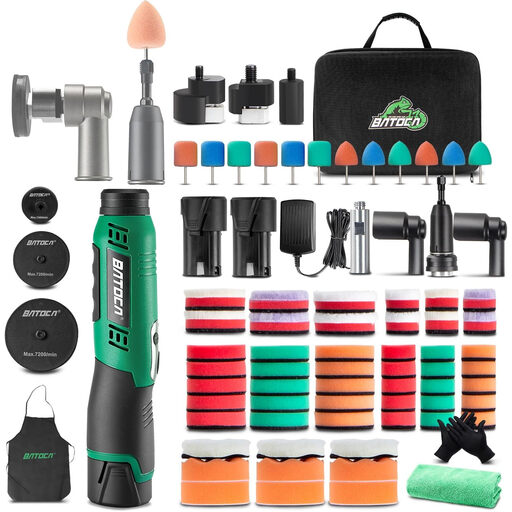
Why This Fits Their Persona: Detailers, motorcycle owners and vehicle enthusiasts working around grilles, rims, mirrors and tight body contours can use its compact interchangeable heads.
It specifies separate DA and rotary ranges, multiple backing plates and two batteries, rather than relying on one headline speed figure.
25 mm, 50 mm and 75 mm backing plates; DA and RO modes; separate ranges of 1000–5000 RPM and 4200–21000 RPM.
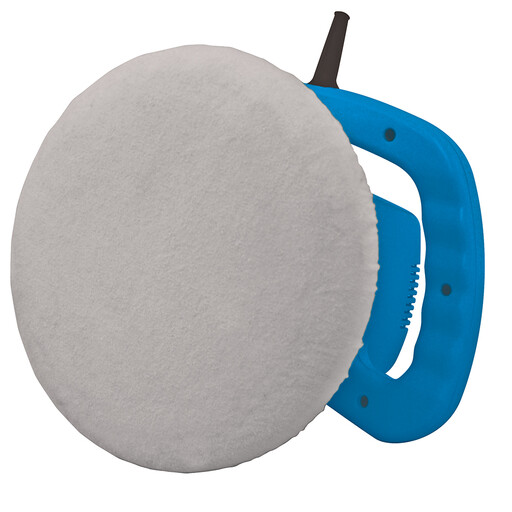
Why This Fits Their Persona: A corded orbital format with a large pad suits users covering broad bonnet, roof and door areas near a suitable outdoor power source.
Its random orbit movement is intended for controlled panel polishing, while the instructions specify light pressure, overlapping sections and avoiding prolonged work in one spot.
240 mm foam pad, dual-handle design, synthetic and wool-style bonnets, and stated operating guidance of 3000–4000 orbits per minute.
Wash and dry the vehicle first, then remove bonded contaminants where necessary. Mask unpainted trim and test the compound and pad combination on a small, inconspicuous section. A car scratch remover may be sufficient for light scuffs or paint transfer, while deeper marks that catch a fingernail may require bodywork rather than machine polishing.
Use eye protection, suitable respiratory protection when product instructions require it, and keep cables away from the pad. For corded equipment, inspect the lead and plug before use and follow the manufacturer’s instructions for outdoor electrical equipment. Keep the machine moving, avoid sharp edges and allow both pad and paintwork to cool.
We have compiled a complete, real-time list of products that fully satisfy these strict selection criteria and UK safety regulations.
It can be a practical starting point because its orbital movement distributes heat more broadly than a fixed-axis rotary machine. Beginners should still use a low speed, light pressure, suitable pad and small test area before working across the full panel.
Runtime varies with load and speed. For example, the listed BATOCA S6 specifies up to 30 minutes without load, while the BATOCA S2 lists approximately 60 minutes per battery. Treat these as stated operating figures rather than guaranteed polishing time under every condition.
A mini polishing machine is designed for detail areas and light surface defects. It may improve minor swirls, oxidation and superficial marks when paired with the right compound. Deep scratches that reach through the paint or clear coat generally need professional bodywork assessment rather than repeated polishing.