
24/7 Customer Support

Free returns

Same-day & Next-day Delivery

Quality Guaranteed

Unlock Your Welcome Offers: FREE Delivery | Up to 80% OFF | Free 30-day JoyPlus trial
Download the APP
A car power inverter can turn a vehicle’s 12V DC supply into 220V–240V AC electricity for chargers, laptops, small appliances and camping equipment. However, choosing one based only on a large wattage printed on the box can lead to poor performance, blown vehicle fuses or a drained battery.
As the Joybuy Product Recommendation Officer, I focus on the practical details that marketing descriptions often leave out. Here are the main traps to avoid before buying a portable vehicle power inverter in the UK.
A 4000W peak inverter does not continuously provide 4000W. Peak or surge power is usually available briefly when equipment such as a motor, compressor or power tool starts. The continuous or rated wattage is the figure to use when matching everyday loads.
For example, an inverter rated at 2000W continuous and 4000W peak may support a high starting surge, but it still should not be operated continuously above 2000W.
Many car accessory sockets are protected by a fuse around 10A to 15A. At 12V, that commonly limits practical socket-powered use to approximately 120W–180W, depending on the vehicle.
A 300W car inverter may therefore need a direct battery connection for higher loads. Never replace a vehicle fuse with a higher-rated fuse simply to run a more powerful inverter. Check the vehicle handbook and the inverter’s installation instructions.
A modified sine wave inverter can be suitable for basic chargers, lights and some simple electronics, but its stepped waveform may cause noise, extra heat or compatibility problems with certain equipment.
A pure sine wave inverter produces a smoother AC waveform and is generally more suitable for sensitive electronics, audio equipment and appliances with motors or electronic controls. It usually costs more, so consider the equipment you actually intend to power rather than paying for a specification you do not need.
List the wattage of each device and decide whether they will run at the same time. Add their continuous consumption together, then allow additional capacity for equipment with motors or heating elements.
Typical guidance:
At 2000W, a 12V system may draw well over 160A after conversion losses. This is not suitable for a cigarette-lighter socket.
Most products described as a 12V to 230V power inverter or 12V to 240V inverter are intended for cars, SUVs, vans, caravans and motorhomes with a 12V electrical system. They are not automatically suitable for 24V trucks or commercial vehicles.
Confirm:
A USB car inverter can be convenient when most of your equipment charges by USB. Check the total USB output rather than counting ports alone. USB-C Power Delivery may be useful for compatible phones, tablets and smaller laptops.
Also look for objective safety features such as:
Do not use an inverter in a damp location, cover its vents or leave it operating unattended inside a closed vehicle.
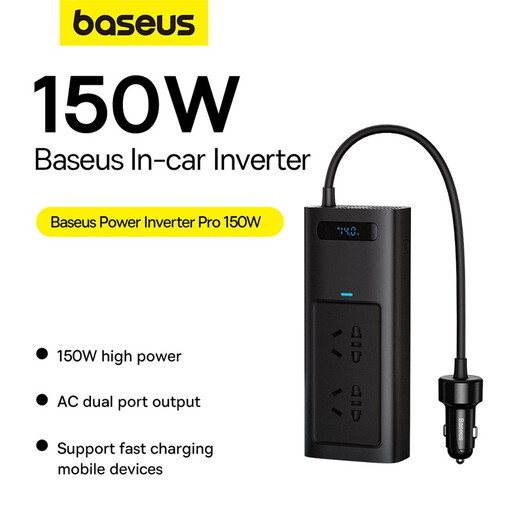
Why This Fits Their Persona: A compact choice for commuters, students and road-trippers who mainly need laptop, phone and camera charging from a standard 12V socket.
Its 150W maximum output sets a clearer expectation than an oversized peak-power figure. It uses a modified wave, so it is better matched with straightforward chargers than sensitive equipment.
Provides USB and two Type-C outputs, with a compact 176 × 71 × 39mm body and storage bag.
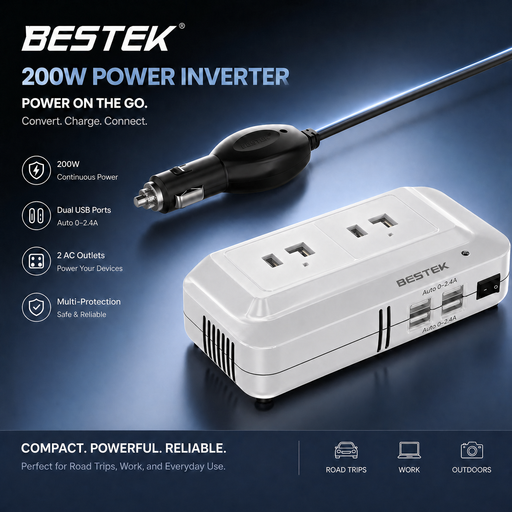
Why This Fits Their Persona: Useful for families on long journeys, campsite stays and drivers who need several charging points in one compact unit.
The 200W rated limit helps prevent confusing surge output with normal operation. Low- and over-voltage shutdown specifications provide clearer protection boundaries.
Includes two AC outlets, four USB ports and an additional 12V socket, with a 165 × 82 × 40mm design.
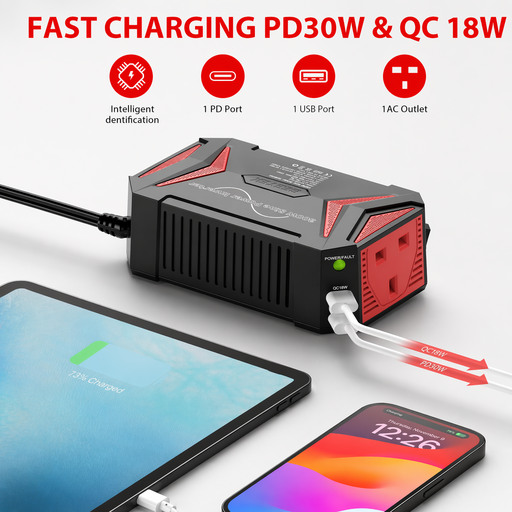
Why This Fits Their Persona: Suits users who want smoother AC output for laptops, televisions, game consoles and other electronics during travel or outdoor work.
The pure sine wave specification avoids the uncertainty of modified wave output for compatible sensitive electronics. Its 300W rated output remains clearly stated.
Offers dual 4.8A USB output, one AC outlet and a compact body designed for standard 12V vehicles.
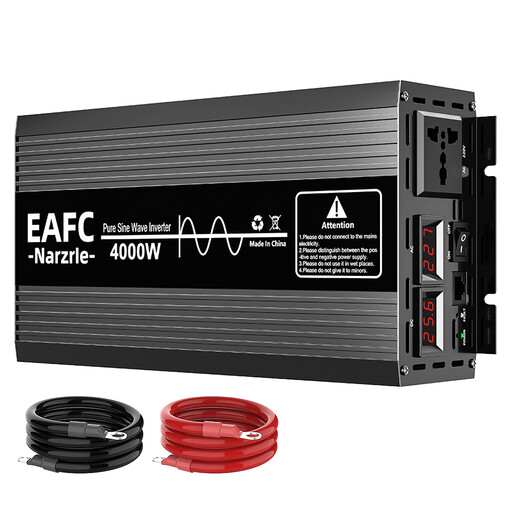
Why This Fits Their Persona: Intended for properly wired 12V battery systems in motorhomes, trucks, work vehicles, camping set-ups and emergency power backup applications.
The listing separates 2000W continuous output from 4000W peak output and specifies direct battery connection for loads above 150W, rather than suggesting cigarette-socket use.
Pure sine wave output, dual digital voltage displays, intelligent cooling fans and multiple protection functions.
We have compiled a complete, real-time list of products that fully satisfy these strict selection criteria and UK safety regulations.
No. Check that the vehicle uses a 12V system. Some trucks and larger commercial vehicles use 24V, which can damage a 12V inverter. Also check the accessory socket’s fuse rating before connecting a high-load device.
Runtime depends on battery capacity, vehicle condition, inverter efficiency and the connected load. A phone charger uses relatively little power, while a heater or kettle can drain a battery quickly. Avoid leaving a starter battery powering equipment while the engine is off.
It can be worthwhile when powering sensitive electronics, audio equipment or devices with motors and electronic controls. For simple charging and low-demand equipment, a modified sine wave inverter may be adequate if its instructions confirm compatibility. Always compare the waveform, continuous wattage and connection method together.