
24/7 全天候客户支持

免费退货

当日/次日达

品质保障

开启新人专享福利: 全场免邮 | 低至 2 折 | 免费试用 30 天 JoyPlus 会员
下载 Joybuy
A flat laptop battery during a crucial client call from a service station, or the chorus of "my tablet's dead" from the back seat on a family holiday—these are modern travel frustrations. Keeping essential electronics charged and running while on the road is no longer a luxury, but a necessity. A car power inverter is a simple and effective solution, transforming your vehicle's 12V DC power into the 230V AC power your devices need.
However, the market is filled with options, and choosing the correct one is vital for both the safety of your devices and your vehicle. This guide is designed to help you understand the key features to look for and to present a few carefully selected options that meet the demands of UK drivers, from daily commuters to avid campers.
Before you make a choice, consider these practical points to ensure you get a device that fits your needs.
The type of AC power an inverter produces is critical. A pure sine wave inverter generates a clean, smooth and consistent electrical current, almost identical to the power you get from a wall socket at home. This is essential for powering sensitive electronics like laptops, digital cameras, drones and some medical equipment. Using a less stable waveform can cause these devices to run hotter, make strange noises, or even suffer permanent damage. While modified sine wave inverters are often cheaper, a pure sine wave model is a safer and more reliable choice for anything beyond a simple phone charger.
Consider what you plan to power. The wattage rating tells you how much power the inverter can supply. A 300W power inverter is a versatile choice, capable of running a car laptop charger and other small electronics simultaneously. Always check the power requirements (in watts) of your devices. For connectivity, look for a car inverter with USB ports. Modern units often include a mix of standard USB-A ports, fast-charging QC3.0 ports and even high-speed USB-C PD (Power Delivery) ports for newer laptops and smartphones.
A reliable DC to AC inverter for car use must have built-in safety protections. Look for features like internal fuses, automatic shutdown for over-voltage or low-voltage situations (to protect your car battery), overload and overheating protection. A built-in cooling fan is also a key feature, as it helps dissipate heat during operation, ensuring the inverter runs safely and efficiently, especially on long journeys.
Here are our recommendations for reliable and portable power inverter models that offer a great balance of features, safety and performance for UK drivers.
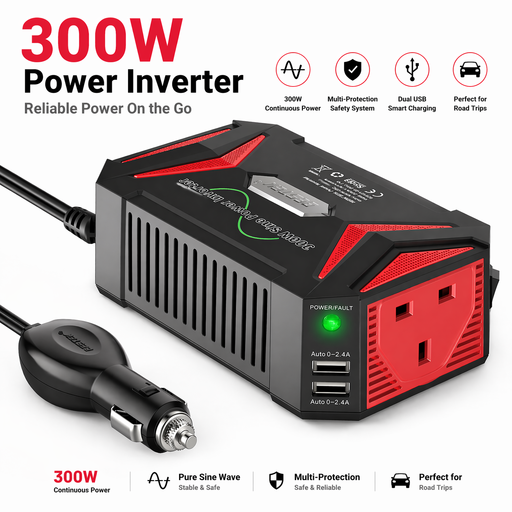
Why It Stands Out: This model focuses on delivering exceptionally stable power. Its pure sine wave output ensures that sensitive and expensive electronics, like laptops and cameras, run smoothly and safely without risk of damage from power fluctuations.
Pros:
Who is it for? Mobile professionals, photographers and anyone who needs to reliably power a laptop or other sensitive equipment in their car, van or motorhome.
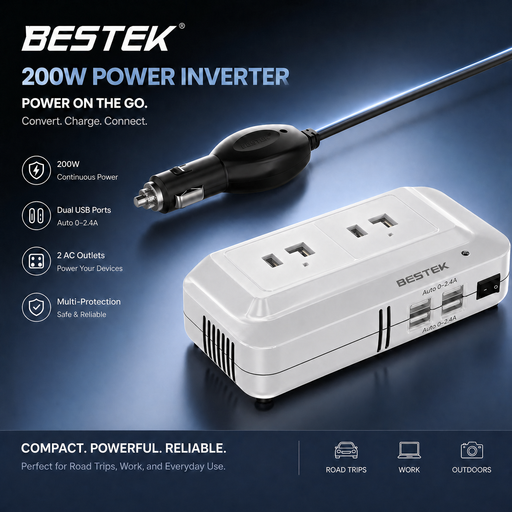
Why It Stands Out: This inverter is a multitasking powerhouse. With two AC outlets and four USB ports, it can charge up to six devices at once, making it an excellent choice for family road trips or work crews with multiple gadgets.
Pros:
Who is it for? Families on long journeys, campers or anyone who needs to charge multiple smartphones, tablets and other devices simultaneously.
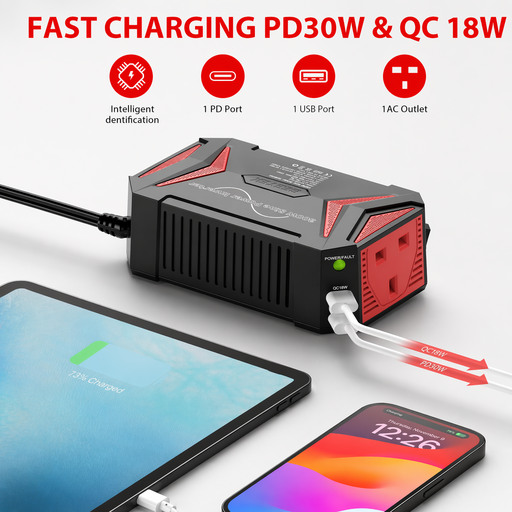
Why It Stands Out: This model combines the stability of a pure sine wave inverter with the latest in fast-charging technology. The inclusion of a PD 30W Type-C port and a QC 18W USB port makes it perfect for rapidly charging modern devices like MacBooks, iPads and flagship smartphones.
Pros:
Who is it for? Tech-savvy users, digital nomads and anyone with modern, fast-charging devices who needs both speed and the safety of a pure sine wave output.
The inverters highlighted here are excellent all-rounders, but your specific needs might call for a different power level or feature set. Whether you need a higher wattage model for more demanding equipment or a more basic unit for simple charging, there are plenty of choices available.
Explore our full range of electric chargers to find the perfect fit for your vehicle and devices.
1. Can a car power inverter drain my car battery? Yes, if used for an extended period while the engine is off, a car power inverter can drain your vehicle's battery. Most quality inverters include a low-voltage protection feature that automatically shuts the unit off before the battery is fully depleted. For continuous use, it is always recommended to have the vehicle's engine running.
2. What can I run on a 300W power inverter? A 300W power inverter is suitable for most low-power electronics. This includes laptops, tablets, smartphones, digital cameras, drones, portable game consoles and small LED lights. It is not designed for high-power appliances like hair dryers, electric kettles, microwaves or power tools, which require much higher wattage.
3. Do I really need a pure sine wave inverter? For sensitive electronics like laptops, DSLR cameras, audio equipment and medical devices, a pure sine wave inverter is strongly recommended. It provides a clean and stable power source that prevents potential damage and ensures the device functions correctly. For simply charging a phone or running a non-sensitive device like a small fan, a modified sine wave inverter may be adequate, but pure sine wave offers far greater compatibility and peace of mind.