
24/7 Customer Support

Free returns

Same-day & Next-day Delivery

Quality Guaranteed

Unlock Your Welcome Offers: FREE Delivery | Up to 80% OFF | Free 30-day JoyPlus trial
Download the APP
Buying car repair tools can look straightforward until a socket slips, a spanner fails to reach a recessed fastener or a torque wrench covers the wrong range. For UK vehicle owners, DIY enthusiasts and tradespeople, the right kit depends less on the number printed on the box and more on compatibility, access, material quality and safe use.
This guide explains the buying pitfalls to avoid, the specifications worth checking and suitable options for different types of work.
A 400-piece mechanic tool set may sound comprehensive, but the headline number can include duplicate bits, adaptors and sizes you rarely use. Check the actual contents: drive sizes, metric sockets, imperial sockets, extensions, deep sockets, bits and spanners.
For many UK cars, a practical starting point is a set with metric sockets, although imperial sizes can still be useful for older vehicles, imported models, machinery and household repairs.
A standard ratchet may not reach a fastener behind a suspension component or inside an engine bay. Similarly, a straight spanner can be awkward where surrounding parts restrict movement.
Useful access features include:
A torque wrench or digital torque adaptor can help you apply a specified value, but it does not determine the correct setting for your vehicle. Always use the vehicle manufacturer’s service information and select a tool whose operating range suits the required value.
Do not use a torque wrench as a general breaker bar unless the manufacturer specifically permits it. Applying excessive force can affect accuracy or damage the mechanism.
Chrome vanadium steel, commonly shown as Cr-V, is widely used for sockets and spanners because it combines hardness with resistance to repeated workshop use. Some bit accessories use S2 steel, which is specified for higher hardness and wear resistance.
A polished, plated or matte chrome finish can make tools easier to clean and may help resist surface corrosion. However, finish alone does not prove suitability for high-load work. Look for clear size markings, secure drive engagement and a case or roll that keeps every piece organised.
Common drive sizes include:
A mixed-drive socket set is often more useful than a single-drive kit. Check whether it includes both metric and imperial sizing if you work on several vehicles or machinery.
For torque wrench sets, compare the stated range with your intended task. A bicycle-focused tool may cover approximately 2–26 N·m, while a car wheel or suspension application generally requires a different range and drive size.
Also check whether the tool works in both clockwise and anticlockwise directions, how the setting is locked and whether the product specifies an accuracy figure. Digital tools may provide audible and visual alerts, but batteries, storage conditions and correct set-up still matter.
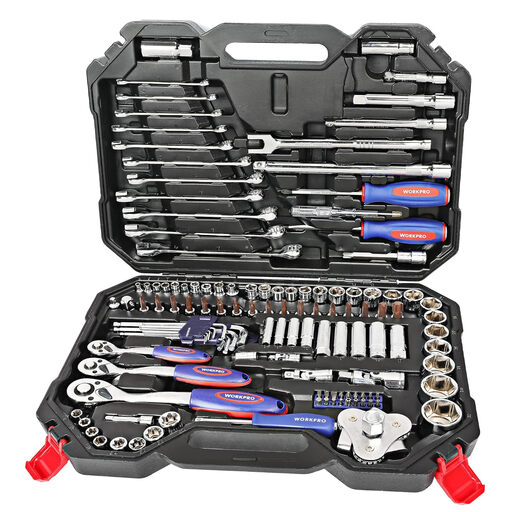
Why This Fits Their Persona: A practical option for a new home mechanic who wants one organised kit for vehicle maintenance, home repairs and occasional roadside tasks.
The listed contents are more informative than the piece count alone: it includes 1/4-inch, 3/8-inch and 1/2-inch drive tools, spanners, bits and hex keys.
Triple-chrome-plated, heat-treated finish; blow-moulded case with designated storage positions.
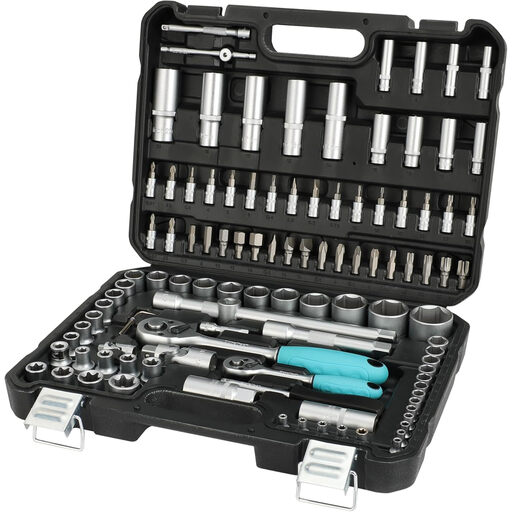
Why This Fits Their Persona: Suitable for regular garage use where a broad socket and accessory selection is more important than carrying a compact kit.
The 1/4-inch and 1/2-inch drives, extension bars and universal joints address common access problems in car and motorcycle work.
Cr-V sockets, S2 bits, 72-tooth ratchets and a marked blow-moulded storage box.
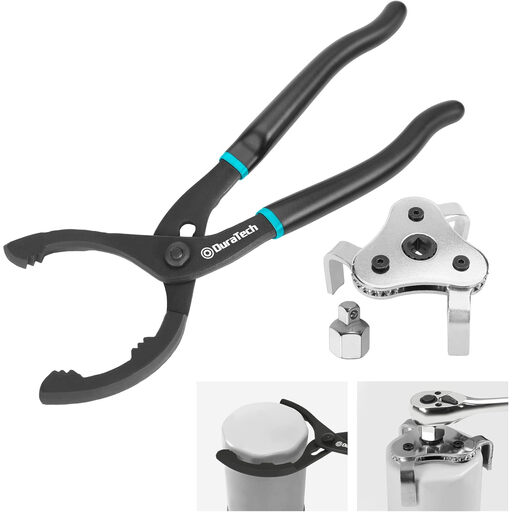
Why This Fits Their Persona: Designed for vehicle owners and workshop users who regularly carry out oil changes on cars, motorcycles, vans or larger equipment.
Instead of relying on a generic strap alone, this set combines pliers with a three-jaw tool adjustable for filters measuring 63–103 mm.
Heat-treated steel construction; 3/8-inch and 1/2-inch adaptor compatibility is listed.
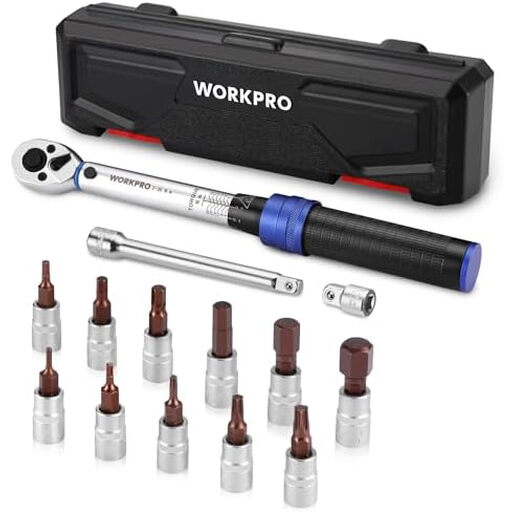
Why This Fits Their Persona: A focused choice for bicycle and motorcycle maintenance where smaller fasteners and controlled tightening are central to the job.
Its stated 2–26 N·m range is more suitable for smaller fasteners than a large automotive torque wrench, helping avoid using an unsuitable scale.
72-tooth, dual-direction design; includes hex, Torx, extension and socket-adaptor accessories.
Once a core set is in place, task-specific automotive hand tools can prevent improvised methods. Brake line spanners have a partially enclosed flare-nut profile that gives better engagement than a standard open-ended spanner. The DURATECH three-piece set covers 10–17 mm pairings and includes a storage pouch.
For general fastening, combination spanner sets remain useful. The Silverline 14-piece set covers 1/4-inch to 1-1/4-inch, uses drop-forged Cr-V steel and has 15-degree offsets. The DURATECH eight-piece offset double-ring set covers 6–22 mm and uses a 75-degree offset for tighter spaces.
Bicycle repair tools should be selected by torque range and bit compatibility rather than by the number of pieces. For larger automotive torque work, the MoveCrab digital torque adaptor covers 6–200 N·m and includes 3/8-inch and 1/4-inch adaptors. Its listed features include selectable units, sound and light alerts, three working modes and automatic switch-off.
Before choosing, compare your vehicle handbook, fastener sizes and available working space. You can also browse the wider wrench set range to match the kit to your workshop tasks.
We have compiled a complete, real-time list of products that fully satisfy these strict selection criteria and UK safety regulations.
Start with a metric socket set covering 1/4-inch and 3/8-inch drives, a selection of combination spanners, screwdrivers, pliers, extensions and a breaker bar. Add a torque wrench once you begin work involving wheel nuts, engine components or manufacturer-specified tightening values.
Not always. Match the set to frequency and workload. Occasional maintenance may only require core sockets and spanners, while frequent repairs justify stronger storage, wider size coverage, multiple drive sizes and replacement availability. Avoid paying for duplicate pieces that do not suit your vehicles.
Wipe tools clean after use, particularly after contact with oil, coolant or road salt. Keep them dry, return each item to its marked position and lightly lubricate ratchet mechanisms where permitted by the manufacturer. Torque wrenches should generally be returned to their lowest setting after use, following the supplied instructions. Replace tools showing cracks, damaged drives, rounded jaws or significant deformation.