
24/7 Customer Support

Free returns

Same-day & Next-day Delivery

Quality Guaranteed

Unlock Your Welcome Offers: FREE Delivery | Up to 80% OFF | Free 30-day JoyPlus trial
Download the APP
Bringing the mesmerising cosmos into your car's interior has moved from a luxury exclusive to six-figure vehicles to an accessible modification for any enthusiast. A car starlight headliner kit can transform your daily driver into a unique, personalised space. However, the market is flooded with options and it's easy to make a purchase you'll later regret.
As a Joybuy Product Recommendation Officer, my role is to help you navigate the choices and focus on what truly matters for a high-quality installation. Before you commit, let's look at the common pitfalls that can turn your dream celestial ceiling into a dim disappointment.
To ensure you get a vibrant and long-lasting result, focus on these three technical specifications. They are far more important than flashy marketing claims.
This is the most critical factor for a realistic look.
The illuminator determines the brightness and effects of your fibre optic car roof lights.
How you interact with your lights is a key part of the experience.
We've analysed the specifications of various kits to match them with different types of car enthusiasts.
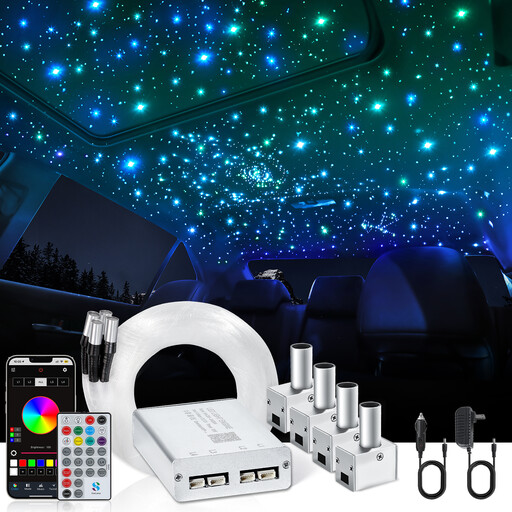
Why This Fits Their Persona: This is a well-balanced kit for someone undertaking their first starlight installation. It offers a high fibre count and modern features like app control without the added complexity or cost of meteor effects, making it perfect for achieving a premium look in a saloon or hatchback.
With 1000 fibre strands, it completely avoids the "sparse sky" pitfall. The 12W RGBW light engine provides ample brightness and pure white light, steering clear of the "dim and lifeless" trap. The 3m fibre length is suitable for most standard UK cars.
The 4-port split design allows for easier fibre management during installation and offers the potential for multi-zone colour control via the app, a feature usually reserved for more advanced kits.
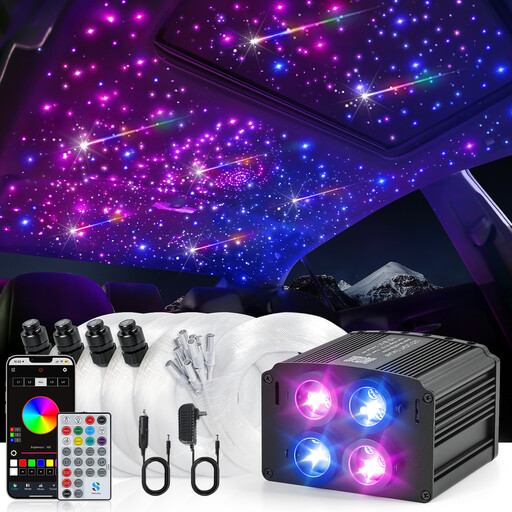
Why This Fits Their Persona: For the modifier who wants the most dynamic and head-turning effect. This is a genuine shooting star headliner kit, designed to create a show-stopping display for car meets, events or simply for maximum personal enjoyment.
The powerful 32W light engine delivers exceptional brightness. With 1000 twinkle fibres plus 240 dedicated meteor strands, the result is incredibly dense. The generous 4m (13.1ft) fibre length makes it suitable for larger SUVs and custom projects.
The integrated 2-in-1 light engine provides both twinkle and meteor effects from a single, compact unit. This offers a highly realistic and customisable celestial display that is difficult to achieve with separate components.
We have compiled a complete, real-time list of products that fully satisfy these strict selection criteria and UK safety regulations.
This is a significant DIY project. For a first-time installer, it's wise to set aside a full weekend (approximately 8-12 hours). The process involves carefully removing the car's headliner, mapping and drilling hundreds of tiny holes, threading each fibre, securing them and wiring the light engine to a 12V power source.
When installed correctly, no. The kit should be wired to an ignition-switched 12V source, such as the fuse box or cigarette lighter socket. This means it will only draw power when the car is running or in accessory mode. The power consumption of most LED light engines (12W-32W) is very low and will not have a noticeable impact on your battery or alternator while the engine is on.
The PMMA (Polymethyl methacrylate) plastic fibres are very robust and flexible. They do not burn out like traditional bulbs and are resistant to heat and moisture. The main risk of damage is during installation; kinking or sharply bending a fibre can create a weak point. The lifespan of the system is determined by the LED light engine, which is typically rated for 20,000 to 50,000 hours of use.