What matters when choosing?
Decide what the card reader’s cable actually does, then choose how much laptop expansion the desk needs. A charging-only reader, a laptop needing a few extra ports and a workstation with permanent peripherals call for different arrangements.
Direct charging arrangement
Consider it when: The reader does not need a USB data connection to the laptop and its own charging arrangement meets your needs.
Trade-off: It keeps the desk setup simple but adds no ports for other laptop peripherals.
Compact USB-C hub
Consider it when: You need a reachable USB port for a suitable reader cable or accessory, plus a small number of other connections.
Trade-off: Check that its port layout and power arrangement suit every device you plan to connect.
Powered desktop dock
Consider it when: Displays, networking, storage or several other peripherals will stay connected beside the reader.
Trade-off: Allow desk space for the dock and its cables, and check which functions your laptop can use.
| Concern |
What to check |
Who this matters to |
| Desk space and access |
Check the device’s dimensions, host-cable direction and whether a suitable port will remain within reach. |
I need room to use the reader without shifting the laptop or pulling its cable across the counter. Around 36% of consumers put accessible, space-saving placement first. |
| Reader connection |
Check the exact reader model, what its USB cable is used for and the connectors at both ends. |
If my reader pairs through an app, I do not want to buy a dock on the assumption that USB handles payments. For around 29% of consumers, confirming the reader’s connection method is the primary need. |
| Laptop power and displays |
Compare laptop USB-C video and charging support with the dock’s stated host power output and display requirements. |
I need the laptop to charge and run the intended display setup through the connection I choose. Around 21% of consumers give that compatibility their highest priority. |
| Other desk peripherals |
Count the USB ports needed after allowing for the reader, then check any Ethernet, storage or display connections. |
When a printer, storage device or other accessory stays plugged in, I want enough connections without repeated cable swaps. That is the leading concern for around 14% of consumers. |
Brands to consider
These brands illustrate different hub and dock formats; suitability depends on the individual model and your laptop and reader.
StarTech.com
Its range includes compact USB-C hubs and larger desktop docks.
- StarTech.com specifies three USB-A ports and a 105 × 45 × 16 mm body for its HB31C3ASDMB hub.
- Those dimensions and ports describe that hub, not every StarTech.com dock; check the exact model’s layout and power arrangement.
Belkin
Belkin offers USB-C hubs and adapters for adding laptop connections without setting up a full desktop dock.
- Its hub and adapter guide describes USB-C expansion for peripherals.
- Check the chosen adapter and laptop specifications for the display and charging functions you need.
CalDigit
The TS4 is a Thunderbolt desktop-dock option for a desk with several connected devices.
- A fixed dock is worth considering when the reader is only one part of a larger peripheral setup.
- CalDigit says full TS4 functionality depends on the host computer; USB-C-based computers or tablets have reduced functionality.
Anker
Its USB-C hub range includes models that combine USB expansion with card slots.
- Anker lists 10 Gbps USB-C and USB-A ports plus SD and microSD slots for the Anker 565 hub.
- Check the laptop’s display capability and what charging equipment the particular hub requires.
Joybuy products for a small desk
These USB-C adapters and hubs offer ports for a reader cable or other desk peripherals. Before choosing one, check the reader’s connection method, the available desk space and any laptop charging or display requirements.
 No image available
Targus USB-C Universal Dual HDMI 4K Docking Station, 100W PD Pass-Thru (Retail Packaging)
Consider this if the reader shares a desk with display connections and you need a USB-C docking arrangement. The named variant specifies dual HDMI 4K and 100 W Power Delivery pass-through; check laptop video support, the required power adapter and the power that reaches your laptop.
View on Joybuy
 No image available
V7 V7UC-U3CRJ45HDVG-BLK USB-C Adapter
Consider this when the desk also needs display or wired-network connections. The named adapter lists 4K HDMI, VGA, Gigabit Ethernet, two USB 3.0 ports and 100 W Power Delivery; check the laptop’s display support and the power delivered to it before relying on those functions.
View on Joybuy
 No image available
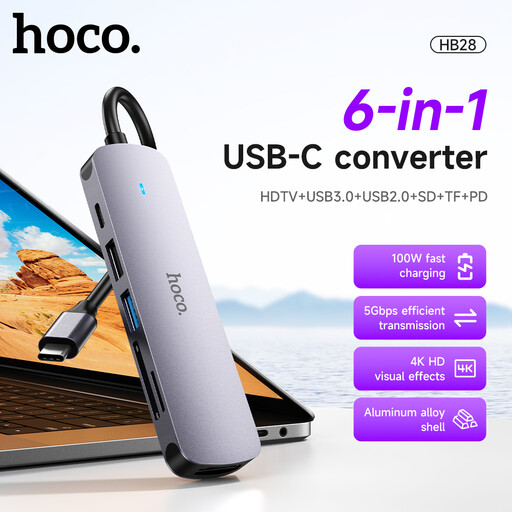
HOCO HB28 USB-C Multi-Function Converter, Metal Grey
Consider this for a reader cable and a modest number of other connections, subject to the reader’s requirements. The named variant lists USB 3.0, USB 2.0, HDTV, SD, TF and PD connections; check its dimensions, display support and laptop charging arrangement for your desk.
View on Joybuy
 No image available
MOVESPEED DK5A1 10-in-1 USB-C Docking Station
Consider this when a reader cable needs to share the desk with several other peripherals. The named model lists 4K 60 Hz HDMI, USB-C 10 Gbps, USB-A 10 Gbps/5 Gbps, SD/TF 160 MB/s and 3.5 mm audio; check the physical footprint and how the laptop will be charged.
View on Joybuy
 No image available
Baseus Metal Gleam Series II 10-in-1 USB Hub, Cosmic Black
Consider this if the reader is one of several devices needing USB or network access. The named variant lists HDMI outputs at 4K 120 Hz and 4K 60 Hz, 10 Gbps USB-A and USB-C ports, two 480 Mbps USB-A ports, RJ45, SD/TF and a USB-C PD connection; check laptop video support, charging output and desk fit.
View on Joybuy
Frequently asked questions
Will a USB dock connect my payment reader directly to the laptop?
Do not assume it will: the reader model determines whether USB is used for charging, data or another purpose. SumUp’s setup instructions describe app-based reader connection, while its reader information describes USB-C charging options. Check your own terminal’s instructions before treating a dock port as a payment connection.
How many USB ports does a small payment desk need?
Count the reader’s required connection, if any, and every other device that will stay plugged in. Allow a suitable, accessible port for the reader cable, then check the connector types needed by a keyboard, printer, drive or other accessory; a charging-only reader may not need a dock port at all.
Can I charge the laptop through a USB-C hub?
You can do so only when the laptop and chosen hub support a suitable USB-C Power Delivery arrangement and sufficient power reaches the laptop. StarTech.com specifies that its DKT30CMHSDPD adapter reserves 8 W from a 100 W input, leaving up to 92 W for laptop charging with an appropriate adapter; check the figures for the model you choose.
Do I need a Thunderbolt dock for a card reader?
A reader that only needs charging does not, by itself, call for a Thunderbolt dock. Consider one if the rest of the desk setup requires its connections and the laptop can use them; CalDigit says its TS4 has reduced functionality with USB-C-based computers or tablets.


